

Show 1465: Food Fight! Should We Flip the Food Pyramid Upside-Down?
Release Date: 03/14/2026
 Show 1473: How Music Heals: The Neuroscience Behind an Ancient Medicine
The People's Pharmacy Podcast
What do you conjure up when you think of music? Perhaps you imagine a singer-songwriter telling her story. On the other hand, you might imagine a parade with a marching band, an orchestra playing an outdoor concert or a mother singing her baby to sleep with a lullaby. Regardless of the format, music acts on the brain in unique ways. Neuroscientists are learning how music heals and why healers around the world have integrated music into their rituals for millennia. At The People’s Pharmacy, we strive to bring you up to date, rigorously researched insights and conversations about...
info_outline Show 1428: The Hidden Power of the Unconscious Brain (Archive)
The People's Pharmacy Podcast
In this episode, a renowned neurosurgeon shares what he has learned in decades of working to restore ailing brains. His new book covers a vast range of neuroscience. Our dilemma was what to pay attention to in all those options. In a sense, that is always the human situation. We are capable of conscious processing of approximately 200 bits per second (bps) of information. Our unconscious brain deals with as much as 11 million bps. At The People’s Pharmacy, we strive to bring you up to date, rigorously researched insights and conversations about health, medicine, wellness and...
info_outline Show 1472: Beyond Lyme: Stealth Infections from Flea and Tick Bites
The People's Pharmacy Podcast
Tick season is well underway in many parts of the country. It seems that a mild winter and a warm spring have brought the nymphs out seeking blood. If that blood is yours, you may be exposed to a range of pathogens. What’s more, ticks are not the only creatures ready to bite you. Fleas are an even bigger problem when it comes to transmitting bacteria called Bartonella. That genus is responsible for cat scratch disease and trench fever. When the infection goes chronic, it’s called bartonellosis. What are the dangers of flea and tick bites? At The People’s Pharmacy, we...
info_outline Show 1471: Broken Bills: Why Americans Pay Twice as Much for Less Care
The People's Pharmacy Podcast
Americans often boast of having the best health care in the world. It is certainly the most expensive health care. We pay twice as much as people in many other industrialized nations. Are we getting our money’s worth? Some population statistics, such as life expectancy, suggest we could be doing much better. How can we make sense of the complexity of American health care? At The People’s Pharmacy, we strive to bring you up to date, rigorously researched insights and conversations about health, medicine, wellness and health policies and health systems. While these conversations intend to...
info_outline Show 1470: Why Your Doctor Should Prescribe Exercise to Treat Depression, Cancer & Aging
The People's Pharmacy Podcast
If you had to name one thing that could contribute to better health throughout the lifespan, what would it be? We think exercise, or at least physical activity deserves the top spot. Yet in 2025, fewer than half of adults met the guidelines for aerobic physical activity. And less than one-quarter were doing both aerobic and muscle-strengthening exercises on a regular basis. Perhaps your doctor should prescribe exercise. What could we expect as the benefits? At The People’s Pharmacy, we strive to bring you up to date, rigorously researched insights and conversations about health,...
info_outline Show 1469: Fresh Air & Sunlight: How Some Hospitals Are Rediscovering This Healing Secret
The People's Pharmacy Podcast
Hospitals can be pretty overwhelming. Sometimes you may feel like you need a map to find your way around the maze, not to mention a trusty guide to get you to the department or health professional that could actually help you overcome illness. In addition, being hospitalized often means being deprived of fresh air & sunlight. Could that be a mistake for proper healing? At The People’s Pharmacy, we strive to bring you up to date, rigorously researched insights and conversations about health, medicine, wellness and health policies and health systems. While these conversations...
info_outline Show 1468: Healing Joints and Nerves: The New Science of Regenerative Therapies
The People's Pharmacy Podcast
Millions of Americans are in pain. Arthritic joints make exercise difficult, even though moving is one of the best things we can do for joint pain. Pinched nerves can cause excruciating, long-lasting pain. The usual treatments, such as NSAIDs, may help ease the pain momentarily, but do nothing to help heal the underlying condition. What do you know about the new science of regenerative therapies? At The People’s Pharmacy, we strive to bring you up‑to‑date, rigorously researched insights and conversations about health, medicine, wellness and health policies and health systems....
info_outline Show 1429: How to Love Your Liver and Protect its Superpowers (Archive)
The People's Pharmacy Podcast
This week, Joe and Terry discuss liver health with two specialists. You may not have spent much time thinking about your liver. It is, however, an absolutely essential organ. When the liver is working properly, every part of the body gets the nutrients it needs and no parts are exposed to damaging toxins. These are among its superpowers. Find out why you should love your liver. At The People’s Pharmacy, we strive to bring you up to date, rigorously researched insights and conversations about health, medicine, wellness and health policies and health systems. While these...
info_outline Show 1467: Can You Disagree Without Fighting? Building Bridges, Not Battles!
The People's Pharmacy Podcast
A chance encounter with a stranger on an airplane offers lessons for all of us in how to disagree without fighting. Infectious disease expert Morgan Goheen, MD, was wary when the person in the seat next to hers struck up a conversation with questions about the origins of Lyme disease and the value of being vaccinated against COVID. His views were quite different from hers. Yet they managed, in the course of the flight, to exchange perspectives in a respectful manner. Can we all learn how to do that? At The People’s Pharmacy, we strive to bring you up to date, rigorously...
info_outline Show 1466: Could Hidden Infections Be Driving Chronic Disease?
The People's Pharmacy Podcast
Chronic diseases make up the bulk of the problems that modern health care must address. Each condition seems to have its own drivers–cholesterol for heart disease, airway hyperreactivity for asthma, neurotransmitter imbalance for depression and other psychiatric disorders, a buildup of amyloid beta in the brain for Alzheimer disease. What if all these conditions had similar origins? Today we’ll consider the evidence suggesting that hidden infections may be driving many chronic diseases. At The People’s Pharmacy, we strive to bring you up to date, rigorously researched...
info_outlineEvery five years, the Departments of Agriculture and of Health and Human Services jointly issue guidelines on what we should eat. The most recent Dietary Guidelines for Americans (2025-2030) have been controversial. [Here is a link: https://www.dietaryguidelines.gov] Among other things, the administration decided to flip the food pyramid upside-down in illustrating its recommendations. Why did that cause such a stir, and what will it mean for you?
At The People’s Pharmacy, we strive to bring you up to date, rigorously researched insights and conversations about health, medicine, wellness and health policies and health systems. While these conversations intend to offer insight and perspective, the content is provided solely for informational and educational purposes. Please consult your healthcare provider before making any changes to your medical care or treatment.
Why Flip the Food Pyramid?
Nobody has actually explained to us why they decided to flip the food pyramid on its head. The food pyramid itself debuted in 1991 as an illustration of what we should eat, but many people found it confusing. In 2011, it was replaced by a MyPlate graphic. So why return to the food pyramid now, especially upside-down?
Our guest, noted nutrition researcher Christopher Gardner, suggest that it might be a way of denoting dramatic changes from previous guidance. Spoiler alert: only a few details are dramatically different. The main changes are a commendable emphasis on eating real food and attention to red meat as a protein source and full-fat rather than low-fat dairy products.
Do Americans Need More Protein?
If you pay attention at the supermarket, you’ll probably notice that a lot of product tout their protein content. Even things that don’t seem like they’d stand out as sources of protein (granola, pancake mix) are being offered in containers emblazoned with the promise of protein. Surprisingly, though, this is not a response to an urgent need. Most Americans get adequate protein and don’t need to concentrate on increasing their intake. Might it be a marketing tool?
Should We Worry About Dairy as We Flip the Food Pyramid?
Generally, public health experts recommend that we avoid foods high in saturated fat such as butter or cheese and opt instead for lower fat items, like skim milk. Consuming excessive amounts of saturated fat can raise blood levels of dangerous LDL cholesterol. On the other hand, Dr. Gardner points out that dairy fat differs in some ways from the saturated fats in meat, for instance. We don’t have enough studies to evaluate health consequences of consuming full-fat dairy. Will that raise cholesterol? Might it increase the chance of heart disease? We still need more research to be able to tell.
What About Eggs?
Speaking of cholesterol, what about eggs? For decades, Americans were warned not to eat eggs. Experts thought these cholesterol-rich foods would raise the level of cholesterol in our blood. But although eggs are high in cholesterol, they are low in saturated fat. Joe describes an astonishing experiment in which a person ate two dozen eggs a day. After a month, his LDL cholesterol was lower than when he started. Dr. Gardner remarks that we need to know not only what we are eating, but also instead of what and with what. Eggs with sausage and cheese are quite different from a veggie frittata.
What’s for Breakfast?
Let’s consider what people might be eating for breakfast instead of eggs. Quick toaster pastries, sweetened cereal, orange juice and toast with jam are all popular options that are high in refined carbohydrates. At least for some people, such foods may make blood sugar and insulin spike. That could lead to a midmorning crash, which in turn could encourage someone to have a midmorning snack. Is that a bad idea? Maybe it is one reason to flip the food pyramid.
If We Flip the Food Pyramid, Will It Help with Weight Loss?
Dr. Gardner has run studies comparing the results of healthful low-carb diets to healthful low-fat diets. He and his colleagues found no significant difference in the weight loss people experienced on average. But none of us is an average person. The range of responses to these diets was huge, with some people losing a lot of weight and other losing none or even gaining.
How to Lose Weight
Based on this research, it seems no single diet will work for everyone. What makes a big difference is satiety. If what you eat makes you feel full and keeps you feeling full, it will help keep you from eating too much. No need to flip the food pyramid in that case. And, says Dr. Gardner, no need to rely on continuous glucose monitors unless your blood sugar is out of range. Just paying attention to how food makes you feel and to the maxim Eat Real Food will be a pretty good guide for most of us.
Dietary Guidelines That Flip the Food Pyramid Shape Food for Kids
One important way that the Dietary Guidelines for Americans are implemented is school lunch. Institutions receiving funds from the federal government must follow these guidelines. Substituting minimally processed foods for the inexpensive ultraprocessed foods that are currently found on many school menus will probably be more expensive. The new guidelines also recommend that kids not get any foods with added sugar until they are at least ten years old. That would be a big difference in children’s diets, at as big as when we flip the food pyramid. Is it practical?
This Week’s Guest
Christopher Gardner, PhD, is a nutrition researcher. He is the director of nutrition studies at the Stanford Prevention Research Center and the Rehnborg Farquhar Professor of Medicine at Stanford University.
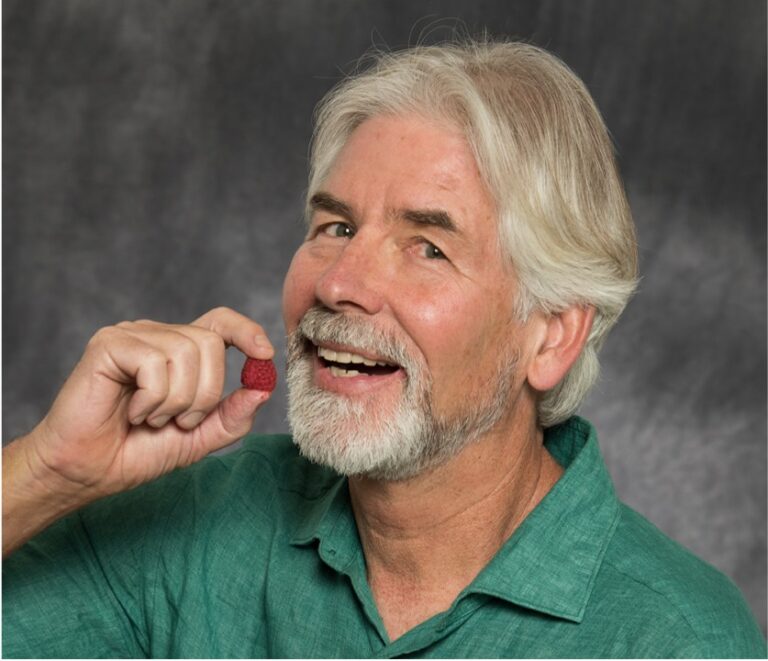
Christopher Gardner, PhD, director of nutrition studies at the Stanford Prevention Research Center and the Rehnborg Farquhar Professor of Medicine at Stanford University
Listen to the Podcast
The podcast of this program will be available Monday, March 16, 2026, after broadcast on March 14. You can stream the show from this site and download the podcast for free. In this episode, Dr. Gardner discusses the types of fat he uses in his kitchen and why. What oils does he choose for sautés or salad dressing? What is his perspective on olive oil? what does he eat for breakfast, lunch and dinner, and what is he buying at the market?