

 #242 Doug Wilbur on Propaganda
The Cognitive Crucible
The Cognitive Crucible is a forum that presents different perspectives and emerging thought leadership related to the information environment. The opinions expressed by guests are their own, and do not necessarily reflect the views of or endorsement by the Information Professionals Association. During this episode, Doug Wilbur discussed propaganda, information warfare, and strategic optimism–emphasizing society's capability for problem-solving. He defined propaganda as any communication intended to influence behavior in the propagandist's favor, distinguishing it from persuasion. Wilbur...
info_outline #241 Andy Whiskeyman on Cognitive Intelligence
The Cognitive Crucible
The Cognitive Crucible is a forum that presents different perspectives and emerging thought leadership related to the information environment. The opinions expressed by guests are their own, and do not necessarily reflect the views of or endorsement by the Information Professionals Association. During this episode, Andrew Whiskeyman discusses his co-authored article: . "COGINT" is the systematic mapping, safeguarding, and operational exploitation of decision-making architectures in the contemporary cognitive battle space. Topics include: understanding and protecting human decision-making...
info_outline #240 Anthony Vinci on the Fourth Intelligence Revolution
The Cognitive Crucible
The Cognitive Crucible is a forum that presents different perspectives and emerging thought leadership related to the information environment. The opinions expressed by guests are their own, and do not necessarily reflect the views of or endorsement by the Information Professionals Association. During this episode, Anthony Vinci, author of , discusses how the battlefield has shifted from physical territory to the human brain. From China’s influence within U.S. education and gaming to the subtle "mind hacking" potential of AI-generated misinformation, Anthony breaks down the strategic...
info_outline #239 Ian Brown on Snowmobiles and Grand Ideals
The Cognitive Crucible
The Cognitive Crucible is a forum that presents different perspectives and emerging thought leadership related to the information environment. The opinions expressed by guests are their own, and do not necessarily reflect the views of or endorsement by the Information Professionals Association. John Boyd is well known to have formally written down very little of his own theories on war and conflict, making researching his concepts challenging and leading many to infer meanings based on their own interpretations—or others’—of what little easily accessible evidence of his thinking remains....
info_outline #238 Bill Wall on AI in Information Operations
The Cognitive Crucible
The Cognitive Crucible is a forum that presents different perspectives and emerging thought leadership related to the information environment. The opinions expressed by guests are their own, and do not necessarily reflect the views of or endorsement by the Information Professionals Association. During this episode, Bill Wall discusses ’s comprehensive AI platform. The conversation explores the necessity for the U.S. to balance military focus with information strategies, diplomacy, and a deeper understanding of the populace to achieve success in modern conflicts. Recording Date: 9 Dec 2025...
info_outline #237 Josh “Bugsy” Segal on Ukraine, Electronic Warfare, and Fast Battlefield Innovation
The Cognitive Crucible
The Cognitive Crucible is a forum that presents different perspectives and emerging thought leadership related to the information environment. The opinions expressed by guests are their own, and do not necessarily reflect the views of or endorsement by the Information Professionals Association. During this episode, Dr. Josh “Bugsy” Segal recaps his recent observations from the Ukraine battlefield and concerns for Western governments which don’t adapt quickly. Ukraine's rapid development of sophisticated, cost-effective domestic defense technology, including advanced counter-drone...
info_outline #236 Michael Lissack on Anticipatory Agents
The Cognitive Crucible
The Cognitive Crucible is a forum that presents different perspectives and emerging thought leadership related to the information environment. The opinions expressed by guests are their own, and do not necessarily reflect the views of or endorsement by the Information Professionals Association. During this episode, Michael Lissack discusses –a unified theoretical framework that reconciles Quantum Bayesianism (QBism), Robert Rosen's theory of Anticipatory Systems, the causal bubbles interpretation of quantum mechanics, and pragmatic constructivism through Hans Vaihinger's philosophy of 'as...
info_outline #235 Rob Thelen on the US Army IWAR Initiative
The Cognitive Crucible
The Cognitive Crucible is a forum that presents different perspectives and emerging thought leadership related to the information environment. The opinions expressed by guests are their own, and do not necessarily reflect the views of or endorsement by the Information Professionals Association. During this episode, COL Rob Thelan discusses the US Army’s Information Warfare (IWAR) Branch. IWAR aims to integrate the IO (Information Operations) and PSYOP (Psychological Operations) communities into a unified, conventional force branch. Other topics include: U.S. lagging behind adversaries like...
info_outline #234 Robert Thibadeau on a Million Identities and Computational Cognitive Neuroscience
The Cognitive Crucible
The Cognitive Crucible is a forum that presents different perspectives and emerging thought leadership related to the information environment. The opinions expressed by guests are their own, and do not necessarily reflect the views of or endorsement by the Information Professionals Association. During this episode, Bob Thibadeau returns to the Cognitive Crucible and discusses the fundamentals of computational cognitive neuroscience and privacy. He asserts that everyone should manage a million identities on an embodied chip, share these identities selectively, and change them frequently....
info_outline #233 Orlandon Howard on Rethinking Strategic Communication
The Cognitive Crucible
The Cognitive Crucible is a forum that presents different perspectives and emerging thought leadership related to the information environment. The opinions expressed by guests are their own, and do not necessarily reflect the views of or endorsement by the Information Professionals Association. During this episode, Lt. Col. Orlandon Howard discusses rethinking strategic communication for U.S. military public affairs, exploring topics such as the PESO model and the balance between informing and influencing. The discussion centers around his recent article: “.” Recording Date: 24 Sep 2025...
info_outline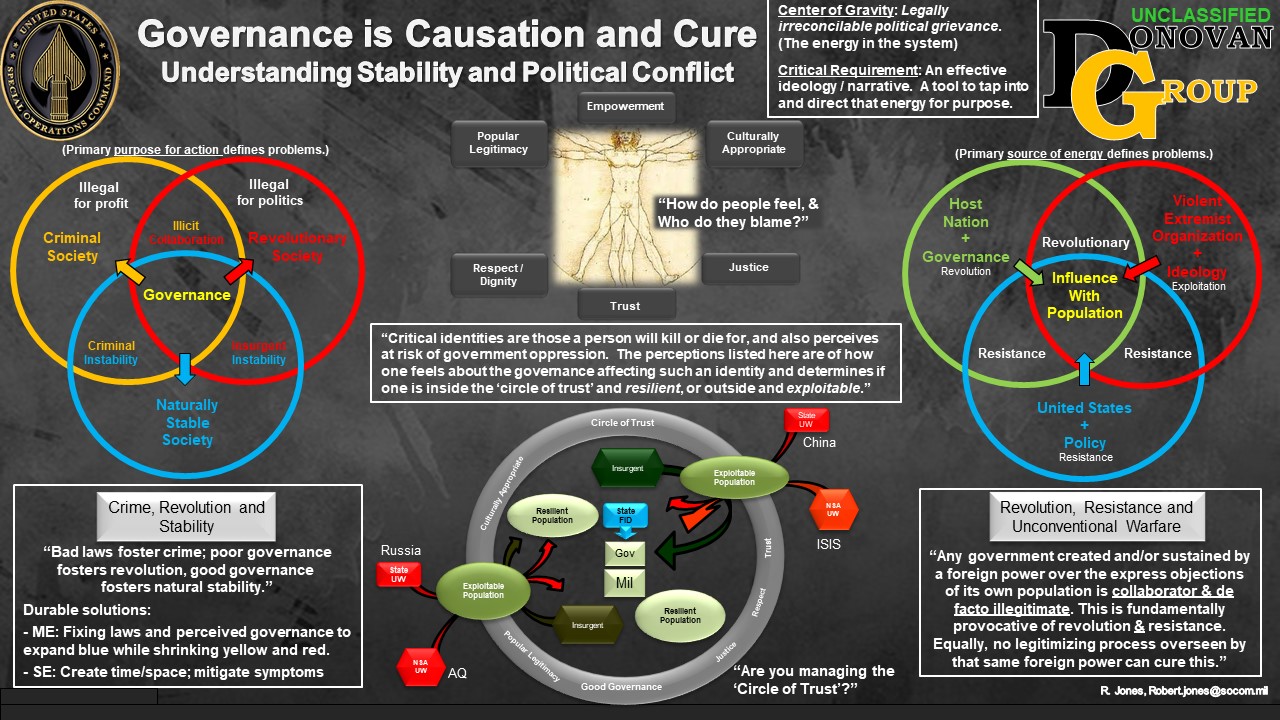
Link to full show notes and resources
Guest Bio: Mr. Robert Jones is a retired U.S. Army Special Forces Colonel; a former Deputy District Attorney; a Fellow with the Center for Advanced Defense Studies (C4ADS), and the Senior Strategist at U.S. Special Operations Command. Currently serving as a member of the SOCOM J5 Donovan Group, Mr. Jones is responsible for leading innovative thinking on the strategic environment and understanding how it impacts factors critical to national security, such as competition, the character of conflict, deterrence and societal stability.
Mr. Robert Jones is a retired U.S. Army Special Forces Colonel; a former Deputy District Attorney; and the Senior Strategist at U.S. Special Operations Command. Currently serving as a member of the SOCOM J5 Donovan Group, Mr. Jones is responsible for leading innovative thinking on the strategic environment and understanding how it impacts factors critical to national security, such as competition, the character of conflict, deterrence and societal stability.
Mr. Jones’s principle focus is on the fundamental human aspects of political conflict. In a rapidly evolving strategic environment, good strategy is rooted in understanding what remains constant and why; while good tactics demands a realistic appreciation for what is different or changed. Successful campaigning demands a fusion of the two. He enjoys “wire brushing” concepts by routinely standing in front of tough audiences. None of these is tougher than those he faces in his role as a fixture in the Joint Special Operations University’s Enlisted Academy, applying a commonsense perspective to bring our most experienced Special Operators strategic insights they can actually use. This is also the third consecutive year that Mr. Jones has addressed the Air War College class during the Operational Design phase of their curriculum, sharing practical insights gleaned from his experiences.
He has been a featured speaker at Universities as storied as Oxford, St Andrews, Stanford and Harvard; and has led professional development events with operational units across the SOCOM enterprise. Mr. Jones is also a Fellow with the Center for Advanced Defense Studies (C4ADS).
About: The Information Professionals Association (IPA) is a non-profit organization dedicated to exploring the role of information activities, such as influence and cognitive security, within the national security sector and helping to bridge the divide between operations and research. Its goal is to increase interdisciplinary collaboration between scholars and practitioners and policymakers with an interest in this domain.
For more information, please contact us at communications@information-professionals.org.
Or, connect directly with The Cognitive Crucible podcast host, John Bicknell, on LinkedIn.