

 21. Lead Poisoned Apes and Our Human Origins
The Fossil Files
Lead is a well known pollutant affecting human health over the course of our urbanisation and industrialisation. But what about before this? Analysis of a range of fossil hominid teeth from the Pleistocene reveals that lead poisoning might have been a ubiquitious part of our deep evolutionary history. Furthermore, lab experiments looking at the effect of lead exposure on human and neanderthal brain development reveals the interplay between this pollutant and 'the language gene' (FOXP2). Together, this suggests that the development of language, socialisation and ultimate evolutionary success of...
info_outline 20. Back-breaking and baby making, the disturbing bedroom habits of hadrosaurs
The Fossil Files
Having large body sizes conferred all sorts of advantages on dinosaurs, but it potentially made breeding a bit complicated. This week we take a look at some weird pathologies in fossil hadrosaurs (duck billed dinosaurs and friends) and what they might tell us about their amourous habits - do broken backs provide evidence of rough housing in the bedroom? This week's paper is "Deciphering causes and behaviors: A recurrent pattern of tail injuries in hadrosaurid dinosaurs" by Filippo Bertozzo and colleagues, published in IScience November 2025 The widescreen artwork is by Troco.
info_outline 19. Dinosaurs were doing fine (before the asteroid), with Steve Brusatte. part 2
The Fossil Files
Part 2: Around 66 million years ago an enormous asteroid barrelled into the earth and wiped out ichthyosaurs, pterosaurs, and dinosaurs*. Debate has raged back and forth as to whether the dinosaurs were already in decline before this mass extinction or were still going strong. This week, Susie and Rob are joined by Prof. Steve Brusatte to take a look at what vertebrates were doing just before the asteroid hit. In part 2 we discuss what would have happened if the asteroid had missed, Steve's new upcoming book, Jurassic World, and Nannotyrannus. *except birds of course. Widescreen...
info_outline 18. Dinosaurs were doing fine (before the asteroid), with Steve Brusatte. part 1
The Fossil Files
Around 66 million years ago an enormous asteroid barreled into the earth and wiped out icthyosaurs, pterosaurs, and dinosaurs*. Debate has raged back and forth as to whether the dinosaurs were already in decline before this mass extinction or were still going strong. This week, Susie and Rob are joined by Prof. Steve Brusatte to take a look at what vertebrates were doing just before the asteroid hit. We discuss his new paper on fossil vertebrates from New Mexico, its implications for scenarios of dinosaur evolution and extinction, and what is life is like for a working palaeontologist,...
info_outline 17. Will palaeontologists go extinct? AI & the future of palaeo
The Fossil Files
Artificial Intelligence seems to be changing everything, everywhere, all at once. But how will the science of studying the very old be transformed by the technology of the new? In this episode Susie and Rob take a look at the risks and opportunities for palaeontology with the application of AI: palAIontology. Can we use AI to find, identify, and classify fossils? The paper's discussed this week are: "Artificial intelligence in paleontology" by Congyu Yu and colleagues published in Earth Science Reviews May 2024 and "Early humans and the balance of power: Homo habilis as prey" by...
info_outline 16. Rotting crocs, the dino bus, and engineering skulls: Day 3 at the Society of Vertebrate Paleontology
The Fossil Files
In the last of our series from the massive Society of Vertebrate Paleontology meeting, Susie and Rob finally manage to catch up for a gossip. In this episode with get a disgusting taste of rotting crocodile experiments with Stephanie Drumheller of the University of Tennessee, an insight into the Dinosaur battle bus education project that has been travelling the Mongolian steppe with Bolor Minjin of the American Museum of Natural History and the Institute for the Study of Mongolian Dinosaurs, and finally how engineering approaches can help us figure out what fossil organisms were up to long...
info_outline 15. Swimming robots and walking fish: Day 2 at the Society of Vertebrate Paleontology
The Fossil Files
New fossil discoveries keep coming thick and fast, but we managed to sit down with the researchers as they present them. In this episode Susie and Rob catch up (in person!) on their second day in Birmingham and talk to the researchers tackling important transitions in vertebrate evolution: the transitions of moving onto land, into the sea, into the air. This includes Emily Hillan of University of Chicago and her discovery of a new specimen of the walking fish (?) Tiktaalik, Dave Hone of Queen Mary University London on his new research on pterosaurs and spinosaurs, Dean Lomax about his new...
info_outline 14. Nanotyrannus and vertebrate origins: day 1 at the society of vertebrate paleontology
The Fossil Files
The Fossils Files are on Tour! Susie and Rob are in Birmingham for the massive Society of Vertebrate Paleontology conference which has made a rare trip to Europe. We will be meeting and chatting with palaeontologists from all over the world and bringing you the latest discoveries and hot gossip. On day 1 we join the Nanotyrannus craze and chat to co-author of that study, James Napoli of Stoney Brook NY. The amazing "Duelling Dinos" specimen has been released the world by the North Carolina Museum of Natural Sciences and has sent dinosaur fans aflutter with its implications for tyrannosaurs. We...
info_outline A new head banging dinosaur
The Fossil Files
A newly discovered fossil from the Cretaceous of Mongolia tells us an interesting story about the purported head butting behaviour of dinosaurs. Pachycephalosaurs are famous for their thick domed heads but it has been disputed how or when this evolved. The beautifully preserved Zavacephale rinpoche has a well preserved skull and dome but also loads of details of the body and tail as well. What is suprising is that this individual is much smaller, and occurs much earlier, than other pachycephalosaurs. We take a look at this new fossil and what this means for interpreting the evolution of...
info_outline Cretaceous zombie ants
The Fossil Files
Cordyceps is a weird fungus that can take over the brain of ants and spiders causing them to go zombie and commit suicide in order to spread disease. Weirder still, some new fossils from the Cretaceous have directly captured this nightmarish behaviour for the first time. We take a look at these interesting fossils, their potentially shady origin story, and their implications for reconstructing evolution of this unsual parasitic behaviour. Side-note: did fungus cause the extinction of dinosaurs? The main paper discussed this week is by Yuhui Zhuang and colleagues "Cretaceous entomopathogenic...
info_outlineOur evolutionary timeline just leapt back an additional 40 million years into the past. Some new fossil trackways from the early Carboniferous of Australia have been interpreted as the first bone-fide "amniotes". This is the group of egg laying vertebrates which we belong to along, with all the other mammals, birds, and reptiles. These fossils are much earlier than previously thought possible and potentially turns our understanding of this event on its head. We take a look at these fossils and the implications, in particular that there could be loads of missing things out there yet to be found, including our own ancestors and distant relatives.
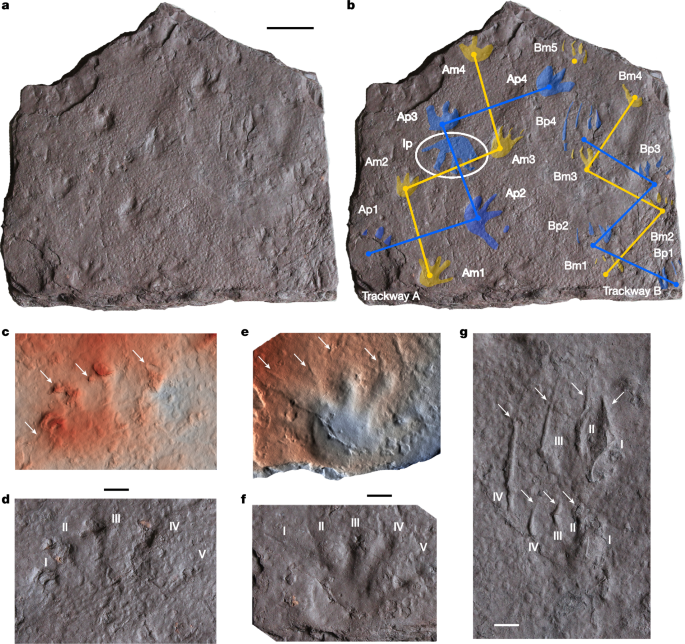
Figure from the study showing the fossil footprints slab, with details of fingers/toes and claws scrapping along the surface, and fossil rain drops.
The paper is "Earliest amniote tracks recalibrate the timeline of tetrapod evolution" by John Long and colleagues, published in Nature in May 2025. https://doi.org/10.1038/s41586-025-08884-5
Widescreen artwork: Marcin Ambrozik..