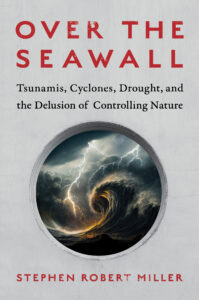
364. Stephen Robert Miller with Marcus Harrison Green: Climate Chronicles — The Delusion of Controlling Nature
Town Hall Seattle Civics Series
Release Date: 08/09/2024
 421. Rashad Robinson with Angela Rye: From Presence to Power
Town Hall Seattle Civics Series
Why do some fights for justice hit a wall while others succeed? What does it take to win social change, especially now? According to author and social change strategist Rashad Robinson, it all comes down to understanding one thing: the difference between presence and power. Robinson has watched many movements unfold in his more than twenty years at the highest levels of leadership in two of the most significant social movements of our time: the fight for LGBTQ rights and the fight for racial justice. He’s taken on tech giants and the criminal justice system, politicians in Washington and...
info_outline 420. Ben Wikler with Governor Jay Inslee: This Is The Plan: How to End America's Meltdown and Save Democracy
Town Hall Seattle Civics Series
Ben Wikler, hailed as the “preeminent state party chair” by Nancy Pelosi, led Wisconsin Democrats through a series of hold-your-breath fights against right-wing extremists that resulted, against the odds, in the unrigging of the political system of the most divided — and, until recently, most gerrymandered — state in the nation. His new book, This Is The Plan: How to End America’s Meltdown and Save Democracy, draws on decades of experience in everything from school-board races to presidential elections to bring readers inside the hidden web of power that shapes our lives....
info_outline 419. Cole LeFavour: A Memoir of Land, Love, and Queer Resistance in Red America
Town Hall Seattle Civics Series
Finding and forging one’s identity and purpose can be challenging enough. Doing that while also being a member of a marginalized identity living in a conservative milieu can add more complexity to this experience. For former state Senator Cole LeFavour, that was very much a reality. LeFavour chronicles their life in a new book, In the Arms of Mountains: A Memoir of Land, Love, and Queer Resistance in Red America. As Idaho’s first out LGBTQ+ lawmaker, LeFavour explores a journey through gender, power, and rebellion against a reactionary system. When LeFavour was 11 years old,...
info_outline 418. Barbara McQuade with Debora Juarez: Preserving Our Democracy
Town Hall Seattle Civics Series
New York Times bestselling author and former U.S. Attorney Barbara McQuade offers an exposé on what she frames as an escalating threat of far-right politics to both national security and American democracy. In The Fix: Saving America from the Corruption of a Mob-Style Government, McQuade draws on her decades of legal experience to argue how systems of organized crime and political opportunism exploit the levers of power — using corruption, cruelty, and chaos as tools to dominate institutions and eliminate accountability. McQuade exposes government tactics like information...
info_outline 417. Peter Beinart with Smadar Ben-Natan: Being Jewish After the Destruction of Gaza
Town Hall Seattle Civics Series
As the Gaza war stretches into its third year, journalism professor and MSNBC analyst Peter Beinart claims that, as a Jew, he must reckon with the intense moral and theological tensions that not only he holds, but what he sees as challenges for Judaism as a whole. Because of these tensions, Beinart believes the Jewish community must build a new answer to the question: What does it mean to be a Jew? From his book, Being Jewish After the Destruction of Gaza: A Reckoning, MSNBC analyst Peter Beinart imagines a world where Israeli Jews have the right to equality, not supremacy, and in...
info_outline 416. Kimberlé Crenshaw with Angela Rye: Backtalker: An American Memoir
Town Hall Seattle Civics Series
By way of structured academia or outspoken social commentary, the work of Kimberlé Crenshaw can be found woven throughout the fabric of modern American sociopolitical discourse. Through establishing the concepts of intersectionality and critical race theory, Crenshaw helped lay a foundation for decades of discussion and activism around race and gender across the world. In her upcoming memoir Backtalker, Crenshaw recounts the personal journeys that shaped her as someone who champions taking notice and speaking up. With intimate and compelling storytelling, Crenshaw takes readers...
info_outline 415. Celebrating Bike Everywhere Month 2026: 2nd Annual Bike Month Bash
Town Hall Seattle Civics Series
Do you bike in Seattle — or want to? Join Cascade Bike Club for Town Hall Seattle’s 2nd annual Bike Month Bash. Seattle’s bike network and transit connections are expanding as the city prepares for the FIFA World Cup and a flood of visitors this summer. But gaps remain, and more work is needed to make people of all abilities feel safe biking in our city. There are also many opportunities to support better biking in Seattle, such as the Pedaling Relief Project that rescues and delivers food on behalf of multiple food banks. Bring your enthusiasm and questions for our panel of...
info_outline 414. Red May 2026: ICE-Age Policing presented by Town Hall Seattle and Red May
Town Hall Seattle Civics Series
a month-long spree of red arts, red theory, and red politics based in Seattle, Washington, gathers each spring to discuss a world beyond capitalism. For this year’s event at Town Hall Seattle, Red May brings together a panel to discuss policing in the age of ICE. “Counterinsurgency has come home. Since the end of the Vietnam War, innovations in militarized policing have come one after another. No knock raids. AI surveillance. Clear and hold neighborhoods. Each new tactic or strategy has been rubber-stamped in Congress by both Democrats and Republicans under the guise of a...
info_outline 413. Khiara M. Bridges with Dr. Karen A. Scott: Expecting Inequity: How the Maternal Health Crisis Affects Even the Wealthiest Black Americans
Town Hall Seattle Civics Series
Black people are three times more likely to die from a pregnancy-related cause, a harrowing statistic that reproductive advocate and author Khiara M. Bridges has been dedicating efforts towards examining for years. The heightened issues facing Black people in maternal healthcare have deep roots in the history of racial inequality in the US and — as Bridges’ most recent work unpacks — persist now even across income levels. In her newest book, Expecting Inequity: How the Maternal Health Crisis Affects Even the Wealthiest Black Americans, Bridges brings attention to the stories...
info_outline 412. Speaking of Seattle: Immigrant Rights Are Human Rights: Hosted by Marcus Harrison Green with Angelina Godoy, Roxana Norouzi, Erika Evans, and Alexis Mercedes Rinck
Town Hall Seattle Civics Series
At a moment when national politics are testing the boundaries of constitutional protections and human dignity, local communities are asking a vital question: What can we do to protect one another? Town Hall Seattle and The Stranger present the March 19 edition of the Speaking of Seattle civic conversation series, an evening focused on immigrant rights, community responsibility, and the everyday actions that help safeguard our neighbors. This timely conversation explores how federal immigration enforcement policies ripple through local communities — and how ordinary people can respond...
info_outlineErratic weather, blistering drought, rising seas, and ecosystem collapse now affect every inch of the globe. Increasingly, we no longer look to stop climate change, choosing instead to adapt to it.
Academics call it maladaptation; simply, it’s about solutions that backfire. In his new book, Over the Seawall, Stephen Robert Miller tells us the stories behind these unintended consequences and the fixes that can do more harm than good. From seawalls in coastal Japan to the reengineered waters in the Ganges River Delta, to the artificial ribbon of water supporting both farms and urban centers in arid Arizona, Miller traces the histories of engineering marvels that were once deemed too smart and too big to fail.
In each story, Miller takes us into the land and culture, seeking out locals and experts to better understand how complicated, grandiose schemes led instead to failure, and to find answers to the technological holes we’ve dug ourselves into; urging us to take a hard look at the fortifications we build and how they’ve fared in the past. Miller embraces humanity’s penchant for problem-solving but argues that if we are to adapt successfully to climate change, we must recognize that working with nature is not surrender but the only way to assure a secure future.
Stephen Robert Miller is an award-winning independent journalist, author, and editor who covers climate change, environmental conservation and agriculture from his home in rural Colorado. His work appears in National Geographic, Discover Magazine, Audubon, The Guardian, and many others. Stephen was a 2018-2019 Ted Scripps Fellow. His new book, Over the Seawall, takes a global perspective on natural hazards and the challenges of adaptation to climate change. He has reported from across the U.S. and Canada, Southeast Asia, and the Arctic. He graduated with a degree in journalism from the University of Arizona and was previously senior editor of environmental justice for YES! Magazine, as well as editor of a Seattle-based weekly newspaper.
Marcus Harrison Green is a columnist for The Seattle Times. A long-time Seattle native, he is the founder of the South Seattle Emerald, which focuses on telling the stories of South Seattle and its residents.