

155. Stingers, burners & shoulder instability in sport. Physio Edge Shoulder Success podcast with Jo Gibson
Release Date: 06/02/2023
 181. Tendinopathy: Is it weakness or inhibition? with Dr Patrick Vallance
Physio Edge podcast
Your patellar tendinopathy patients are performing a solid, progressive loading program, but their quadriceps still test weaker, with lower maximal force output. Are their quads actually weak, or is muscle inhibition limiting the strength they can access? And how does this change your rehab? In this episode, Dr Patrick Vallance (Ph.D, Physiotherapist, Tendinopathy neuroscientist, Lecturer in Physiotherapy at Monash University) and David Pope explore why force output can be reduced in tendinopathy, and how understanding the mechanisms involved can help you tailor your treatment. You’ll also...
info_outline 180. Patellofemoral pain 4 - How to get runners back on track (and trails, hills and anywhere else they run!) with Tom Goom
Physio Edge podcast
Patellofemoral pain (PFP) rehabilitation doesn’t end when your patient gets stronger. The real challenge is getting them back to running, training and racing without triggering another flare-up. In this final episode of the four-part series, Tom Goom (Running Physio) and David Pope explore the fourth pillar of successful PFP rehabilitation: a planned return to running. Continuing Alice’s journey from the previous episodes, a HYROX athlete preparing for competition, Tom and David break down exactly how to rebuild running volume, progress training safely, and help runners hit their goals,...
info_outline 179. Patellofemoral pain 3 - Effective rehab that won't flare their symptoms with Tom Goom
Physio Edge podcast
Strengthening exercises are a key part of successful patellofemoral pain (PFP) rehabilitation. Squats, lunges and single leg squats are often painful early on and can aggravate your patients pain, but on the flip side, we want to build up their tolerance and confidence with these movements. If you introduce an exercise your patient isn’t ready for, progress too quickly, or overload the knee too early, you’ll often flare your patients pain and set their rehabilitation back. In this episode, Tom Goom (Running Physio) and David Pope explore the third pillar of successful PFP treatment:...
info_outline 178. Patellofemoral pain 2 - What to do when runners won't reduce their training with Tom Goom
Physio Edge podcast
Many runners patellofemoral pain (PFP) is aggravated by the activity they love. They either stop running to let their pain settle, and then it returns as soon as they start back up again, or keep running despite the pain getting worse. They may know (and you may have told them) they should reduce their training….but what happens when they can’t? Or won’t? In this episode, Tom Goom (Running Physio) and David Pope explore the second pillar of successful PFP rehab: education and empowerment. Using the real case of Alice, a HYROX athlete preparing for competition, you’ll discover how and...
info_outline 177. Patellofemoral pain 1 - Why it has such a high recurrence rate, and what most rehab plans miss with Tom Goom
Physio Edge podcast
Patellofemoral pain (PFP) is one of the most common running injuries, and the high recurrence rate can make it a frustrating injury for patients to experience and clinicians to treat. In this episode, Tom Goom (Running Physio) and David Pope break down why PFP has such a high recurrence rate, and what most rehab plans miss. You’ll also discover: The "Four pillars" framework Tom uses to treat PFP and other running injuries How and when to keep patients running or exercising when it is essential for their mental health and social life How to find a manageable starting point when a...
info_outline 176. Neck-driven shoulder pain - 5 common misunderstandings. Physio Edge Shoulder Success podcast with Jo Gibson
Physio Edge podcast
When is your patient's shoulder pain from their neck? Are you missing a cervical spine component in your shoulder patients? After a day in clinic reviewing patients with years of unresolved shoulder pain, Shoulder Specialist Physiotherapist Jo Gibson breaks down the five most common mistakes clinicians make when ruling in — or out — the neck. In this podcast, Jo covers: Why you don't need neck pain to have neck-driven shoulder pain (and which pain locations are most pathognomonic) Why referred symptoms below the elbow don't automatically point to the cervical spine Why active range of...
info_outline 175. Tendinopathy treatment: Your guide to isometrics, isotonics & plyometrics with Dr Ebonie Rio
Physio Edge podcast
Should you prescribe isometric or isotonic exercises for your patient's lower limb tendinopathy? When is it safe to add plyometric loading, and how do you progress running or jumping without flaring your patients tendon pain? Why do some "tricky tendons" refuse to respond to your best loading programs? Dr Ebonie Rio (Post-Doctoral Senior Research Fellow, La Trobe University) reveals the evidence-based answers as she guides you through the clinical reasoning and practical strategies for managing patellar, achilles, and other lower limb tendinopathies. In this conversation, you'll follow...
info_outline 174. ACJ - The hidden culprit behind stubborn shoulder pain? Physio Edge Shoulder Success podcast with Jo Gibson
Physio Edge podcast
Have any of your shoulder patients improved and then plateaued, unable to regain their full range of movement, or get rid of their painful arc? Sometimes it’s not the cuff, capsule, nerves or neck—it’s the acromioclavicular joint (ACJ) holding things back. In this episode, Jo Gibson sheds light on this often-overlooked contributor to persistent shoulder pain. From real patient case studies to the latest research and simple clinic-ready symptom modification tests, Jo shares practical strategies you can use immediately. Learn how to identify ACJ involvement, and use targeted rehab...
info_outline 173. Hip flexor pain in runners: Diagnosis, myths, and rehab. Physio Edge Track record: Running repairs podcast with Tom Goom
Physio Edge podcast
Anterior hip pain is often blamed on the hip flexors, but in runners, that’s rarely the diagnosis. So how can you identify the real cause and guide patients to a safe, effective recovery? In this episode, Tom Goom (Running Physio) explores the function of the hip flexors in running, key differentials for anterior hip or groin pain, and practical rehab strategies you can use right away. You’ll discover: Why true hip flexor tendinopathy is uncommon in endurance runners Red flags and key tests to identify bone stress fractures and intra‑articular pathology Early‑stage loading strategies...
info_outline 172. Shoulder pain assessment & clinical reasoning. Physio Edge Shoulder Success podcast with Jo Gibson
Physio Edge podcast
Your patient presents with shoulder pain, and straight away you need to identify: Is it rotator cuff related shoulder pain, frozen shoulder, instability, or something else entirely? Is it rotator cuff related shoulder pain, frozen shoulder, instability, or something else entirely? Is the pain actually coming from the shoulder? Could it be the cervical spine? Is there a tear that needs urgent referral? Should you order imaging? Refer to a surgeon? Or confidently continue with rehab? In this podcast, Jo Gibson (Upper Limb Rehabilitation Specialist Physio) guides you through a simple,...
info_outline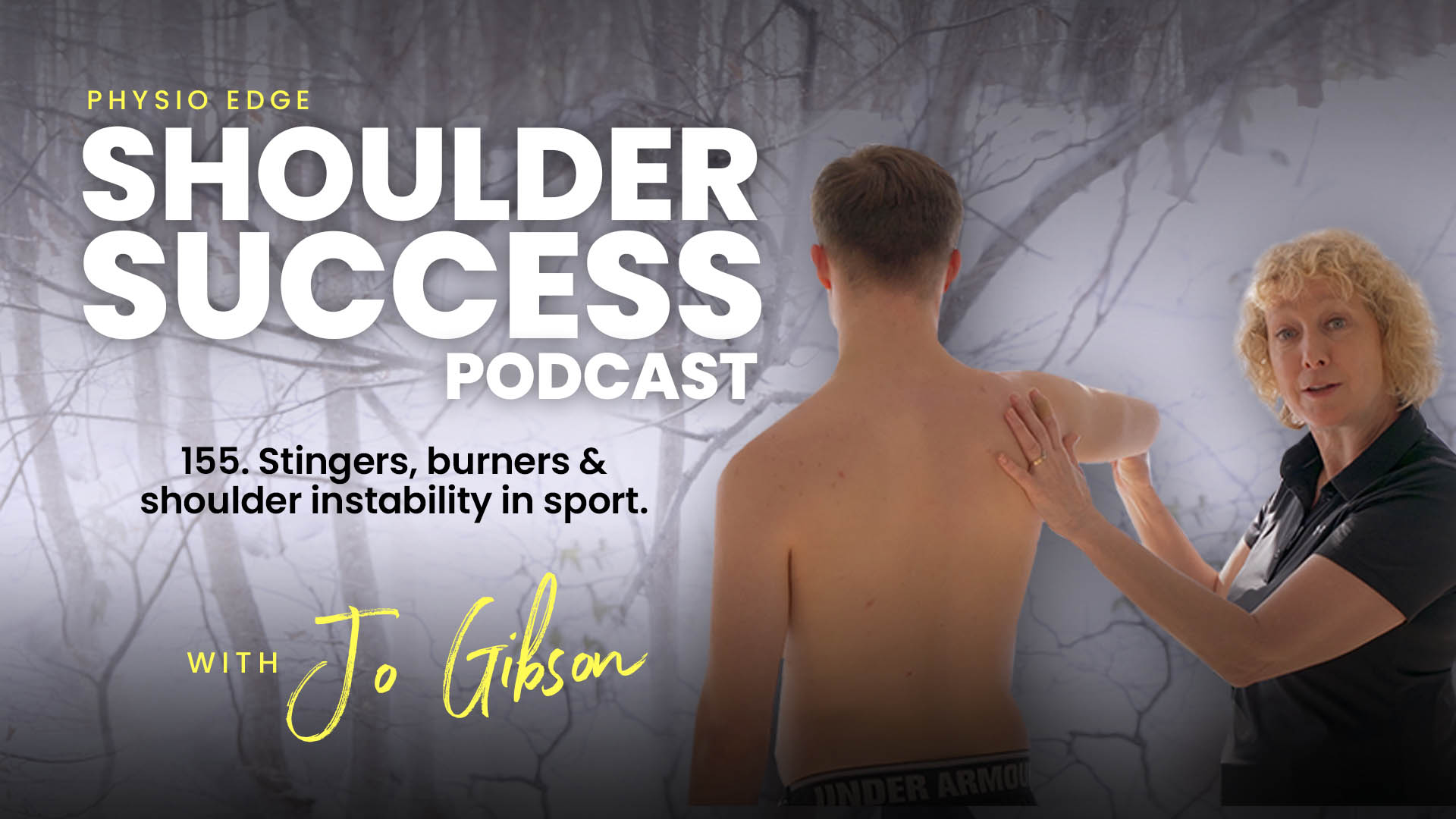
Stingers or burners are a burning or stinging pain, often with some paraesthesia and occasionally weakness, often occurring in impact sports such as rugby or American football.
When your patients present with neck and arm symptoms, how can you differentiate a stinger or burner from a C/sp fracture, discogenic symptoms or nerve root compression, which all require very different treatment?
How should you manage patients with one-off or repeated stingers or burners?
Find out in this podcast with Jo Gibson (Upper Limb Rehabilitation Specialist Physio).
The handout for this podcast consists of a transcript, summary and articles referenced in the podcast.




Click here for the free webinar with Jo Gibson “Rotator cuff revealed! Rehab & reasoning”. 
Free trial Clinical Edge membership
Use a fresh approach to your musculoskeletal and sports injury treatment with a free trial Clinical Edge membership at clinicaledge.co/freetrial
Links associated with this episode:
- Free webinar - Rotator cuff revealed: Rehab & reasoning with Jo Gibson
- Improve your confidence and clinical reasoning with a free trial Clinical Edge membership
- Join Jo Gibson live on Facebook & ask your shoulder related questions every Monday
- Download and subscribe to the podcast on iTunes
- Download the podcast now using the best podcast app currently in existence - Overcast
- Listen to the podcast on Spotify
- Jo Gibson on Twitter
- Let David know what you liked about this podcast on Twitter
- Review the podcast on iTunes
- Infographics by Clinical Edge
Articles associated with this episode:
- Download the podcast handout to receive the articles associated with this podcast.
- Bowles DR, Canseco JA, Alexander TD, Schroeder GD, Hecht AC, Vaccaro AR. The prevalence and management of stingers in college and professional collision athletes. Current reviews in musculoskeletal medicine. 2020 Dec;13:651-62.
- Sobue S, Kawasaki T, Hasegawa Y, Shiota Y, Ota C, Yoneda T, Tahara S, Maki N, Matsuura T, Sekiguchi M, Itoigawa Y. Tackler’s head position relative to the ball carrier is highly correlated with head and neck injuries in rugby. British journal of sports medicine. 2018 Mar 1;52(6):353-8.
- Swiatek PR, Nandurkar TS, Maroon JC, Cantu RC, Feuer H, Bailes JE, Hsu WK. Return to play guidelines after cervical spine injuries in American football athletes: a literature-based review. Spine. 2021 Jul 1;46(13):886-92.
Chapters:
- 03:56 - What are stingers or burners?
- 08:13 - 3 key mechanisms
- 14:36 - Signs & symptoms
- 15:36 - Management guidelines
- 18:46 - Shoulder instability treatment