

433: The Uncrackable Justification for Choice Reading
The Spark Creativity Teacher Podcast | ELA
Release Date: 07/22/2026
 445: The Poetic Structure Lesson I Can't Wait to Do (Today)
The Spark Creativity Teacher Podcast | ELA
Today on the pod, let me walk you through a fun new way of teaching poetic structure. I'm doing it TODAY, and I'm so excited about it, I just had to share it immediately. Poetic Terms you could explore: form, structure, concrete poem, line break, enjambment, stanza, repetition, rhythm, rhyme Access the post, "How to Make Digital Poetry Tiles," here: Go Further: Explore alllll the Episodes of . Snag three Join our community, , on Facebook. Come hang out on . Enjoying the podcast? Please consider sharing it with a friend, snagging a screenshot to share on the ‘gram, or...
info_outline 444: How One Teacher used Panel Discussions to Help Students Find their Voices
The Spark Creativity Teacher Podcast | ELA
When you think back to your high school English classes, is there a certain activity that really sticks with you? One lesson or project that still hums through your brain and puts a smile on your face when you look back? I have a feeling that today’s guest, veteran teacher Wendy Eberhardt, will have a lot of students who look back on their lives in high school and think about the activity she’s about to share with us. I don’t want to ruin the surprise, so let’s just say that Wendy has come up with an incredible way to help her kids find their voices, and she’s about to give us all...
info_outline 443: What I've Learned about Teaching Reading Strategies
The Spark Creativity Teacher Podcast | ELA
As a fairly constant reader for the last few decades, I sometimes forget how challenging reading can be. But then I get into, for example, a dense thirty page research write-up about the study of how different factors affect relationships between kindergarten teachers and kindergarten moms in Finland, and I remember. Reading can be so hard. So how can you make it easier for your students, as they dive into the books you share? Well, one option is to share explicit strategies they can plug into along the way. Penny Kittle does such a beautiful job of demonstrating the way she does this in...
info_outline 442: How One Teacher Leveraged Hexagonal Thinking for Messy Magic
The Spark Creativity Teacher Podcast | ELA
It’s easy to think of hexagonal thinking as a one-and-done. But it’s not. It’s a strategy you can tailor to a thousand different situations. Andi Jackson, veteran teacher, creative thinker, and hexagonal thinking launcher-extraordinaire, is here today to spotlight the possibilities. She’s taken hexagonal thinking, originally developed by Anthony Hodgson in the business world, and remixed it in three different creative ways to help guide her students through complex thinking toward original writing. She’s about to share her stories and tips with us, and I’m positive you’ll come...
info_outline 441: 4 Ways to Help Early Finishers Thrive in ELA
The Spark Creativity Teacher Podcast | ELA
We've all had the experience of planning a detailed activity meant to take thirty or forty minutes, and then watching a student close their book or notebook after five. It's confusing. It feels obvious that they couldn't have done a good job, and yet it's often not the best use of teacher time to litigate this individually with each early finisher. And yet, preparing a plan for what to do is tricky, because there's not a one-size-fits-all approach to students finishing early, because it looks different in different situations. Sometimes students finish early because they rushed, but...
info_outline 440: ELA Classroom Design: Come Tour with Me
The Spark Creativity Teacher Podcast | ELA
I've been the first one to school a lot lately, and I'm spending a lot of quiet moments in my classroom, thinking about what's working well, what I can tweak, and how I can best use the spaces I've set up. Rounding the bend into week three feels very different than the summer what-if energy, so I'm in a position now to tell you what's working, what's a work-in-progress, and what I still need to work out. I wish I could swing by and see your classroom too - wouldn't it be fun if there was some way we could run a vast YouTube channel with just 90 second videos of classrooms all over the world?...
info_outline 439: How to Play Genre Trashketball (A Lesson + A Game)
The Spark Creativity Teacher Podcast | ELA
"What's this?" I was crouched alongside a student on the first day of school as she filled out her reading profile. She pointed her pink highlighter at the section of genres, unsure how to proceed. I wanted to know if she liked scifi or romance, dystopia or suspense or YA. She wanted to know what they were, and she wasn't the only one to ask. So I pushed back my plans for the next class a bit, and made time for a lesson on genre instead. And it was such a blast, I want to share it with you today, in case your students are asking the same questions as mine. Today I'll walk you through a...
info_outline 438: Experiments in Ungrading: What does it look like to Decenter Grades?
The Spark Creativity Teacher Podcast | ELA
There are so many ways to grade students. You can avoid zeros, use a standards-based approach, allow iteration, tweak your late policy, experiment with different categories and percentages. What works best? That’s hard to say. But today’s guest, Dr. Brittany Dillman, wanted to try something different. She’s an expert in educational psychology and educational technology, and directs several online masters programs at Michigan State University. She decided, with her colleagues, to step away from traditional grading and its many remixes altogether, and pursue an alternative known as...
info_outline 437: 16 Graphic Novels for your Classroom Library
The Spark Creativity Teacher Podcast | ELA
Recently I listened to Daniel Wilingham's book, Why Don't Kids Like School?, about how we can use what we know about how the mind works to make school work better for kids. And I found myself nodding along in chapter two as he talked about reading: "Do whatever you can to get kids to read, but it's not enough. People sometimes ask whether graphic novels count, or whether audiobooks do. The answer is an emphatic yes." I couldn't agree with Wilingham more. Sure, I've heard the argument that students need "rigor" at school. The canon. The classics. But I would certainly side with Penny Kittle...
info_outline 436: Highly Recommended: This Free Vocabulary Tool
The Spark Creativity Teacher Podcast | ELA
You know how I love to share a great find, and this week I've got a real winner for your vocabulary program. On this episode of "Highly Recommended," I'll tell you about a new tool I just found and why it's so high impact for helping kids learn new words. Let's dive in. Word Dissector App Link: Go Further: Explore alllll the Episodes of . Get my popular Join our community, , on Facebook. Come hang out on . Enjoying the podcast? Please consider sharing it with a friend, snagging a screenshot to share on the ‘gram, or tapping those ⭐⭐⭐⭐⭐ to help others...
info_outline
So here's the thing. I know I talk a lot about reading. It's pretty important to me. But all week I've been trying to prepare a different podcast, one NOT about the uncrackable justification for choice reading. But recently I heard from several teachers over in CHSE about thriving reading programs they had going, only to get shut down by folks who felt like reading in class was a waste of time. And then I kind of ended up in a rabbit hole, as I am wont to do. It's like researching the justification for choice reading became my guilty pleasure, sucking up all my time. I listened to audiobooks on my walks, pored over research roundups and articles at the coffee shop, hit up the hammock with my Penny Kittle, and stared and stared and stared at the growing evidence mounting in my endless Google doc of notes.
The evidence is clear. The need for help for kids who don't read, don't like reading, and don't want to read is great. And yet STILL we are prioritizing reading snippets and drilling for tests to "improve" our readers' reading. I want you to have the information you need to fight. So here I am. Again. Despite my efforts to focus on something else this week. Let's dig deep.
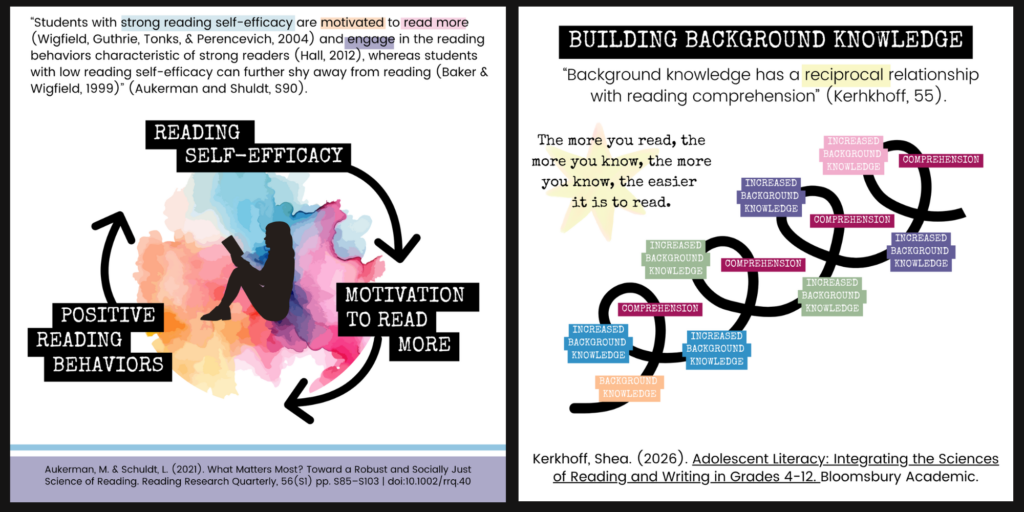
Illustration for The Cycles I share in this episode:
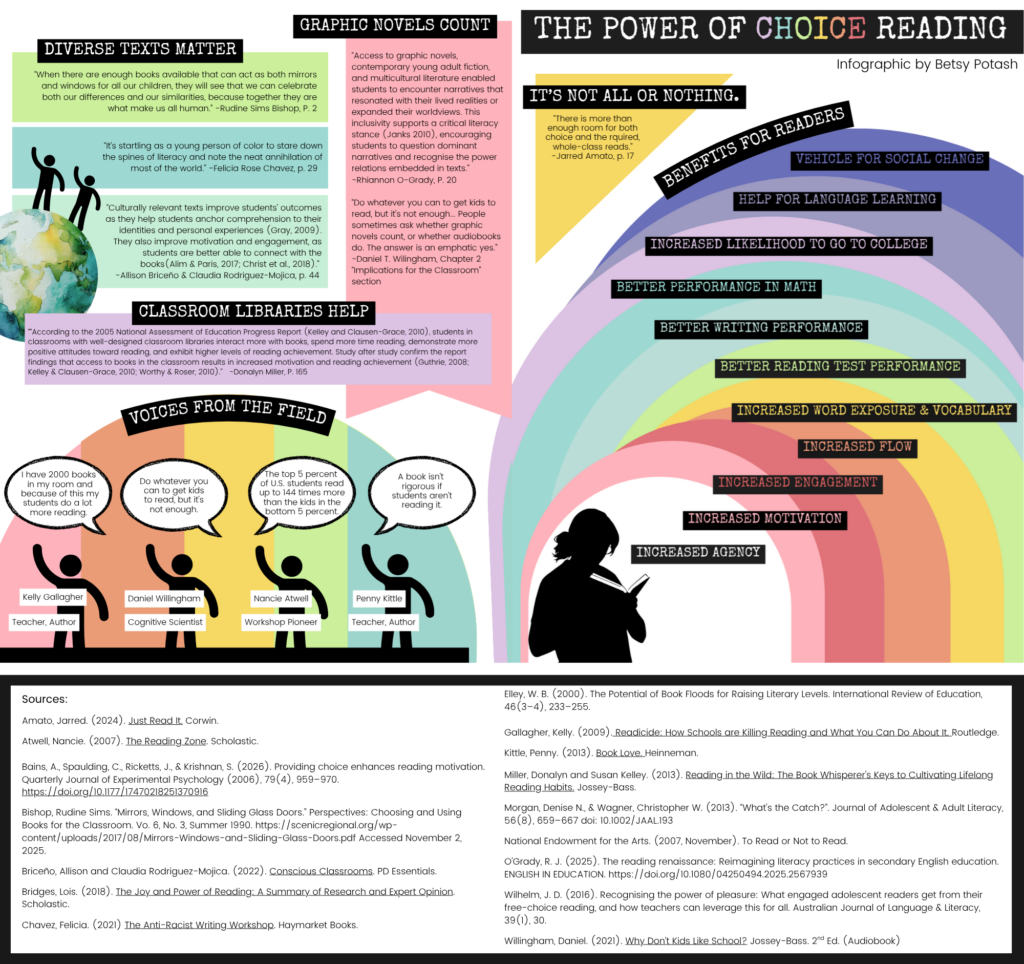
The Infographic I mentioned:
Go Further:
Explore alllll the Episodes of The Spark Creativity Teacher Podcast.
Launch your choice reading program with all my favorite tools and recs, and grab the free toolkit.
Join our community, Creative High School English, on Facebook.
Come hang out on Instagram.
Enjoying the podcast? Please consider sharing it with a friend, snagging a screenshot to share on the ‘gram, or tapping those ⭐⭐⭐⭐⭐ to help others discover the show. Thank you!
Sources:
Amato, Jarred. (2024). Just Read It. Corwin.
Atwell, Nancie. (2007). The Reading Zone. Scholastic.
Aukerman, M. & Schuldt, L. (2021). “What Matters Most? Toward a Robust and Socially Just Science of Reading.” Reading Research Quarterly, 56(S1) pp. S85–S103 | doi:10.1002/rrq.40
Bains, A., Spaulding, C., Ricketts, J., & Krishnan, S. (2026). Providing choice enhances reading motivation. Quarterly Journal of Experimental Psychology (2006), 79(4), 959–970. https://doi.org/10.1177/17470218251370916
Bishop, Rudine Sims. “Mirrors, Windows, and Sliding Glass Doors.” Perspectives: Choosing and Using Books for the Classroom. Vo. 6, No. 3, Summer 1990. https://scenicregional.org/wp-content/uploads/2017/08/Mirrors-Windows-and-Sliding-Glass-Doors.pdf Accessed November 2, 2025.
Briceño, Allison and Claudia Rodriguez-Mojica. (2022). Conscious Classrooms. PD Essentials.
Bridges, Lois. (2018). The Joy and Power of Reading: A Summary of Research and Expert Opinion. Scholastic.
Chavez, Felicia. (2021) The Anti-Racist Writing Workshop. Haymarket Books.
Elley, W. B. (2000). The Potential of Book Floods for Raising Literary Levels. International Review of Education, 46(3–4), 233–255.
Gallagher, Kelly. (2009). Readicide: How Schools are Killing Reading and What You Can Do About It. Routledge.
Kerkhoff, Shea. (2026). Adolescent Literacy: Integrating the Sciences of Reading and Writing in Grades 4-12. Bloomsbury Academic.
Kittle, Penny. (2013). Book Love. Heinneman.
Miller, Donalyn and Susan Kelley. (2013). Reading in the Wild: The Book Whisperer's Keys to Cultivating Lifelong Reading Habits. Jossey-Bass.
Morgan, Denise N., & Wagner, Christopher W. (2013). “What's the Catch?” Journal of Adolescent & Adult Literacy, 56(8), 659–667 doi: 10.1002/JAAL.193
National Endowment for the Arts. (2007, November). To Read or Not to Read.
O'Grady, R. J. (2025). The reading renaissance: Reimagining literacy practices in secondary English education. ENGLISH IN EDUCATION. https://doi.org/10.1080/04250494.2025.2567939
Wilhelm, J. D. (2016). Recognising the power of pleasure: What engaged adolescent readers get from their free-choice reading, and how teachers can leverage this for all. Australian Journal of Language & Literacy, 39(1), 30.
Willingham, Daniel. (2021). Why Don’t Kids Like School? Jossey-Bass. 2nd Ed. (Audiobook)