

399. Indigenous Peoples’ Day: Turning Adversaries into Tribal Allies to Save Salmon
Town Hall Seattle Civics Series
Release Date: 02/09/2026
 423. Gerard Ryle with Jas Randhawa: How the Panama Papers Changed the World
Town Hall Seattle Civics Series
A decade after the Panama Papers exposed the hidden world of offshore finance, the investigation’s consequences continue to unfold. Governments have recovered at least $1.4 billion, transparency laws have changed, and investigative journalism has been transformed. But financial secrecy has evolved alongside these reforms. Join Gerard Ryle, executive director of the International Consortium of Investigative Journalists, for a conversation with financial crime expert Jas Randhawa about the investigation that reshaped public understanding of offshore finance and sparked arrests, legislation...
info_outline 422. Leah C. Stokes with David Roberts: The Carbon Wave: Democracy, Parenthood, and the Race to Protect Our Planet
Town Hall Seattle Civics Series
They were perhaps an unlikely trio: the professor Leah Stokes, the policy wonk Sonia Aggarwal in the White House, and the DC insider Adrian Deveny in the Senate, but together, they crafted the boldest climate legislation of our time. In her newest book, The Carbon Wave, Leah Stokes chronicles the turbulent path of their climate bill as it veered between breakthrough and collapse — from the hopeful beginnings of the Green New Deal in 2018, to the bill’s near-certain defeat by Senator Joe Manchin in the winter of 2021, to the surprise passage of the landmark legislation in August 2022....
info_outline 421. Rashad Robinson with Angela Rye: From Presence to Power
Town Hall Seattle Civics Series
Why do some fights for justice hit a wall while others succeed? What does it take to win social change, especially now? According to author and social change strategist Rashad Robinson, it all comes down to understanding one thing: the difference between presence and power. Robinson has watched many movements unfold in his more than twenty years at the highest levels of leadership in two of the most significant social movements of our time: the fight for LGBTQ rights and the fight for racial justice. He’s taken on tech giants and the criminal justice system, politicians in Washington and...
info_outline 420. Ben Wikler with Governor Jay Inslee: This Is The Plan: How to End America's Meltdown and Save Democracy
Town Hall Seattle Civics Series
Ben Wikler, hailed as the “preeminent state party chair” by Nancy Pelosi, led Wisconsin Democrats through a series of hold-your-breath fights against right-wing extremists that resulted, against the odds, in the unrigging of the political system of the most divided — and, until recently, most gerrymandered — state in the nation. His new book, This Is The Plan: How to End America’s Meltdown and Save Democracy, draws on decades of experience in everything from school-board races to presidential elections to bring readers inside the hidden web of power that shapes our lives....
info_outline 419. Cole LeFavour: A Memoir of Land, Love, and Queer Resistance in Red America
Town Hall Seattle Civics Series
Finding and forging one’s identity and purpose can be challenging enough. Doing that while also being a member of a marginalized identity living in a conservative milieu can add more complexity to this experience. For former state Senator Cole LeFavour, that was very much a reality. LeFavour chronicles their life in a new book, In the Arms of Mountains: A Memoir of Land, Love, and Queer Resistance in Red America. As Idaho’s first out LGBTQ+ lawmaker, LeFavour explores a journey through gender, power, and rebellion against a reactionary system. When LeFavour was 11 years old,...
info_outline 418. Barbara McQuade with Debora Juarez: Preserving Our Democracy
Town Hall Seattle Civics Series
New York Times bestselling author and former U.S. Attorney Barbara McQuade offers an exposé on what she frames as an escalating threat of far-right politics to both national security and American democracy. In The Fix: Saving America from the Corruption of a Mob-Style Government, McQuade draws on her decades of legal experience to argue how systems of organized crime and political opportunism exploit the levers of power — using corruption, cruelty, and chaos as tools to dominate institutions and eliminate accountability. McQuade exposes government tactics like information...
info_outline 417. Peter Beinart with Smadar Ben-Natan: Being Jewish After the Destruction of Gaza
Town Hall Seattle Civics Series
As the Gaza war stretches into its third year, journalism professor and MSNBC analyst Peter Beinart claims that, as a Jew, he must reckon with the intense moral and theological tensions that not only he holds, but what he sees as challenges for Judaism as a whole. Because of these tensions, Beinart believes the Jewish community must build a new answer to the question: What does it mean to be a Jew? From his book, Being Jewish After the Destruction of Gaza: A Reckoning, MSNBC analyst Peter Beinart imagines a world where Israeli Jews have the right to equality, not supremacy, and in...
info_outline 416. Kimberlé Crenshaw with Angela Rye: Backtalker: An American Memoir
Town Hall Seattle Civics Series
By way of structured academia or outspoken social commentary, the work of Kimberlé Crenshaw can be found woven throughout the fabric of modern American sociopolitical discourse. Through establishing the concepts of intersectionality and critical race theory, Crenshaw helped lay a foundation for decades of discussion and activism around race and gender across the world. In her upcoming memoir Backtalker, Crenshaw recounts the personal journeys that shaped her as someone who champions taking notice and speaking up. With intimate and compelling storytelling, Crenshaw takes readers...
info_outline 415. Celebrating Bike Everywhere Month 2026: 2nd Annual Bike Month Bash
Town Hall Seattle Civics Series
Do you bike in Seattle — or want to? Join Cascade Bike Club for Town Hall Seattle’s 2nd annual Bike Month Bash. Seattle’s bike network and transit connections are expanding as the city prepares for the FIFA World Cup and a flood of visitors this summer. But gaps remain, and more work is needed to make people of all abilities feel safe biking in our city. There are also many opportunities to support better biking in Seattle, such as the Pedaling Relief Project that rescues and delivers food on behalf of multiple food banks. Bring your enthusiasm and questions for our panel of...
info_outline 414. Red May 2026: ICE-Age Policing presented by Town Hall Seattle and Red May
Town Hall Seattle Civics Series
a month-long spree of red arts, red theory, and red politics based in Seattle, Washington, gathers each spring to discuss a world beyond capitalism. For this year’s event at Town Hall Seattle, Red May brings together a panel to discuss policing in the age of ICE. “Counterinsurgency has come home. Since the end of the Vietnam War, innovations in militarized policing have come one after another. No knock raids. AI surveillance. Clear and hold neighborhoods. Each new tactic or strategy has been rubber-stamped in Congress by both Democrats and Republicans under the guise of a...
info_outline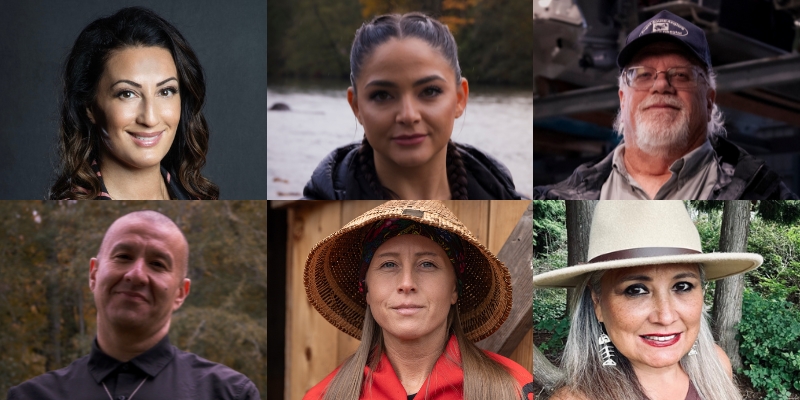
Our region is facing tremendous setbacks for salmon populations and Northwest tribal treaty rights. Fish runs continue to fall short while Indigenous communities bear the brunt of climate change, political polarization, and existential threats to their way of life. Tribes can’t overcome these issues alone, but it’s not just a matter of finding allies — it’s how to get them in the game.
The Billy Frank Jr. Salmon Coalition, formed by Salmon Defense, has taken an innovative approach to protect salmon, restore ecosystems, and build climate resilience by uniting unexpected allies, who have often been at odds in the past. This diverse coalition includes tribal leaders, scientists, state and local officials, fishers, attorneys, conservation groups, and local industries.
Join us on Indigenous Peoples’ Day, for a conversation offering a timely reminder that Indigenous knowledge systems are not only vital to climate resiliency but must also be centered in policy-driven solutions. See how cross-cultural dialogue can help foster creativity and how lasting alliances are strengthened by collaboration amongst groups with different viewpoints.
Peggen Frank (SeiiNiiSeii) is a leader in salmon conservation, tribal advocacy, and treaty rights protection. Since joining Salmon Defense in 2011, she has helped grow the nonprofit into a powerful conservation organization focused on education, advocacy, and litigation. Her key projects include the Billy Frank Jr. curriculum, a sčədadxʷ (salmon) education video, and the Salmon Warriors campaign. Peggen is an enrolled member of the Northern Arapaho Tribe, born and raised on the Wind River Indian Reservation, and now lives in the homelands of the Nisqually Indian people. As Executive Director of Salmon Defense, Peggen manages the likeness and legacy of Billy Frank Jr., ensuring his influence inspires future generations.
Kadi Bizyayeva is the Stillaguamish Tribe of Indians vice-chairwoman, fisheries director, and Northwest Indian Fisheries commissioner. She was also appointed to the Washington Salmon Recovery Funding Board by Gov. Jay Inslee. Kadi is passionate about her role protecting and conserving tribal treaty rights and believes in honest co-management and finding common ground. Her experience includes assisting with project oversight and policy guidance, as well as accounting and administration in several roles within the Northwest Indian Fisheries Commission and the Stillaguamish Tribes’ Natural Resources Department, where she has worked since 2013. Along with her professional roles and achievements, Kadi is also a wife, mother, and a tribal fisher and hunter.
Ron Garner is president of the Puget Sound Anglers State Board, a member of the Billy Frank Jr. Salmon Coalition and a key member of the Western Washington sportfishing community. In 2018, he had the rare honor for a nontribal member – let alone a sportfisherman – of attending a Northwest Indian Fisheries Commission meeting. Ron is passionate about advocating for habitat restoration and reconnection in the Stillaguamish River watershed to promote healthy salmon populations, particularly endangered Chinook. His experience also includes serving on several Washington State Department of Fish and Wildlife advisory committees and task forces related to marine wildlife. Along with his sportfishing community leadership experience and advocacy, Ron is a self-employed commercial construction business owner.
William Frank III served on the Nisqually Tribal Council for many years in several roles, including chairman, and currently serves as chairman of the Wa He Lut Indian School and the Salmon Defense board. He also runs Medicine Creek Tribal Strategies, an independent consulting firm. William is the son of the late Billy Frank Jr., a nationally recognized leader and activist for tribal rights and protecting salmon. His father helped tribes win the landmark 1975 court case that recognized treaty rights and made tribes co-managers of the salmon resource. This court decision completely changed the landscape in Washington after the Fish Wars or ‘fish-ins’ of the 1960s and 1970s, a series of civil disobedience protests where tribal fishers were arrested, beaten, and jailed for fishing off reservation in their ‘usual and accustomed fishing grounds’ – as granted by the treaties negotiated in the mid-1800s. As a leader, fisher, and member of the Billy Frank Jr. Salmon Coalition, he carries on his father’s legacy of bringing together diverse groups of experts to advocate for salmon and the environment.
Cecilia Gobin (dzahdzah’lahk) is a member of the Tulalip Tribes, based in Tulalip, Washington. She is an experienced Policy Analyst, currently working with the Northwest Indian Fisheries Commission (NWIFC) where she focuses on the protection and advancement of tribal treaty rights and resources, including habitat protection and salmon recovery. Prior to NWIFC, Cecilia worked in cultural resources for the Tulalip Tribes, and also for the U.S. House of Representatives’ House Natural Resources Committee’s Office of Indian Affairs, working with policy and legislation related to natural resources and the effects for tribes in Indian Country. She is also a lifetime commercial fisher and remains deeply connected to her community and traditional lifeways.
Lisa Wilson has extensive experience in fisheries policy and treaty rights protection. She earned a bachelor’s degree in Native Environmental Science from Northwest Indian College, where she produced the documentary Time Immemorial: A Fishing History of the Lummi People as her capstone project. Lisa primarily serves as an elected member of the Lummi Indian Business Council and as vice chair of the Northwest Indian Fisheries Commission. She is also on the Salmon Defense board, co-chairs the Natural Resources Committee for the Affiliated Tribes of Northwest Indians and the Lands and Natural Resources Committee for the National Congress of American Indians and is the former Endangered Species Act manager for Lummi Natural Resources.
Presented by Town Hall Seattle and the Billy Frank Jr. Salmon Coalition.