

Christopher Barnes on Sleep and Work
Conversations on Careers and Professional Life
Release Date: 11/07/2022
 PNW Climate Week: State of Climate Tech VC in the PNW Round Table
Conversations on Careers and Professional Life
Episode summary: Five Pacific Northwest climate tech investors — recorded live at Pacific Northwest Climate Week 2026 — break down where climate tech venture capital is actually flowing this year, why Seattle still trails Silicon Valley on VC dollars, and what they're really evaluating when a founder walks into the room. The conversation applies directly to anyone raising capital, building a company, or job searching in a market where AI has made it easy to look good on paper and harder to stand out. Guest bios: Gabriel Scheer is Senior Director, Investments and Innovation,...
info_outline AI Ready: Archit Gupta on Overcoming the Cold Start and Building a Socratic Tutor With AI
Conversations on Careers and Professional Life
Archit Gupta went from never having written a line of code to building AI tools that grade hundreds of student cases and a Socratic AI tutor for a graduate class — in one year. Archit is graduated from Foster's MSBA (Master of Science in Business Analytics) in June, and served on the committee that planned Foster's first AI Spark Day. Before Foster, he worked in M&A at KPMG, founded a consumer fintech startup focused on retail investors, and held product roles at a Singapore-based fintech. He entered the program with no software background and built AI-assisted grading and tutoring...
info_outline AI Ready: Tejash Bagri's AI Prototype Landed Him an Interview
Conversations on Careers and Professional Life
First-year Foster MBA (Class of '27) explains how he turned a stalled application into an interview by building a go-to-market prototype before reaching out — and what that says about standing out when every candidate has the same AI tools. A practical case study for anyone in a competitive recruiting process. Tejash was part of the core organizing team for Foster's inaugural and leads the school's AI and Data Analytics Society. Before his MBA, he worked as chief of staff for a group of organizations in a startup environment, where he built AI-driven workflows for research,...
info_outline AI Ready: Ahmad Ghabboun Discovers His Interest in AI
Conversations on Careers and Professional Life
AI Ready: Ahmad Ghabboun Ahmad Ghabboun built a Demo Day–winning AI product during his MSIS program — after arriving with no plans to work in AI at all. He breaks down how his mindset shifted, how his design background made him a stronger prompter, and how to build AI fluency that actually holds up in interviews. Useful for students and early-career professionals trying to get AI-ready without faking it. Ahmad Ghabboun is a Master of Science in Information Systems (MSIS) 2026 Graduate at the UW Foster School of Business. Before Foster, he spent roughly fifteen years in UX and product...
info_outline AI Ready: Hannah Hoffmaster - How a Non-Technical Student Became AI-Ready in One Year
Conversations on Careers and Professional Life
Hannah Hoffmaster went from a self-described two-out-of-seven in technical skill to building multi-agent AI tools in a single year at Foster. This episode is for anyone — technical or not — trying to understand what genuine AI fluency looks like and how to build it. is a student completing the one-year MSIS program at the University of Washington Foster School of Business. She came to the program with some knowledge of statistics and R, but little coding experience. Through her coursework — including Prof. Leo Bousioux's AI and Generative AI in Business class — she developed the...
info_outline AI Ready: Prof. Léonard Boussioux on Why You Don't Have to Specialize Anymore
Conversations on Careers and Professional Life
On this episode, I speak wtih Léonard Boussioux — Assistant Professor, Foster School of Business; Adjunct, Paul G. Allen School of Computer Science & Engineering, UW. PhD, MIT (machine learning & operations research). Co-founder of . "Professor Leo," as his students call him, is a leader in AI education, research, experimentation, and adoption. He and I are on the Foster AI Taskforce, and sat down for this conversation in August of 2025. Leo rejects the career advice you've heard your entire life: pick a lane, specialize, go deep. His counter-argument is that AI now lets you...
info_outline AI Ready: Nathan Fitzgerald
Conversations on Careers and Professional Life
Nathan Fitzgerald didn't come up through tech. He spent years as a lobbyist, moved into marketing, got laid off in 2024, and treated that moment as a forcing function: how do I build a skill set that doesn't become obsolete? That question led him to Foster's MSIS program — and to a clear-eyed view of what AI can and can't do. In this conversation, Nathan talks about what it actually looks like to learn AI tools from scratch when you're mid-career. We discuss the concept of cognitive offloading — the risk that you let AI do the thinking for you and end up unable to defend your own work. He...
info_outline AI Ready with Anshula Singh
Conversations on Careers and Professional Life
Anshula Singh came into Foster's MBA program with five years of software engineering experience — building products at Salesforce and ServiceNow, working with machine learning, helping train early LLMs from the inside. She wasn't new to AI. She was already watching it closely. In her second winter quarter, she took Software Entrepreneurship — a course where students pitch ideas on day two, form teams, and spend ten weeks building a company. Anshula's team built Authscript, an AI platform to automate prior authorization forms in healthcare. They got far enough to pitch in front of VCs. Then...
info_outline Conversations On Careers: AI Ready - Miniseries Teaser
Conversations on Careers and Professional Life
Two questions are on every student's mind right now: How will AI affect the job I'm trying to get? And how do I show up actually ready to use it? AI Ready — a miniseries from Conversations on Careers and Professional Life -- will feature students from Foster's MBA and graduate programs talking honestly about how they're learning to work with AI. In the classroom. In recruiting. In the work they're already doing. Foster launched an AI strategy this year built around a straightforward premise: graduates should leave ready to use AI as a real professional tool. That means a...
info_outline Ted Jordan From Outsider To Ally - Cultivating A Network to Advance Your Career
Conversations on Careers and Professional Life
Ted Jordan spent 24 years at Microsoft as a global program and account manager before becoming a consultant, professional speaker, and guest lecturer at UW Foster School of Business. His talk — From Outsider to Ally — reframes how we think about networking: less about tactics, more about making the other person feel seen. In this conversation, Ted shares the specific approaches he used to build relationships inside one of the world's most complex organizations — and what he teaches MBA students about doing the same. What we cover The subject line that gets a response every time Why...
info_outline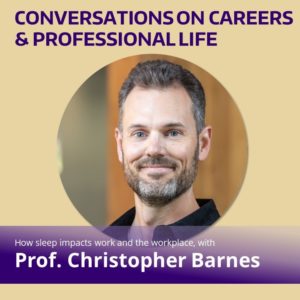 My sleep hasn't been great for years. I never have trouble falling asleep, but I wake after about 5 hours and then have trouble getting back to sleep. I average about 7 hours of sleep a night, sometimes more, sometimes less (an improvement over a few years ago). A few years back, after hearing author Matt Walker talk about his book, Why We Sleep on a podcast (watch his TED Talk), I went down the rabbit hole (not for the first time) on ways to improve my sleep. I'm happy to report, that it many ways, it has gotten better and my relationship to sleep has as well. I write this as a preface for why the topic of this episode is so important to me. Sleep is important for mental and physical health, and for the quality of our work product, our relationships, and the broader work environment as we'll here from my guest, Professor Christopher Barnes.
Christopher Barnes is a Professor of Management and the Michael G. Foster Endowed Professor of Management at the Foster School of Business. His recent research over the past few years focuses on sleep and its impact on work, ethics, decision making and work place engagement. His research has been featured in the Foster Business Magazine, Harvard Business Review, and a TEDx Talk
I've long wanted to have Professor Barnes on the podcast, somewhat selfishly, because of my own interest in -- and challenges with sleep. In April of 2022, I invited him to present to faculty and staff as part of my work on the Health, Wellness and Professional Development Committee at Foster, and after that, I knew I what he had to say would be important to my listeners.
We discussed how sleep hygiene can improve sleep:
- Stick to a schedule for wake time and bed time.
- Avoid alcohol, caffein and nicotine too close to be time, up to 12 hours prior for caffein.
- Use your bed for just two things, sleep and sex.
- Don't stare into your smart device screen before bedtime,
- We briefly touch on his research on Blue-light filtering glasses, and we discussed one reputable supplier, Swanwick Sleep.
- I'll add: keep your bedroom dark and cool. Consider lowering the lighting in your house in the hour or two before bed
- Get bright (preferably natural) light upon waking. For those of us in the PNW, you might want to get a "happy light" for these dark winter months, and use it for 20 minutes upon waking. (I have one from Verilux.)
Some other important resources:
If you suffer from insomnia or sleeplessness, the best experts now recommend avoiding sleeping pills. From my reading, the jury is out on Melatonin except at low doses for short periods of time (like around dealing with a time change). One reason why sedatives and melatonin aren't great is that while they will bring on sleep, they disrupt the best kind of sleep for your brain, deep wave sleep. I learned about this from Matt Walker, so if you want to learn more, follow the links in the first paragraph, or check out this three-part podcast.
The gold standard is now Cognitive Behavioral Therapy for Insomnia, or CBT-I. You can even get apps and online programs to that deliver CBT-I therapy, some are actually FDA Approved. Chris mentioned Sleepio. There is also a free email based program from Insomnia Coach that I found helpful. There are some supplements that can help with sleep, but you should talk to your doctor about taking anything regularly for help with sleep, whether it is over the counter, or prescription.
Chris also mentioned Arrianna Huffington's book, The Sleep Revolution (you can watch a talk she gave for Talks At Google, or read an interview with her), Dr. Nathaniel Watson (also at UW) and the American Academy of Sleep Medicine.
There is also a great recorded talk from the Whole U Speaker Series with Dr. Michael Vitiello on Getting a Good Night's Sleep.