loader from loading.io

REBEL CAST - RENOVATE Trial: HFNC vs BPAP in Acute Respiratory Failure

REBEL Cast

Release Date: 02/05/2026

REBEL MIND Ep7 - Growth vs Fixed Mindset in Medicine show art REBEL MIND Ep7 - Growth vs Fixed Mindset in Medicine

REBEL Cast

🔑Key Points 🌱 Growth mindset transforms learning – Residents and students who believe skills can be developed are more open to feedback, more resilient after failure, and more engaged in practice. 🧠 Language matters in feedback – Simple reframes such as “You’re developing procedural skills” instead of “You’re not strong at procedures” encourage persistence and normalize the learning curve. 🤝 Mindset shapes team culture – Growth mindset leaders foster psychological safety, invite input, and create collaborative teams. Fixed...

info_outline
REBEL MIND Ep6 – How to Sleep When the World Says You Can’t show art REBEL MIND Ep6 – How to Sleep When the World Says You Can’t

REBEL Cast

🔑Key Points ☕ Try the coffee nap! Where you combine caffeine and a 30-minute nap to then have that boost energy and alertness by the time it kicks in. 💤 Sleep isn’t optional—it’s crucial for memory, mood regulation, and physical recovery. It is fundamentally different from rest ❌ Replacing sleep with caffeine isn’t effective and can have negative health impacts. Make getting enough sleep a priority 🌞 Sunlight exposure is important for maintaining circadian rhythms and sleep quality. This applies even if you work as a nocturnist 💡 Creating a personalized sleep...

info_outline
REBEL MIND Ep5 - Applying Performance Science In and Out of the Emergency Department show art REBEL MIND Ep5 - Applying Performance Science In and Out of the Emergency Department

REBEL Cast

📌 Key Points 🔍 Understanding the Why: The significance of understanding underlying causes, beyond initial diagnoses, in both sports and emergency medicine is explored. ⏱️ Recovery Focus: Emphasizing the importance of recovery time and small daily choices in optimizing performance for both athletes and emergency physicians. 📊 Data-Driven Insights: The Arena Labs approach uses personalized data, leveraging wearable technology and expert coaching to tackle burnout and enhance well-being. 🤝 Personalization and Partnership: Arena Labs’ collaboration with emergency...

info_outline
REBEL Core Cast 150.0: Emergency Medicine Consults: How to Call a Consult + Handle Pushback show art REBEL Core Cast 150.0: Emergency Medicine Consults: How to Call a Consult + Handle Pushback

REBEL Cast

In this episode of Rebel Core Content, Swami breaks down one of the most important (and most underrated) skills in emergency medicine: how to give a clean, effective consult—and what to do when you get pushback. Learn a simple 4-step framework to structure every consult (introduce yourself, lead with the ask, give a focused summary, and close the loop), plus ready-to-use scripts for common scenarios. We also cover how to respond to refusals, keep conversations professional, and escalate appropriately when patient safety or disposition is at risk.

info_outline
REBEL CAST: The RSI Trial – Ketamine vs Etomidate in Rapid Sequence Intubation show art REBEL CAST: The RSI Trial – Ketamine vs Etomidate in Rapid Sequence Intubation

REBEL Cast

REBEL Cast: The RSI Trial — Ketamine vs Etomidate in Critically Ill Adults In this episode, we break down the 2025 NEJM RSI trial comparing ketamine and etomidate for tracheal intubation in critically ill adults (Casey et al., PMID: 41369227). This multicenter randomized trial enrolled 2,365 patients across ED and ICU settings and asked a clinically important question: does ketamine improve 28-day mortality compared with etomidate? What we cover: Primary outcome: no statistically significant difference in 28-day mortality Secondary signal: higher “cardiovascular collapse” with...

info_outline
REBEL CAST - RENOVATE Trial: HFNC vs BPAP in Acute Respiratory Failure show art REBEL CAST - RENOVATE Trial: HFNC vs BPAP in Acute Respiratory Failure

REBEL Cast

📌 Key Points 💨 HFNC met criteria for non-inferiority to BPAP for preventing intubation or death within 7 days in four of the five ARF subgroups. 🧪 Bayesian dynamic borrowing increased power across subgroups but created variable certainty, especially in smaller groups such as COPD. 🫁 The immunocompromised hypoxemia subgroup did not meet non-inferiority, leading to early trial stopping for futility. ⚖️ Rescue BPAP use, subgroup-specific exclusion criteria, and non-standardized BPAP delivery are important contextual factors that influence...

info_outline
REBEL MIND Ep4 – Rest Is Not Sleep: The Seven Dimensions of True Recovery show art REBEL MIND Ep4 – Rest Is Not Sleep: The Seven Dimensions of True Recovery

REBEL Cast

🗝️Key Points  Rest isn’t a luxury; it’s a necessity and differs significantly from sleep in terms of mental and physical recovery needs.  Uncovering the seven types of rest can highlight diverse needs: physical, mental, sensory, creative, emotional, social, and spiritual.  Rest from high-stress environments such as the ED is crucial for reducing exhaustion, enhancing decision-making, and maintaining empathy.  The necessity for intentional rest: tailor your rest strategies to meet personal recharge needs effectively.  Rest should be deserved, not...

info_outline
REBEL Core Cast 149: Review of Corticosteroids in Community-Acquired Pneumonia show art REBEL Core Cast 149: Review of Corticosteroids in Community-Acquired Pneumonia

REBEL Cast

🗝️ Key Points 💉 Hydrocortisone Saves Lives: The 2023 Cape Cod Trial (NEJM) showed a clear mortality benefit and reduced need for intubation in severe CAP patients treated with hydrocortisone. 📊 Guidelines Are Catching Up: The SCCM (2024) and ERS now recommend steroids for severe CAP, while ATS/IDSA updates are still pending. 🔥 Redefining “Severe”: Patients requiring high FiO₂ (>50%), noninvasive or mechanical ventilation, or PSI >130 meet criteria for steroid therapy — even outside the ICU. 🍬 Main Risk = Hyperglycemia: Elevated glucose was the most...

info_outline
REBEL CAST – IncrEMentuM26 Speaker Spotlight : Drs. Sara Crager and Ryan Ernst show art REBEL CAST – IncrEMentuM26 Speaker Spotlight : Drs. Sara Crager and Ryan Ernst

REBEL Cast

📝Introduction Welcome to this special edition of the REBEL Cast, where we unravel key highlights and educational insights from the IncrEMentuM Conference in Spain. This event is a cornerstone for advancing emergency medicine education, drawing esteemed speakers and participants from around the globe. As emergency medicine gains traction in Spain, this conference has become an essential platform for knowledge exchange and professional growth. Today, host Dr. Mark Ramzy shines a spotlight on two phenomenal educators: Drs. Sara Crager and Ryan Ernst who shared their expertise and...

info_outline
REBEL MIND Ep3 - Performance Coaching in Medicine show art REBEL MIND Ep3 - Performance Coaching in Medicine

REBEL Cast

📌 Key Points 💪 Building Resilience: Rebel MIND, in partnership with Arena Labs, introduces a science-based performance coaching platform specifically tailored for healthcare professionals, focusing on stress management and burnout prevention. 🤝 Personal Insights: Jackie Penn shares her journey from exercise science to digital coaching, highlighting the importance of tailored coaching in high-pressure environments like healthcare. 🎯 Clinician-Centric Approach: Understanding unique challenges faced by ER doctors, the program provides practical tools for stress and transition...

info_outline
 
More Episodes

📌 Key Points

  • 💨 HFNC met criteria for non-inferiority to BPAP for preventing intubation or death within 7 days in four of the five ARF subgroups.
  • 🧪 Bayesian dynamic borrowing increased power across subgroups but created variable certainty, especially in smaller groups such as COPD.
  • 🫁 The immunocompromised hypoxemia subgroup did not meet non-inferiority, leading to early trial stopping for futility.
  • ⚖️ Rescue BPAP use, subgroup-specific exclusion criteria, and non-standardized BPAP delivery are important contextual factors that influence how subgroup results should be interpreted.

📝 Introduction

  • Bilevel Positive Airway Pressure (BPAP) has long been a foundational modality in the management of acute respiratory failure (ARF), particularly in COPD exacerbations and cardiogenic pulmonary edema, where it can rapidly reduce work of breathing and improve gas exchange. It remains a core tool in our respiratory support arsenal.

  • High-flow nasal cannula (HFNC), however, has expanded what we can offer patients by delivering many of the same physiologic benefits through a far more comfortable interface. With high flows, modest PEEP, and effective dead-space washout, HFNC can improve oxygenation and decrease work of breathing while preserving the ability to talk, cough, eat, and interact with staff and family. This combination of physiologic support and tolerability makes HFNC especially attractive in patients where comfort, anxiety, or cardiovascular stability are key considerations, and in settings where prolonged noninvasive support may be needed. Rather than competing with BPAP, HFNC broadens our options in ARF and allows us to better match the modality to the patient and their underlying disease process.

  • The RENOVATE trial set out to answer a high-impact question across five distinct etiologic groups: Is HFNC non-inferior to BPAP (NIV) for preventing intubation or death in acute respiratory failure?

⚙️ What They Did

Is HFNC non-inferior to BPAP for rate of endotracheal intubation or death at 7 days in patients with acute respiratory failure due to a variety of causes?

  • Multicenter, randomized non-inferiority trial
  • 33 Brazilian hospitals
  • Nov 2019 – Nov 2023
  • Adaptive Bayesian hierarchical modeling with dynamic borrowing
  • Open label, outcome adjudicators blinded
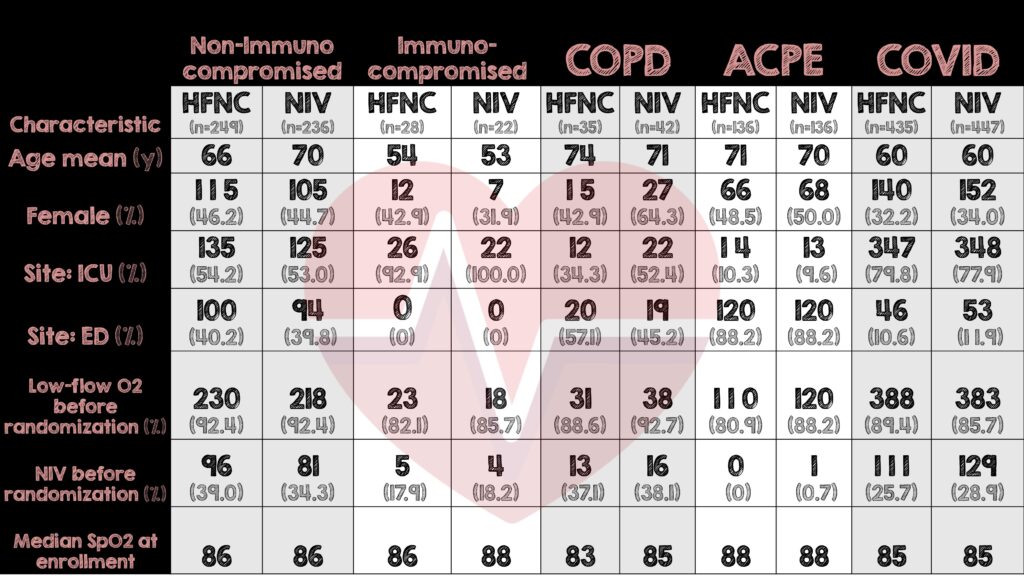
  • Patients were classified into 5 subgroups
💪 Strengths

  • Broad, multicenter design: Large multicenter randomized trial comparing HFNC vs BPAP across several etiologies of acute respiratory failure in ED and ICU settings.
  • Etiology-based and COVID-specific subgroups: Patients were stratified into prespecified clinical subgroups (COPD with acidosis, ACPE, immunocompromised hypoxemia, non-immunocompromised hypoxemia), and COVID-19 was later added and analyzed as a separate subgroup rather than being combined with the original ARF categories.
  • Bayesian hierarchical model with dynamic borrowing: The primary analysis used a Bayesian hierarchical framework that allowed information to be borrowed across subgroups when treatment effects were similar and reduced borrowing when subgroups differed.
  • Prespecified non-inferiority and futility rules: Each subgroup had predefined non-inferiority and futility boundaries, and enrollment in the immunocompromised subgroup was stopped early after crossing a futility threshold.
  • Standardized BPAP delivery system: BPAP was delivered using a single BPAP system/interface across participating centers.
  • Single healthcare system and population: All sites were within one national healthcare system, with broadly similar clinician training, practice patterns, and patient populations for that country.
  • Current practice relevance: The trial addresses a post-COVID era question in which HFNC is widely used, providing comparative HFNC vs BPAP data across multiple ARF etiologies in a pragmatic ED/ICU population.

⚠️ Limitations

  • Small subgroup sizes: The COPD (35 vs 42) and immunocompromised (28 vs 22) subgroups included relatively few patients compared with the other etiologic groups.
  • Dependence on borrowing for COPD estimates: COPD treatment-effect estimates in the primary model were heavily influenced by borrowing from other subgroups, and no-borrowing sensitivity analyses showed wider intervals.
  • Pre-randomization BPAP and exclusion criteria: COPD patients could receive up to 6 hours of BPAP before randomization, and ACPE patients judged to require immediate BPAP were excluded from enrollment.
  • Rescue BPAP in the HFNC arm: Patients assigned to HFNC could receive rescue BPAP; BPAP settings were not standardized, and detailed reporting of rescue BPAP management and outcomes (including number of episodes) was limited.
  • Non-standardized weaning strategies: Weaning protocols for HFNC and BPAP were not tightly protocolized or aligned, and HFNC weaning permitted flows down to 25–30 L/min.
  • Single-country setting: All participating centers were located in one country.

🛣️Side Tangent on Bayesian Adaptive Model

  • Prior to our deep dive into the discussion, lets first explain the importance of the statistical method used in the RENOVATE trial, the Bayesian Adaptive Model.

  • A Bayesian Adaptive Model is a trial design that keeps updating its understanding of which treatment works better as new data are collected, and it allows the trial to change course in real time based on those results.

  • Now imagine you’re comparing two pairs of running shoes. Your goal is to see which one helps runners finish faster, so you measure their race times. Runners try Shoe A or Shoe B, and as the results come in, you analyze the times.
    • If runners wearing Shoe A and Shoe B are finishing within a few seconds of each other, you would conclude the shoes perform similarly,  meaning they are non-inferior.

    • If runners wearing one shoe are consistently finishing much faster, you can say that shoe is superior, and the trial may stop early because you’ve clearly found the better option.

    • If one shoe repeatedly produces slower times compared to the standard, you may stop the trial for inferiority, because continuing would not benefit runners.
  • This approach allows the study to learn as it goes and make decisions based on accumulating evidence rather than waiting until the very end.

  • The Bayesian adaptive model also utilizes a statistical tool known as dynamic borrowing. Dynamic borrowing is a statistical method that allows data from related groups to be shared or pooled when their outcomes appear similar, but automatically reduces or stops that sharing when the groups differ, ensuring accuracy and preventing misleading conclusions.
  • For example, if Shoes A and B are producing similar race times (non-inferior), the coach can combine or “borrow” data from both groups and average their times, which increases statistical precision.

  • However, if one shoe becomes clearly superior or clearly inferior, dynamic borrowing stops, because the race times are no longer comparable and averaging them would distort the results.

  • In this running-shoe analogy, the RENOVATE trial was essentially comparing Shoe A (BPAP) and Shoe B (HFNC) to see which helped patients “run faster,” or achieve better clinical outcomes in 5 different pathologies.

  • In this running-shoe analogy, the RENOVATE trial was essentially comparing Shoe A (BPAP) and Shoe B (HFNC) to see which helped patients “run faster,” or achieve better clinical outcomes across five different respiratory pathologies. As results accumulated, the Bayesian adaptive model used dynamic borrowing and could combine results when both devices performed similarly, but stopped pooling data if one clearly helped patients more or less.

🗣️ Discussion

  • What RENOVATE asked and what it found: The RENOVATE trial is the first multicenter randomized study to directly evaluate whether HFNC is non-inferior to BPAP for preventing intubation or death across multiple etiologies of acute respiratory failure. Overall, HFNC met non-inferiority criteria in four of the five predefined subgroups, with much of the statistical strength coming from the Bayesian borrowing structure. However, several design and analytic choices limit how confident we can be in these findings across all groups.
  • Bayesian model, borrowing, and small numbers: The Bayesian hierarchical model improves precision by “sharing” information between subgroups when outcomes look similar, but this does not fully fix the problem of small sample sizes. In subgroups with low numbers, the model still has less power and more uncertainty, and the apparent stability of the estimates is heavily influenced by the borrowing framework rather than large, subgroup-specific datasets.
  • COPD and ACPE – who actually got randomized: In both COPD and ACPE, enrollment decisions likely removed many of the sickest patients from randomization. COPD patients could be stabilized for up to six hours on BPAP before being randomized, and ACPE patients who clearly required immediate BPAP were excluded altogether. Because the trial never reported how many patients were treated or excluded in the ACPE group, we do not have a clear picture of how sick the randomized patients really were.
  • Rescue BPAP in the HFNC arm: Rescue therapy adds another layer of ambiguity. Nearly a quarter of COPD patients in the HFNC arm required rescue BPAP, yet the study did not describe the BPAP pressure settings used, how many times rescue could be repeated, or whether these patients ultimately improved, failed, or required intubation. This is particularly important because the primary endpoint is intubation within seven days, and we do not know how much non-standardized BPAP rescue influenced that outcome in patients initially assigned to HFNC.
  • Different weaning strategies between HFNC and BPAP: Weaning practices also differed meaningfully between HFNC and BPAP. HFNC patients could be considered “weaned” while still receiving flows that are well above physiologic baseline (25–30 L/min), whereas BPAP weaning was left largely to clinician judgment without tightly aligned criteria. This lack of standardized weaning makes it difficult to directly compare the two modalities in terms of duration of support and when a treatment should be considered to have “failed.”
  • Value of multiple etiologic subgroups: Rather than asking a single global question of whether HFNC works for all causes of acute respiratory failure, the trial was designed with multiple etiologic subgroups. This allows us to compare HFNC and BPAP within distinct pathologies commonly seen in the ED and ICU. In practice, this design helps us look across each subgroup and think about which modality—HFNC or BPAP—may be most appropriate for a given underlying diagnosis.
  • Immunocompromised subgroup had early futility and inadequate support: In immunocompromised patients, HFNC clearly underperformed BPAP on early outcomes. Intubation rates were higher with HFNC (50.0% vs 31.8%), and early deaths were also higher (17.9% vs 13.6%), leading this subgroup to cross a prespecified futility boundary and stopping further enrollment. By 28 and 90 days, mortality was similar between HFNC and BPAP in this cohort, suggesting that HFNC alone did not provide enough up-front respiratory support for this high-risk group rather than causing a lasting difference in long-term outcomes.
  • Why COVID was separated from the original ARF subgroups: Early in the COVID-19 pandemic, clinicians were making treatment decisions in real time without established guidelines or a solid understanding of disease trajectory. Many COVID patients behaved clinically like an immunocompromised or atypical ARF cohort. If COVID patients had been left inside the original ARF subgroups, they could have distorted those results and biased the trial toward an apparent signal of HFNC futility. By separating COVID into its own subgroup, the investigators preserved the integrity of the non-COVID etiologic groups while still including COVID patients in the overall study population. This approach allowed for cleaner estimates within each subgroup and more appropriate borrowing across groups without letting a large, atypical population dominate the model.
  • Standardized BPAP delivery as a control: Using one BPAP delivery method for all patients created a built-in control on the BPAP side of the trial. The interface and mode were standardized, so the main difference between patients was their underlying disease and assignment to HFNC vs BPAP. This consistency across BPAP subgroups reduces “noise” in how BPAP was delivered and makes it easier to attribute differences in outcomes to the disease process and modality choice rather than variation in the BPAP setup itself.
  • Single-country setting and external validity: Running the entire study in one country means clinicians share similar training, practice patterns, and system-level resources, which helps keep management more consistent across subgroups and centers. The trade-off is external validity: what is considered “standard” care in this health system may look very different in other countries, particularly in resource-limited settings, so these findings may not translate perfectly to other practice environments.

📘 Author's Conclusion

“HFNC met criteria for noninferiority to NIV for the primary outcome in 4 of the 5 patient groups. Small sample sizes and sensitivity to the analysis model suggest further study is needed in COPD, immunocompromised patients, and ACPE.”

💬 Our Conclusion

HFNC appears to perform comparably to BPAP in non-immunocompromised hypoxemic and COVID-positive patients. However, the data in COPD, ACPE, and immunocompromised patients are limited and statistically fragile—heavily influenced by small numbers and modeling assumptions—so BPAP  should remain the preferred modality when ventilatory support is clearly required and may offer more reliable benefit in these groups.

🚨 Clinical Bottom Line

HFNC is a great option for many patients with acute respiratory failure, but some patients clearly need BPAP up front. In patients with obvious BPAP-responsive physiology—such as COPD with acidosis, ACPE with increased work of breathing, or frank hypercapnia—or in those who are crashing at the door, BPAP remains the first-line choice. In more stable patients, especially those without a strong indication for BPAP, with limited hypercapnia, or where comfort and longer-term tolerance matter, HFNC is a reasonable first-line option for extra respiratory support while you closely watch their trajectory and stay ready to escalate.