

Jet Fuel Hoax: Jets don't use fuel to keep engines running - Fuel Disruptions: Trigger Drug Shortages, Food Price Surges, and Global Instability. What is Aerotoxic Syndrome?
Psychopath In Your Life with Dianne Emerson
Release Date: 05/10/2026
 Jet Fuel Hoax: Jets don't use fuel to keep engines running - Fuel Disruptions: Trigger Drug Shortages, Food Price Surges, and Global Instability. What is Aerotoxic Syndrome?
Psychopath In Your Life with Dianne Emerson
“First the fuel spikes. Then the shelves thin out. Then the explanations begin. By then, it’s already too late.” Clips: Music: Oil is not just about gasoline. It is tied to food production, pharmaceuticals, plastics, transportation, war, global finance, and the daily survival of modern industrial society. From the rise of John D. Rockefeller and Standard Oil to the growth of global giants like and , the oil industry helped shape the modern world economy. But critics argue that the story of oil is also a story of monopolies, political...
info_outline The Nuclear Scare SCAM. Russia Did NOT Develop Their Own Nuclear Atomic Weapon: FDR Sent Them USA Plans. Was Chernobyl Chemical or Nuclear?
Psychopath In Your Life with Dianne Emerson
Chernobyl Wasn’t Just an Explosion—People Stayed, Ate Contaminated Food, and Kept Working While the Danger Spread, and Many Questions Still Aren’t Fully Answered Clip: The official story of the Chernobyl disaster centers on radiation—but what if that narrative is only part of the record? In this episode, we examine how exposure was defined, measured, and ultimately controlled. Workers were assigned radiation “doses”—often estimated after the fact—while overlapping symptoms like nausea, fatigue, neurological disruption, and long-term illness blurred...
info_outline My Story: Is It Sulfur or Uranium in My Home MURDERING Me? Alzheimer's: Uranium And Sulfur Gases -Can Produce the EXACT Same Symptoms.
Psychopath In Your Life with Dianne Emerson
“The warning signs are real—the silence around them is the cover.” What’s Causing the Damage? Gas Odors, Toxic Exposure, and Non-Healing Wounds—How Real Symptoms Get Dismissed, Reframed, and Blamed on the Victim While Environmental Risks and Medical Blind Spots Stay Hidden. Music: This episode investigates the growing gap between environmental exposure symptoms and how they are explained—or dismissed—by medical and institutional systems. From sulfur-based gas odorants and airborne industrial compounds to documented cases in mining and Native American...
info_outline Elites and Rape: From Paris to Bacha Bazi -Who Built the System That Protects It? Are powerful men who rape boys GAY or pedophiles?
Psychopath In Your Life with Dianne Emerson
“When power is immune and children are powerless, abuse doesn’t hide in the shadows—it gets renamed as culture, art, or tradition, and sold back to the public as civilization.” Clips: Music: Across history and across systems, the same pattern repeats: when power concentrates and accountability disappears, children become expendable. From the practice of bacha bazi in Afghanistan to institutional abuse scandals in the West, evidence shows that exploitation of boys has been documented, reported, and repeatedly tolerated at high levels. Investigations...
info_outline Madrassas: Islamic schools from Egypt to Pakistan accused of systemic abuse -rape, sexual assault, forced labor, and violence against boys.
Psychopath In Your Life with Dianne Emerson
“They call it discipline. They call it education. But when children are trapped in closed systems without oversight, and abuse is repeated, hidden, and unpunished—what you’re looking at isn’t failure. It’s a system that learned how to protect itself, not the boys inside it.” Clips:: Do you have a psychopath in your life? The best way to find out is read my book. Support is Appreciated: My old discussion forum with last 10 years of victim stories, is back online. My HOME Address: 309 E. Klug Avenue, Norfolk,...
info_outline Monarch Butterfly: Named for Kings, Born Without Mothers. -CIA Project MK7 -WHY does Satan Hate Women?
Psychopath In Your Life with Dianne Emerson
“Monarchy isn’t family—it’s a closed breeding system for power, where elites replicate control while the rest live with the consequences.” From monarchy and inherited rule to institutional systems that move, classify, and erase identity, the pattern repeats: continuity without accountability. The language changes—“legacy,” “bloodline,” “placement,” “care”—but the structure remains. Generations are replaced, not raised. Records are created, altered, or lost. And the individuals inside the system are expected to adapt without ever being anchored. This...
info_outline Male Rape Scandal: The Boy Scouts of America-backed by churches and royalty-taught boys to trust their leaders while secretly keeping “perversion files". Hundreds of thousands of boys abused.
Psychopath In Your Life with Dianne Emerson
“When an institution knows who the predators are and moves them instead of stopping them, the cover-up becomes part of the crime.” The Boy Scouts of America Abuse Scandal: A Century of Hidden Files, Predators, and the 2022 Survivor Settlement The Boy Scouts of America abuse scandal is one of the largest child abuse cases in U.S. history. For decades, the Boy Scouts promised parents honor, safety, and leadership for their sons. Instead, court records reveal a century-long pattern of hidden abuse and institutional silence. This episode examines the Boy Scouts abuse...
info_outline Male Rape: Laws have excluded male victims, leaving men and boys abused in churches, prisons, schools and institutions without legal recognition or protection under the law. Is Jesus Christ really SATAN?
Psychopath In Your Life with Dianne Emerson
“For decades the law didn’t fail male victims. It erased them.” This episode investigates the history of male rape laws and sexual assault legislation, revealing how legal definitions for decades failed to recognize many forms of assault against men and boys. Early rape statutes in the United States were written narrowly, often defining rape only as forced intercourse against a woman, leaving male victims—especially in prisons, institutions, and custodial settings—largely outside the protection of the law. The episode explores how these legal gaps shaped the history of prison...
info_outline Follow the Incest and Money - Consanguineous Marriage - The highest rates of cousin marriage in the world exceeding 40-60% across Saudi Arabia and Qatar. Is the Black Stone of Mecca SATANIC?
Psychopath In Your Life with Dianne Emerson
“When power keeps marrying itself, corruption isn’t a flaw — it’s the design. Follow the incest and the money, and you don’t find culture or tradition. You find a system terrified of accountability.” First genetic mutation for colorectal cancer identified in Ashkenazi Jews Do you have a psychopath in your life? The best way to find out is read my book. Support is Appreciated: Download Pods here: NEW: My old discussion forum with last 10 years of victim stories, is back...
info_outline Why Saudi Arabia, the UAE, and Qatar Dress Alike: Britain Didn’t Just Influence the Middle East — It Created the Royal Families Running the Gulf Today
Psychopath In Your Life with Dianne Emerson
info_outline“First the fuel spikes. Then the shelves thin out. Then the explanations begin. By then, it’s already too late.”
Clips: Jet Fuel Hoax -- SPACEBUSTERS - YouTube
Music: War Pigs
![Trollskull Alley Noire [ENG/ITA] - Dungeon Masters Guild | Dungeon ...](https://i.gyazo.com/925f17d2d8dcfd72e12804aab661f5f2.png)
In the NEWS:
‘DRUG ADDICT?’: Ex-Trump Employee TELLS DARK TRUTH Of Trump’s Drug Use | The Kyle Kulinski Show
Rome Didn't Fall — It Became the Vatican
The Mormon Sodas Are TAKING OVER
OpenAI Secretly Lobbying For Gov Bailout - YouTube
Royal Hunting Party Victim? Andrew's Palace. Epstein's Plane. A Dead 17-Year-Old. - YouTube
New Mandatory Social Security Bank Access Rule EM-25046 REV
He Asked, "Black People What Do You Have To Lose…"
Joe Rogan Experience #2138 - Tucker Carlson
(31) Aerotoxic Syndrome: When Toxins Attack The Nerves
Jet Fuel Hoax • Free Energy High Bypass Turbofan Engines
What does "High-Bypass Turbofan" mean? • GlobeAir
Low vs High Bypass Turbofan Engines: What’s the Difference? | Blog- Monroe Aerospace
What Is The Key Difference Between Turbojets & Turbofans?
(PDF) Performance Analysis of High Bypass Ratio Turbofan Aeroengine
Propulsive Engines: Turbojet, Turbofan and Turboprop Engine | Thermodynamics
Why are high bypass turbo jets quieter than pure turbo jets? - Aeropeep
Chinese indigenous high-bypass turbofan engines | Aviation Week | Pakistan Defence
Aerotoxic syndrome - Wikipedia
(8) Why are the BBC banned from using Aerotoxic Syndrome? | LinkedIn
Aerotoxic syndrome: A new occupational disease caused by contaminated cabin air?
Big Oil’s Lies Are Killing Our Planet — And Us
[PDF] [EPUB] Ringmaster: Vince McMahon and the Unmaking of America Download
Do you have a psychopath in your life? The best way to find out is read my book. BOOK *FREE* Download – Psychopath In Your Life4
Support is Appreciated: Support the Show – Psychopath In Your Life
Tune in: Podcast Links – Psychopath In Your Life
Download Pods here: TOP PODS – Psychopath In Your Life
My old discussion forum with last 10 years of victim stories, is back online. Psychopath Victim Support Community | Forums powered by UBB.threads™
Google Maps My HOME Address: 309 E. Klug Avenue, Norfolk, NE 68701 SMART Meters & Timelines – Psychopath In Your Life
Oil. From farm to pharmaceutical, diesel truck to dinner plate, pipeline to plastic product, it is impossible to think of an area of our modern-day lives that is not affected by the petrochemical industry. The story of oil is the story of the modern world.
Parts of that story are well-known: Rockefeller and Standard Oil; the internal combustion engine and the transformation of global transport; the House of Saud and the oil wars in the Middle East.
Other parts are more obscure: the quest for oil and the outbreak of World War I; the petrochemical interests behind modern medicine; the Big Oil money behind the “Green Revolution” and the “Gene Revolution.”
But that story, properly told, begins somewhere unexpected. Not in Pennsylvania with the first commercial drilling operation and the first oil boom, but in the rural backwoods of early 19thcentury New York state. And it doesn’t start with crude oil or its derivatives, but a different product altogether: snake oil.
“Dr. Bill Livingston, Celebrated Cancer Specialist” was the very image of the traveling snake oil salesman. He was neither a doctor, nor a cancer specialist; his real name was not even Livingston. More to the point, the “Rock Oil” tonic he pawned was a useless mixture of laxative and petroleum and had no effect whatsoever on the cancer of the poor townsfolk he conned into buying it.
He lived the life of a vagabond, always on the run from the last group of people he had fooled, engaged in ever more outrageous deceptions to make sure that the past wouldn’t catch up with him. He abandoned his first wife and their six children to start a bigamous marriage in Canada at the same time as he fathered two more children by a third woman. He adopted the name “Livingston” after he was indicted for raping a girl in Cayuga in 1849.
When he wasn’t running away from them or disappearing for years at a time, he would teach his children the tricks of his treacherous trade. He once bragged of his parenting technique: “I cheat my boys every chance I get. I want to make ’em sharp.”
A towering man of over six feet and with natural good looks that he used to his advantage, he went by “Big Bill.” Others, less generously, called him “Devil Bill.” But his real name was William Avery Rockefeller, and it was his son, John D. Rockefeller, who would go on to found the Standard Oil monopoly and become the world’s first billionaire.
The world we live in today is the world created in “Devil” Bill’s image. It’s a world founded on treachery, deceit, and the naivety of a public that has never wised up to the parlor tricks that the Rockefellers and their ilk have been using to shape the world for the past century and a half.
This is the story of the oligarchy. More: How Big Oil Conquered The World - Global ResearchGlobal Research
What is a fume event?
A “fume event” in aviation is an incident where contaminated air — usually involving engine oil, hydraulic fluid, smoke, or overheated system byproducts — enters the aircraft cabin or cockpit ventilation system.
Most modern commercial jets use “bleed air” systems:
- compressed hot air is taken (“bled”) from the engines,
- cooled and conditioned,
- then used for cabin pressurization and ventilation.
Under normal operation, that air should remain separated from engine oil and other chemicals.
A fume event happens when that separation fails or is compromised.
Common Sources
Engine Oil Leakage
This is the most discussed source.
Jet engine oils contain:
- synthetic lubricants,
- additives,
- organophosphates such as tricresyl phosphate (TCP).
If seals leak, tiny amounts of oil can enter the hot compressor airflow and become partially heated or pyrolyzed before reaching cabin air systems.
This often produces the famous:
“dirty socks” smell.
Hydraulic Fluid Leaks
Hydraulic fluids can also contaminate air systems, sometimes producing:
- acrid,
- chemical,
- or burning odors.
Electrical or Mechanical Overheating
Some fume events are caused by:
- overheated wiring,
- insulation,
- air-conditioning packs,
- or other non-oil system failures.
What People Experience
Symptoms reported during fume events can include:
- headaches,
- dizziness,
- nausea,
- eye/throat irritation,
- confusion,
- fatigue,
- tremors,
- breathing difficulty,
- metallic taste,
- cognitive slowing.
In more serious cases:
- pilots or crew may use oxygen masks,
- flights may divert,
- crews may require medical evaluation afterward.
What It Looks Like
Not all fume events involve visible smoke.
Sometimes:
- passengers only notice an unusual odor,
- or crew notice haze under certain lighting conditions.
Descriptions commonly include:
- dirty socks,
- burnt oil,
- wet dog,
- chemical smell,
- musty air,
- burning plastic.
Important Distinction
A fume event itself is widely acknowledged in aviation.
The major dispute is not whether fume events occur.
The dispute is:
- how toxic they are,
- how often they happen,
- and whether repeated exposure can cause long-term neurological injury (“aerotoxic syndrome”).
Why It Became Controversial
The controversy intensified because:
- pilots and flight attendants reported symptoms for decades,
- aircraft often lacked continuous air-quality sensors,
- exposures were hard to measure after the fact,
- and the aviation industry strongly resisted claims of chronic toxic injury.
Critics argued:
- no monitoring meant underreporting,
- and absence of evidence became treated as evidence of absence.
Why the Boeing 787 Became Symbolic
The Boeing 787 Dreamliner became important in the debate because it largely abandoned traditional bleed-air cabin pressurization.
Instead, it uses electrically driven compressors.
Aerotoxicity advocates viewed that as significant because:
- older bleed-air systems inherently allowed a contamination pathway,
- while the 787 reduced that specific pathway.
Manufacturers mainly emphasized:
- fuel efficiency,
- modernization,
- maintenance,
- and passenger comfort improvements.
But the architecture change intensified scrutiny of older aircraft designs.
Historically, similar patterns happened with:
- asbestos,
- tobacco,
- lead,
- Agent Orange,
- PFAS,
- silica dust,
- burn pits.
In many of those cases:
- workers complained for years,
- scientific uncertainty was emphasized,
- litigation moved slowly,
- and recognition came decades later.
Another issue is that many aviation-related claims resolve quietly:
- disability settlements,
- workers’ compensation agreements,
- NDAs,
- insurance resolutions,
rather than massive public courtroom battles.
Aerotoxic syndrome
Is a term used to describe a cluster of long-term symptoms tied to contaminated cabin air exposure among airline pilots and flight attendants
Aerotoxic syndrome is a term used to describe the symptoms of exposure to contaminated air on commercial jets. The air is contaminated by oil fumes from synthetic engine oils and hydraulic fluids that leak into the aircraft breathing air supply.
Airline pilots may be exposed to toxic substances due to fume events, when engine oils, hydraulic fluids, or other toxic chemicals leak into the aircraft's air supply, contaminating the cabin and cockpit. Some of the toxic contaminants include:
Tricresyl phosphate (TCP). A substance used in synthetic jet oils for its flame-retardant and anti-corrosion properties. Even in low doses, repeated exposure may cause lasting harm. 235
Volatile organic compounds (VOCs). Such as aldehydes and solvents. 3
Ultra-fine particles (UFPs). 3
De-icing fluids. 3
Inhaling these substances can lead to both immediate and long-term neurological, cardiological, and respiratory health problems. Some of the symptoms include:
irritation to the eyes, nose, and throat;
headaches, light-headedness, and dizziness;
fatigue, weakness;
confusion and difficulties in concentration.
The aviation industry disputes claims that toxic cabin air can cause serious illness or death, maintaining that fume events are rare and that existing research is inconclusive.
What is Aerotoxic Syndrome (AS)?
In 1999, after a decade of research, an American doctor alongside French and Australian scientists identified and named Aerotoxic Syndrom as acute and chronic ill-health (both for aircrew and passengers) caused from exposure to contaminated unfiltered ‘bleed air’, of which is present in most jet aircraft.
The Boeing 787 with ‘non-bleed architecture’ was proposed also in 1999.
But because the cause of Aerotoxic Syndrome is by commercial aircraft, it appears that governments are protecting the aviation industry rather than the public.
The first responsibility of a government in a democratic society is to protect and safeguard the lives of its citizens. That is where the public interest lies.
The BBC (British Broadcasting Corporation) is paid for by the public and thus is a public service broadcaster. It is supposedly allowing freedom to openly debate all H&S issues (especially inconvenient issues) with balanced arguments even for minority groups and to be tolerant of all beliefs and reasonable arguments.
Timeline:
On 1st February 2007: XLA Flight 120 from the U.K to the U.S had an unreported problem with the air conditioning which led to mass (60) passenger’s chronic ill-health.
On 18th June 2007: Captain John Hoyte founded the Aerotoxic Association at the Houses of Parliament, London to offer support to Aerotoxic victims and survivors.
On 24th June 2007: U.K journalist Chris Booker (founder of Private Eye in the ’60s) who was writing for the respected Daily Telegraph; described the cover-up of Aerotoxic Syndrome as “it is high time this particular cover-up was blown wide open”. Source
June 2007: The House of Lords in London published witness Statements from the U.K passengers of Flight XLA 120 & other professional sick aircrews:
- MrsSamantha Sabatino and her family flew from London to Florida in February 2007. During the flight, some 40 passengers became ill, including herself and three members of her family. Upon arrival to Florida, she was hospitalised suffering from wheezing and crackles in her chest. No infection or viruses were found either in Florida or upon her return home. Her family were still experiencing ill health including violent nausea, tummy cramps, blisters on arms and hands, chest pain, severe headaches, vertigo, insomnia and loss of balance. She had complained to the carrier, XL Airways, who had denied that other passengers had complained of ill health. The Environmental Health Department has not investigated the issue. She received unsatisfactory replies from the Health Protection Agency, the CAA and the Air Transport Users Council. She complained of being swept aside and questioned the effectiveness of these organizations. Source
2007: The documentary ‘Welcome aboard Toxic Airlines’ featuring passengers from flight XLA 120 was given to all MP’s as well as Lords and Ladies in 2009.
21st April 2008: BBC Panorama shows a 30-minute hard-hitting documentary ‘Something in the air’ and covers the start of legal action for the U.K XLA passengers but no reference in the programme to Aerotoxic Syndrome, despite the BBC being asked to include the term.
Is this the beginning of the BBC cover-up?
In 2009 Angus Stickler makes a programme about toxic air and includes Aerotoxic on the Today Radio 4 programme, but no further reporting since.
***This passenger case is critical as it was comprehensively covered by parliament and the media in 2007/8 but when it went to Court in the U.S in 2012, the passengers got nothing and this was never reported by the media. A huge amount of evidence is available for this group passenger case from a single non-reported fume event on a flight, demonstrating the establishment cover-up, led by the BBC.***
February 2015: John Hoyte, Chairman of the Aerotoxic Association is called at short notice in a weekend to talk about toxic cabin air in connection with a serious legal inquest into the death of BA pilot Richard Westgate in 2012. He was filmed on the BBC on condition that: 1) He does not mention the airline he flew for (TNT & Flybe) or 2) ‘Does not to mention ‘Cover-up’). The under 3-minute live interview is done remotely from a BBC studio in Norwich to London.
2017: The formal position of the UK CAA is that there is ‘No positive evidence’ of long term/chronic human ill health, although acute/short term ill health is now accepted.
What is a cover-up?
Merriam Webster dictionary defines cover-up as a) a device or stratagem for masking or concealing, b) a usually concerted effort to keep an illegal or unethical act or situation from being made public.
Who might be contributing to a BBC cover-up?
Vested interests such as airlines, governments, doctors, scientists, lawyers, aircraft manufacturers and most concerning, some media from the U.K.
Who might be interested in exposing a cover-up?
Anyone who has gotten sick from flying and if not managed correctly will be misdiagnosed and then mistreated, which will compound the illness and delay recovery.
The Aerotoxic Association is a U.K registered company who has struggled to survive and in its 12 years of existence has invested £250K in providing free support.
How are cover-up’s measured?
Aerotoxic Syndrome (AS) is still, 20 years after identification, not accepted by the mainstream establishment medicine because it would lead to costly penalties for many vulnerable industries.
AS is an inconvenient hidden illness with multiple symptoms which are treated individually, so only a handful of doctors and patients are aware of the inconvenient cause despite growing awareness over the past 12 years, since the article was written. The costs run into billions with over one million members of the European public (frequent flyers and aircrew) having Aerotoxic Syndrome. The majority of whom have no idea what the cause of their ill health is. The BBC exacerbating it further by not publishing news about AS and aerotoxic in general.
How has the BBC covered Aerotoxic since 2007?
The BBC rarely mentions Aerotoxic in their reports on toxic air exposures (3,640 results in this category) and this can be confirmed by searching for both Aerotoxic and BBC.
Since 2007, the Aerotoxic Association has sent many professionally written media releases to the BBC of new scientific findings, conferences, films and countless other pieces of evidence but it is now rare for the BBC to even reply. The situation has become ‘normalized’ and both the A word and the new materials are being left out of the reporting.
When was the BBC last approached with serious evidence?
Mike Powell was sent an email in August 2019 explaining that Aerotoxic would be exposed in the following few months but failed to respond.
In September 2019 the 13th Annual Cabin Air conference and new documentary film ‘Everybody Flies’ was held in London and the BBC attended to interview the public. The BBC was featured in the film but have yet to share their evidence with the public, which is causing increasing anger amongst the survivors as they feel like they are being ‘gagged’.
Ten years of silence from 2009 was followed by:
In 2019, former Cabin Crew Mike Powell made an excellent programme about a new word ‘Aerotoxicity’ (so the BBC didn’t have to use Aerotoxic) but it was aired on the World Service at 01:00 on New Year’s Day - a clear example of technically covering the issue, whilst ensuring as little U.K coverage as possible during an international holiday.
A further programme was aired on the BBC World Service at Easter 2019 in a further effort to avoid publicity, this more interesting and serious programme has since been removed by the BBC.
Tom Burridge, BBC Transport Correspondent has been reporting the issue since September 2019 but feels as though both journalists are being stopped by lawyers and others from full disclosure and full open debate.
As it is always helpful to engage with local BBC correspondents - Nikki Fox, BBC Norfolk’s Health Correspondent has been fully briefed on the issue using latest evidence but has never asked for a meeting nor shown any interest in covering the issue.
There must be a British Broadcast Corporation directive from 2007 covering Aerotoxic and the journalists are respecting their paymasters. All whilst the license fee payers are left without the evidence to openly debate; this may not be in the public interest as the BBC are supposed to be public service broadcasters and thus should be transparent, balanced and fair to all.
The bind for the BBC is that they cannot cover their own cover-up.
Yet other media can and will do so in the public interest especially at the time of a general election, wherein the BBC has been already guilty of other far less serious deliberate errors.
What is the most recent example of the BBC cover-up of Aerotoxic?
On 21st October 2019, the BBC reported a ‘chemical spillage’ on a flight to the U.S which caused crew and passengers to be hospitalised. It was thought by many experts at the time to be another typical oil ‘fume event’.
Nearly a month later on 19th November 2019, the BBC reported in a hard-hitting ‘legal speak’ that the airline was lying, and it was another oil fume event.
Was Aerotoxic Syndrome mentioned in either BBC report? No.
Is the exposure of the Aerotoxic cover-up in the public interest?
As many members of the public fly, it is estimated that around 30% of the population may be severely affected - thus it is in the public interest to know a cause of ill health and the correct treatment to deal with the illness. It is time for an open free public debate to take place and for the cover-up to be exposed!
A 2017 Dutch research paper shows that 35,000 frequent flyers with AS are in the Netherlands alone, and an estimated 1 million frequent flyers and aircrew in Europe.
Why is Aerotoxic covered up in the UK?
Other major countries in recent years including the U.S, Australia, Germany, France, Switzerland, Australia, the Netherlands and now Italy, have covered Aerotoxic and Aerotoxic Syndrome. The Italian media outlet covered both AS and Aerotoxic in a very hard-hitting 15-minute programme.
This initial Italian programme will be followed by four further weekly Aerotoxic programmes.
Aerotoxic Syndrome has featured in the European media - so after 12 years in the U.K, it was decided that it was time for the Aerotoxic Association to move to Europe on the 25th September 2019 (Early Brexit) after the latest failure of the BBC to cover the issue or mention Aerotoxic.
Abandoned oil wells on land
There are hundreds of thousands of:
- abandoned wells
- orphan wells
- inactive drilling sites
across states like:
- Texas
- Pennsylvania
- Oklahoma
- California
- Louisiana
- West Virginia
Many date back to:
- the late 1800s
- early oil booms
- poorly regulated drilling eras
Some wells were never properly sealed because regulations either:
- did not exist yet
- were weak
- were unenforced
- or the companies disappeared/bankrupted
These are often called “orphan wells” because there is no financially viable company left responsible for cleanup.
Why they matter
Abandoned wells can leak:
- methane
- brine/saltwater
- crude oil
- hydrogen sulfide
- volatile organic compounds
Some contaminate:
- groundwater
- farmland
- streams
- residential property
Methane leakage is a particularly big issue because methane is a powerful greenhouse gas.
There are also physical hazards:
- sinkholes
- explosions
- toxic gas exposure
- unstable land
Some old wells are literally hidden in:
- forests
- neighborhoods
- fields
- under pavement
and records for many older wells are incomplete or lost.
Offshore abandoned rigs
Offshore infrastructure is another huge issue, especially in:
- the Gulf of Mexico
- the California coast
There are:
- inactive platforms
- aging pipelines
- decommissioned wells
- partially dismantled structures
Some offshore rigs are removed entirely, but many remain in some form because full removal is extremely expensive.
A major controversy is who pays:
- oil companies
- taxpayers
- bankruptcy courts
- federal government
because cleanup liabilities can run into billions of dollars.
“Rigs-to-reefs”
An especially controversial program involves turning old offshore rigs into artificial reefs.
Supporters say:
- marine life grows around the structures
- removal can damage ecosystems
- partial retention is cheaper and ecologically useful
Critics argue:
- it leaves industrial debris in the ocean
- companies avoid full cleanup costs
- taxpayers absorb long-term risk
So even “decommissioning” can become politically contentious.
Historical pattern
A recurring criticism of extractive industries is:
- profits are privatized
- long-term environmental liabilities become public burdens
This criticism applies not only to oil, but also:
- mining
- chemical manufacturing
- nuclear waste
- industrial dumping
Historically, many boomtown extraction economies operated with:
- weak oversight
- short-term incentives
- speculative financing
- rapid corporate turnover
which encouraged:
- aggressive extraction
- minimal restoration
- abandonment once profitability declined
The hidden infrastructure problem
One reason the public does not fully grasp the scale is that much of this infrastructure is:
- remote
- underwater
- underground
- out of sight
The U.S. energy landscape contains vast layers of legacy industrial infrastructure from more than a century of extraction.
That includes:
- capped wells
- abandoned refineries
- old pipelines
- waste pits
- offshore structures
- contaminated industrial land
Much of it persists long after the original economic boom ended.
The Nobel family
One of the stranger intersections of oil, explosives, war industry, and philanthropy in modern history.
Here is the basic historical chain:
- The Nobel family were Swedish industrialists and engineers.
- Several brothers became deeply involved in the Russian oil industry in the late 1800s.
- Alfred Nobel invented dynamite in 1867.
- The family made enormous wealth from explosives, arms manufacturing, and oil.
- After Alfred Nobel’s death, his fortune funded the Nobel Prize, including the famous Peace Prize.
That contrast — explosives and war wealth funding a peace prize — has fascinated historians for more than a century.
A few important details:
The Russian Oil Empire
Alfred’s brothers, especially Ludvig Nobel and Robert Nobel, built a major oil empire in the Russian Empire centered around Baku, which at the time was one of the most important oil regions on Earth.
Their company, Branobel (“Brothers Nobel”), became one of the largest oil firms in the world.
They helped pioneer:
- oil pipelines
- oil tankers
- refinery systems
- large-scale kerosene distribution
Before the Middle East dominated oil production, Baku was a global energy center.
Dynamite
Alfred Nobel did not invent nitroglycerin itself, but he figured out how to stabilize it into a safer, commercially usable explosive: dynamite.
Dynamite transformed:
- mining
- railroad construction
- tunneling
- warfare
It made infrastructure projects far easier — but also dramatically improved military explosives.
That dual-use legacy followed Nobel the rest of his life.
Why the Peace Prize?
There are several theories historians discuss.
One major story:
A French newspaper mistakenly published Alfred Nobel’s obituary while he was still alive after his brother died. The headline allegedly called him something like:
“The merchant of death is dead.”
The obituary criticized him for profiting from weapons and explosives.
Whether this directly caused the Nobel Prize creation is debated, but many historians believe it affected how he wanted to be remembered.
So in his will, he directed most of his fortune toward prizes honoring:
- peace
- science
- literature
- medicine
The Nobel Peace Prize became the most symbolic because of the irony:
wealth generated partly from explosives and industrial warfare helping fund an award for peace.
The Oil Angle People Often Miss
A lot of people know “Nobel = Peace Prize.”
Far fewer know the family was deeply tied to:
- Russian oil
- industrial extraction
- arms technology
- global shipping infrastructure
In the late 19th century, oil, explosives, railroads, and empire were tightly connected industries. The same technologies that expanded industry also expanded military power.
That is part of why the Nobel story feels so historically layered:
- oil wealth
- explosives
- empire
- philanthropy
- prestige institutions
All became connected through one family.
“The Standard Oil Company has, largely by unfair or unlawful methods, crushed out home competition. It is highly desirable that an element of competition should be introduced by the passage of some such law as that which has already passed the House, putting alcohol used in the arts and manufactures upon the free list.”
The alcohol tax was repealed in 1906 and for a time corn ethanol at 14 cents a gallon was cheaper than gasoline at 22 cents a gallon. The promise of cheap, unpatentable, unmonopolizable fuel production, production open to anyone with raw vegetable matter and a still, swept the nation.
But cheap, plentiful fuel that can be grown and produced locally and independently is not what the oiligarchs had in mind.
A 1909 USGS report comparing gas and alcohol engines had noted that a significant point in alcohol fuel’s favor was that there were fewer restrictions on alcohol engines. For the oiligarchs, the answer was simple: find a way to place greater restrictions on alcohol engines. Thankfully for them, the answer to their problem was already gaining popular support.
In the 19th century, America had a drinking problem. By 1830, the average American over 15 years old drank seven gallons of pure alcohol per year, three times higher than today’s average. This led to the first anti-alcohol movements in the 1830s and 1840s, and the formation of the Prohibition Party in 1869 and the Women’s Christian Temperance Union in the 1870s. The movement enjoyed widespread and growing support but had few political successes; Maine flirted with prohibition but the ban only lasted five years.
This changed with the formation of the Anti-Saloon League in Standard Oil’s birth state of Ohio in 1893. The ASL was started by John D. Rockefeller’s long-time personal friend Howard Hyde Russell and was bankrolled in part from Rockefeller himself. The ASL, with Rockefeller’s backing, quickly became the driving force behind a national movement to outlaw the production and sale of alcohol.
Rockefeller was a teetotaler himself, not from moral concern but because he was afraid that “good cheer among friends” would lead to his downfall in business. Stephen Harkness, one of the silent partner investors in Standard Oil and a director in the company until his death, had caught Rockefeller’s eye when he made a fortune buying up whiskey in advance of a new excise tax that he had been tipped about and selling it at a huge profit after the tax kicked in.
No, Rockefeller and Standard Oil were not concerned about the moral state of the nation…except as far as it impacted their bottom line. But when prohibition did come in 1920, it had an interesting side effect: although it didn’t ban the use of ethanol as a fuel directly, it did lead to increasingly burdensome restrictions requiring producers to add petroleum products to their ethanol to make it poisonous before it could be sold. Alcohol fuel, now completely unable to compete with gasoline, was abandoned altogether by the automobile industry.
Another existential threat to the vast fortunes of the early oiligarchs was to require an even greater effort at social engineering: public transportation.
By the end of World War I, private car ownership was still a relative rarity; only one in 10 Americans owned a car. Rail was still the transportation of choice for the vast majority of the public, and city-dwellers in most major cities relied on electric trolley networks to transport them around town. In 1936, General Motors formed a front company, “National City Lines,” along with Firestone Tire and Standard Oil of California, to implement a process of “bustitution”: scrapping streetcars and tearing up railways to replace them with GM’s own buses running on Standard Oil supplied diesel. The plan was remarkably successful.
“By the end of the 1940s, GM had bought and scrapped over one hundred municipal electric transit systems in 45 cities and put gas-burning GM buses on the streets in their place. By 1955 almost 90% of the electric streetcar lines in the United States had been ripped out or otherwise eliminated.”
The cartel had been careful to hide their involvement in National City Lines, but it was revealed to the public in 1946 by an enterprising retired naval lieutenant commander, Edwin J. Quinby. He wrote a manifesto exposing what he called “a careful, deliberately planned campaign to swindle you out of your most important and valuable public utilities–your Electric Railway System.” He uncovered the oiligarchs’ stock ownership of National City Lines and its subsidiaries and detailed how they had step by step bought up and destroyed the public transportation lines in Baltimore, Los Angeles, St. Louis and other major urban centres.
Quinby’s warning caught the attention of federal prosecutors and in 1947 National City Lines was indicted for conspiring to form a transportation monopoly and conspiring to monopolize sales of buses and supplies. In 1949, GM, Firestone, Standard Oil of California and their officers and corporate associates were convicted on the second count of conspiracy. The punishment for buying up and dismantling America’s public transportation infrastructure? A $5,000 fine. H. C. Grossman, who had been the director of Pacific City Lines when it oversaw the scrapping of LA’s $100 million Pacific Electric system, was fined exactly $1.
Unsurprisingly, GM and its associates did not remain in the doghouse for long. In 1953 President Eisenhower appointed Charles Wilson, then the President of General Motors, as Secretary of Defense. Wilson, with Francis DuPont of the Rockefeller-connected DuPont family as Chief Administrator of Federal Highways, oversaw one of the largest public works projects in American history: the creation of the interstate highway system. With a war-era excise tax on train tickets still in place and federally funded highways and airports providing cheaper alternatives, rail travel declined a startling 84% between 1945 and 1964.
This social engineering paid off well for Standard Oil and its growing list of petrochemical associates. In the two and a half decades after the outbreak of World War II, vehicle production in Detroit almost tripled, from 4.5 million cars a year in 1940 to over 11 million in 1965. As a result, sales of refined gasoline over the same period rose 300%.
But Rockefeller was not the only oiligarch working to crush all opposition to his monopoly. Across the pond, the European oiligarchs were working to protect their own oil investments from upstart competitors.
In 1889, a consortium of German investors led by Siemens’ Deutsche Bank obtained a concession from the Turkish government for extension of a railway line connecting Berlin to Basra on the Persian Gulf via Baghdad in what was then part of the Ottoman Empire. The Berlin-Baghdad Railway concession was for ninety-nine years and came with mineral rights for twenty kilometers on either side of the line…an especially lucrative deal since the rail cut right through the heart of the still untapped Mesopotamian oil regions south of Mosul along the Tigris River.
For the powers behind the British empire, concerned with the military rise of Germany, this deal was unacceptable.
William Engdahl: Well Germany in the end of the 19th century was looking for outlets for its exports — its industrial exports — as the German economy was growing like China’s has grown in the last 30 years. And they decided that Turkey would be an ideal strategic trade partner for Germany. And Georg von Siemens, one of the directors of Deutsche Bank, came up with a strategy to extend a railway from Berlin all the way down to Baghdad — which was then part of the Ottoman Empire, Baghdad and Iraq today, near the Persian Gulf. German military began training the Turkish military. German industry began investing in Turkey. They saw a huge potential market to begin bringing Turkey into the 20th century economically. Deutsche Bank also negotiated mineral rights — I think it was 20 kilometers either side of the railway — and it was already known in 1914 that Mosul and these other areas contained huge petroleum deposits.
Well, why is that significant? At the end of the 19th century, Jack Fisher–the head of the Admiralty and the head of the Royal Navy–advocated the conversion of the British Navy from coal-fired to oil-fired. That it would have a qualitative strategic improvement in every aspect of warship design. And since Britain didn’t know that they had any oil back then they went to Persia and swindled the Shah out of oil rights in Persia. They went to Kuwait and backed a coup d’etat of the Al-Sabah family to be a British pawn, and they literally wrote a contract with him that nothing that Kuwait does will be done without approval of the British Governor. And Kuwait was known to have oil lying right on the Persian Gulf.
The British looked at this railway plan of the Germans going right down to Baghdad and said ‘My God! You can put soldiers on rail cars and bring them down and threaten the oil lifeline of the British Navy.’ This is a strategic move by the Germans. It also would make Germany independent of the British control of the seas. They would have a landline much like the Chinese “One Belt, One Road” infrastructure for high speed rails going throughout Eurasia into Russia, on into Belarus and Western Europe that removes the United States’ Navy ability to control China and control Central Asia to a great extent.
The British oiligarchs, including the British crown with its hidden controlling stake in Anglo-Persian Oil and the Rothschild’s merchant Marcus Samuel at Royal Dutch Shell, sought to counter this German threat to their commercial and strategic interests. They used Armenian-born naturalized British citizen Calouste Gulbenkian–the architect of the Royal Dutch / Shell merger–in order, as he later recalled “to see British influence get the upper hand in Turkey” against the Germans. If that was his task, it was a remarkable success.
In 1909 the British set up the Turkish National Bank, which was “Turkish” in name only. Founded by London banker Sir Edward Cassel and with directors like Hugo Baring of the Barings banking family, Cassel himself, and Gulbenkian, the Bank set up the Turkish Petroleum Company in 1912. Formed explicitly to exploit the petroleum-rich oil fields of Iraq, then part of the Ottoman Empire, Gulbenkian brokered a deal that forced Deutsche Bank, with its 40 kilometre concessions along the oil-rich Baghdad railway line, into a junior partnership in the company. The stock was split so the British government’s Anglo-Persian Oil Company owned half the shares, with Royal Dutch Shell and Deutsche Bank splitting the other half.
Their plan to take over Germany’s Turkish oil interests had been successful, but in an amazing irony, it didn’t even matter. Gulbenkian finished negotiations for the Iraqi oil concession on June 28, 1914, the same day Archduke Ferdinand was shot in Sarajevo. An alliance the British had been brokering for years to constrain the rising German threat, an alliance involving France and Russia, kicked into motion and the world was engulfed in war. By the end of World War I, the British and their allies had taken over Iraq and its oil deposits anyway, Germany had been completely cut out, and Gulbenkian, their scheming servant, received 5% of all oil field proceeds in the newly minted country.
As the century wore on, the oil industry grew beyond the control of the handful of families that had dominated it since its inception. Oil deposits were located around the globe and the resources of entire nation states were marshaled to control them. Now, threats to the oiligarchs and their interests required multi-lateral, multi-national responses and the consequences of those deals were felt worldwide.
The story of the Oil Shock of 1973 as it has been delivered to us by the history books is well known.
Narrator: By the late 1960s the nation relied on imported oil to keep the economy strong. Then in the early 1970s oil-dependent America’s nightmares came true: 13 oil-producing countries in the Middle East and South America formed OPEC, the Organization of Petroleum Exporting Countries. In 1973 OPEC placed an oil embargo on the US and other nations that had supported Israel against the Arab states in the Yom Kippur war. The American economy went into a tailspin as gas shortages gripped the nation.
Few, however, know that the crisis and its ensuing response was in fact prepared months ahead of time at a secret meeting in Sweden in 1973. The meeting was the annual gathering of the Bilderberg Group, a secretive cabal formed by Prince Bernhard of the Netherlands in 1954.
The Dutch royal family not only gave its royal imprint to Royal Dutch Petroleum, but they are also still rumored to be, along with the Rothschilds, one of the largest shareholders in Royal Dutch Shell, from the days when Queen Wilhelmina’s Anglo-Dutch Petroleum holdings and other investments made her the world’s first female billionaire right through to today. Bernhard’s guest list at the Bilderberg Group reflected his position in the oiligarchy; alongside him at the Swedish conference were David Rockefeller of the Standard Oil dynasty and his protege Henry Kissinger, Baron Edmond de Rothschild, E.G. Collado, the Vice President of Exxon, Sir Denis Greenhill, director of British Petroleum, and Gerrit A. Wagner, president of Bernhard’s own Royal Dutch Shell.
At the meeting in Sweden, held five months before the oil crisis began, the oil-igarchs and their political and business allies were planning their response to a monetary crisis that threatened the world dominance of the US dollar. Under the Bretton Woods system, negotiated in the final days of World War II, the US dollar would be the backbone of the world monetary system, convertible to gold at $35 per ounce with all other currencies pegged to it. Increasing US expenditures in Vietnam and decreasing exports caused Germany, France, and other nations to start demanding gold for their dollars.
With the Federal Reserve’s official gold holdings plunging and unable to stem the tide of demand, Nixon abandoned Bretton Woods in August 1971, threatening the dollar’s position as the world reserve currency.
Richard Nixon: Accordingly, I have directed the Secretary of the Treasury to take the action necessary to defend the dollar against the speculators. I have directed Secretary Connally to suspend temporarily the convertibility of the dollar into gold or other reserve assets except in amounts and conditions determined to be in the interest of monetary stability and in the best interest of the United States.
SOURCE: Nixon Ends Bretton Woods
As leaked documents from the 1973 Bilderberg meeting show, the oiligarchs decided to use their control over the flow of oil to save the American hegemon. Acknowledging that OPEC “could completely disorganize and undermine the world monetary system,” the Bilderberg attendees prepared for “an energy crisis or an increase in energy costs,” which, they predicted, could mean an oil price between $10 and $12, a staggering 400% increase from the current price of $3.01 per barrel.
Five months later, Bilderberg attendee and Rockefeller protege Henry Kissinger, acting as Nixon’s Secretary of State, engineered the Yom Kippur War and provoked OPEC’s response: an oil embargo of the US and other nations that had supported Israel. On October 16, 1973, OPEC raised oil prices by 70%. At their December meeting, the Shah of Iran demanded and received a further price raise to $11.65 a barrel, or 400% of oil’s pre-crisis price. When asked by Saudi King Faisal’s personal emissary why he had demanded such a bold price increase, he replied: “Tell your King, if he wants the answer to this question, he should go to Washington and ask Henry Kissinger.”
In the second move of the operation, Kissinger helped negotiate a deal with Saudi Arabia: in exchange for US arms and military protection, the Saudis would price all their future oil sales in dollars and recycle those dollars through treasury purchases via Wall Street banks. The deal was a bonanza for the oiligarchs; not only did they get to pass the price increases on to the consumers, but they benefited from the huge flows of money into their own banks. The Shah of Iran parked the National Iranian Oil Company’s revenues in Rockefeller’s own Chase Bank, revenues that reached $14 billion per year in the wake of the oil crisis.
With the creation of this new system, the petrodollar, the oiligarchs had reached unprecedented levels of control over the economy. Not only that, but they had also backed the world monetary system with their commodity, oil, and brought potential competition from upstart producer nations under their control all in one step.
But for the insatiable appetites of these monopolist titans, mere control over the world’s monetary system was not enough…
PART THREE: THE WORLD IN THEIR IMAGE
In the nineteenth century, railroad conspiracies and predatory pricing had been enough to assure the oiligarchs’ monopoly. But by the time that the British crown, the Dutch royal family, the Rothschilds and the other European oiligarchs began opening up the Middle East and the Far East to oil exploration in the early twentieth century, the goal was no longer to maximize profits or control the oil industry. It was not even to control international diplomacy. It was to control and shape the world itself. Its resources. Its environment. And its people.
In order to achieve this goal, the oiligarchy would need a facelift.
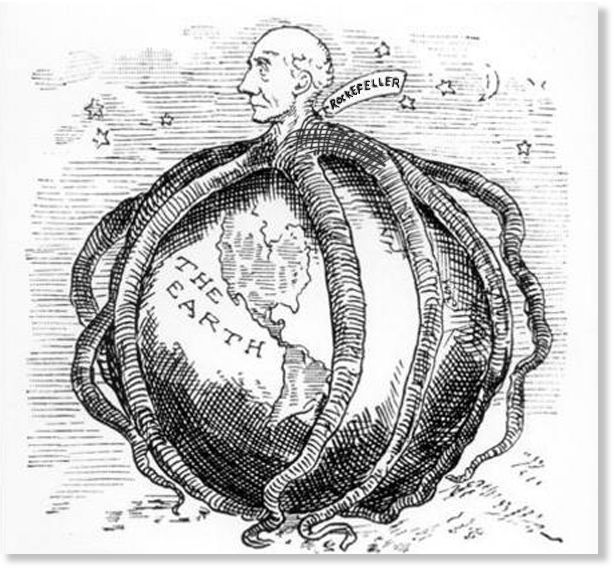
In the current age, with the Rockefeller name now more likely to be associated with Rockefeller Plaza or Rockefeller University than Standard Oil, it is difficult to understand just how hated John D. was in his own day. He was the head of the Standard Oil Hydra an octopus strangling the world in his tentacles, a cutthroat gardener pruning the competitors from the flower of his oil monopoly. As one of the richest men the world had ever known, he was an easy target for the average working man’s frustrations and a magnet for the poor seeking help.

Judith Sealander, Historian: He received on average 50 to 60,000 letters a month, asking for help. Dozens of people followed him in the street. Literally, crowds stood around the Standard Oil offices waiting for him to come out. Little children, painfully thin, crying in the street and so on. Rockefeller felt overwhelmed.
Besieged by the downtrodden, despised by the working man, hounded by Ida Tarbell and the muckraking press, John D. had the mother of all PR problems. The answer was simple: invent the PR industry. He hired Ivy Ledbetter Lee, a journalist-turned-communications expert who invented the modern public relations industry to burnish the Rockefellers’ tarnished image. It was Lee that suggested giving the family name to Rockefeller Center and filming John D. handing out dimes in public.
Narrator: An early master of public relations, Lee used the media which the muckrakers had used to disgrace Rockefeller to turn him into a sympathetic figure. Ivy Lee recognized early the power of the new moving picture and used newsreels to show a remarkably benevolent Rockefeller.
John D. Rockefeller: I am very grateful to you and to a host of people who are so kind and good to me all the time.
Second Man: Why, because you’re so good to everybody.
John D. Rockefeller: Yes, you are.
As Ivy Lee began to control his public image he became oddly a kind of American character, and people kind of warmed to him in a bizarre sort of way. It was like having Frankenstein on the loose walking around New York City or something like that, with a cane and a long hat.
Narrator: Although this plane never takes off, this photo opportunity was presented as Senior’s first flight. Perhaps Ivy Lee’s most brilliant public relations move was the casting of Rockefeller as ‘The Man Who Gave out Dimes.’
Man off camera: Don’t you give dimes, Mr. Rockefeller? Please, go ahead.
Woman: Thank you, sir.
Man: Thank you very much.
John D. Rockefeller: Thank you for the ride!
Man: I consider myself more than amply paid.
John D. Rockefeller: Bless you! Bless you! Bless you!
SOURCE: John D. Rockefeller – Standard Oil
These PR stunts seem obvious and ham-handed by today’s standards, but they were effective enough: to this day people leave dimes on the stone marker at the base of the 70 foot Egyptian obelisk that towers over John D.’s final resting place in Cleveland’s Lake View Cemetery. But it was not stage-managed photo opportunities like these that transformed Rockefeller into a public hero.
In order to win the public over, he was going to have to give them what they wanted. And what they wanted wasn’t difficult to understand: money. But just as his father, Devil Bill, had taught him to do in all his business dealings, Rockefeller made sure to get the better end of the bargain. He would “donate” his great wealth to the creation of public institutions, but those institutions would be used to bend society to his will.
As every would-be ruler throughout history has realized, society has to be transformed from the ground up. Americans in the 19th century still prized education and intellectual pursuits, with the 1840 census finding unsurprisingly that the United States–a nation that had been mobilized by tracts like Thomas Paine’s remarkably popular Common Sense–was a nation of readers, with a remarkable 93% to 100% literacy rate. Before the first compulsory schooling laws in Massachusetts in 1852, education was private and decentralized, and as a result classical education, including study of Greek and Latin and a solid grounding in history and science, was widespread.
But a nation of individuals who could think for themselves was anathema to the monopolists. The oiligarchs needed a mass of obedient workers, an entire class of people whose intellect was developed just enough to prepare them for lives of drudgery in a factory. Into the midst stepped John D. Rockefeller with his first great act of public charity: the establishment of the University of Chicago.
He was aided in this task by Frederick Taylor Gates, a Baptist minister that Rockefeller befriended in 1889 and who would go on to be John D.’s most trusted philanthropic adviser. Gates would go on to write a short tract, “The Country School of Tomorrow,” that laid out the Rockefeller plan for education:
“In our dream, we have limitless resources, and the people yield themselves with perfect docility to our molding hand. The present educational conventions fade from our minds; and, unhampered by tradition, we work our own good will upon a grateful and responsive folk. We shall not try to make these people or any of their children into philosophers or men of learning or science. We are not to raise up from among them authors, orators, poets, or men of letters. We shall not search for embryo great artists, painters, musicians. Nor will we cherish even the humbler ambition to raise up from among them lawyers, doctors, preachers, politicians, statesmen, of whom we now have ample supply.”
Although Rockefeller’s resources weren’t exactly limitless, they might as well have been. In 1902 he established the General Education Board to help implement Gates’ vision for the country school of tomorrow with a staggering $180 million endowment.
The Rockefeller influence on education was felt almost immediately, and it was amplified by help from fellow monopolists of the era who were approaching the topic of philanthropy from the same angle.
Although best known as a steel magnate, Andrew Carnegie’s fortune started on the railroads transporting Rockefeller’s Standard Oil around the country, and was greatly magnified by a lucrative investment in property near Oil Creek that provided steady, profitable oil sales. In 1905 he established the Carnegie Foundation for the Advancement of Teaching, a tax-free foundation through which Carnegie and his appointees could direct the development of the education system in the the United States, and, eventually, worldwide. In 1910, Rockefeller followed suit by establishing the Rockefeller Foundation, which became the tax-free umbrella organization for his philanthropic ambitions.
As the Reece Committee–a Congressional investigation into the activities of these tax-free foundations in the 1950s–discovered, it wasn’t long before Carnegie’s Endowment approached Rockefeller’s Foundation with a proposal: to cooperate on their shared desire to transform the American education system in their own image. Norman Dodd, the director of research for the Congressional committee who was granted access to the Carnegie Endowment’s board minutes, explains:
So they approach the Rockefeller Foundation with a suggestion: that portion of education which could be considered domestic should be handled by the Rockefeller Foundation, and that portion which is international should be handled by the Endowment.
They then decide that the key to the success of these two operations lay in the alteration of the teaching of American History. So, they approach four of the then most prominent teachers of American History in the country — people like Charles and Mary Byrd. Their suggestion to them is this, “Will they alter the manner in which they present their subject”” And, they get turned down, flatly.
So, they then decide that it is necessary for them to do as they say, i.e. “build our own stable of historians.” Then, they approach the Guggenheim Foundation, which specializes in fellowships, and say” “When we find young men in the process of studying for doctorates in the field of American History, and we feel that they are the right caliber, will you grant them fellowships on our say so? And the answer is, “Yes.”
So, under that condition, eventually they assemble twenty (20), and they take these twenty potential teachers of American History to London. There, they are briefed in what is expected of them — when, as, and if they secure appointments in keeping with the doctorates they will have earned.
That group of twenty historians ultimately becomes the nucleus of the American Historical Association. And then, toward the end of the 1920’s, the Endowment grants to the American Historical Association four hundred thousand dollars ($400,000) for a study of our history in a manner which points to what this country look forward to, in the future.
That culminates in a seven-volume study, the last volume of which is, of course, in essence, a summary of the contents of the other six. The essence of the last volume is this: the future of this country belongs to collectivism, administered with characteristic American efficiency.
SOURCE: Norman Dodd interview
With this base for transformation firmly established, the Rockefeller Foundation and like-minded organization embarked on a program so ambitious that it almost defies comprehension.
They transformed the practice of medicine.
As usual, the oiligarchs that funded this change were also there to profit from it, and once again John D. took his queue from “Devil” Bill’s example. William Rockefeller had called his brand of snake oil “Nujol,” for “new oil,” and Standard Oil spun off “Nujol” as a laxative under their Stanco subsidiary. Manufactured on the same premises as “Flit,” an insecticide also derived from Standard Oil’s byproducts, “Nujol” sold at the druggist for 28 cents per six ounce bottle; it cost Standard Oil less than one-fifth of a cent to manufacture. Pharmaceuticals provided a lucrative new opportunity for the oiligarchs, but in a turn-of-the-century America that was still largely based on naturopathic, herbal remedies, it was a tough sell. The oiligarchy went to work changing that.
In 1901 John D. established the Rockefeller Institute for Medical Research. The Institute recruited Simon Flexner, a pathology professor at the University of Pennsylvania, to serve as its director. His brother, Abraham, was an educator who was contracted by the Carnegie Foundation to write a report on the state of the American medical education system. His study, The Flexner Report, along with the hundreds of millions of dollars that the Rockefeller and Carnegie Foundations were to shower on medical research in the coming years, resulted in a sweeping overhaul of the American medical system. Naturopathic and homeopathic medicine, medical care focused on un-patentable, uncontrollable natural remedies and cures was now dismissed as quackery; only drug-based allopathic medicine requiring expensive medical procedures and lengthy hospital stays was to be taken seriously.
Narrator: The fortunes of Carnegie, Morgan and Rockefeller financed surgery, radiation and synthetic drugs. They were to become the economic foundations of the new medical economy.
Edward Griffin: The takeover of the medical industry was accomplished by the takeover of the medical schools. Well, the people that we’re talking about, Rockefeller and Carnegie in particular, came to the picture and said, ‘We will put up money.’ They offered tremendous amounts of money to the schools that would agree to cooperate with them. The donors said to the schools: ‘We’re giving you all this money, now would it be too much to ask if we could put some of our people on your Board of Directors to see that our money is being spent wisely?’ Almost overnight all of the major universities received large grants from these sources and also accepted one, two or three of these people that I mentioned on their Board of Directors and the schools literally were taken over by the financial interests that put up the money.
Now what happened as a result of that is the schools did receive an infusion of money, they were able to build new buildings, they were able to add expensive equipment to their laboratories, they were able to hire top-notch teachers, but at the same time as doing that they eschewed the whole thing in the direction of pharmaceutical drugs. That was the efficiency in philanthropy.
The doctors from that point forward in history would be taught pharmaceutical drugs. All of the great teaching institutions in America were captured by the pharmaceutical interests in this fashion, and it’s amazing how little money it really took to do it.
SOURCE: The Money Takeover Of Medicine
The oiligarchy birthed entire medical industries from their own research centers and then sold their own products from their own petrochemical companies as the “cure.” It was Frank Howard, a Standard Oil of New Jersey executive, who would go on to persuade Alfred Sloan and Charles Kettering to donate their fortunes to the cancer center that would then bear their name. As director of research at Sloan-Kettering, Howard appointed Cornelius Rhoads, a Rockefeller Institute pathologist, to develop his wartime research on mustard gas for the US Army into a new cancer therapy. Under Rhoads’ leadership, nearly the entire program and staff of the Chemical Warfare Service were reformed into the SKI drug development program, where they worked on converting mustard gas into chemotherapy. And once again, the Rockefeller’s own snake oil was being sold as a cancer cure-all.
The oiligarchs’ interest in the burgeoning pharmaceutical industry converged in companies like I.G. Farben, a drug and chemical cartel formed in Germany in the early 20th century. Royal Dutch’s Prince Bernhard served on an I.G. Farben subsidiary’s board in the 1930s and the cartel’s American operation, set up in cooperation with Standard Oil, included on its board Standard Oil president Walter Teagle as well as Paul Warburg of Kuhn, Loeb & Co., itself headed by Jacob Schiff of the Rothschild broker family. At its height, I.G. Farben was the largest chemical company in the world and the fourth largest industrial concern in the world, right behind Standard Oil of New Jersey.
The company was broken up after World War II, but like Standard Oil, its various pieces remained intact and today BASF, one of its chemical offshoots, remains the largest chemical company in the world, while Bayer and Sanofi, two of its pharmaceutical offshoots are among the largest in the world.
Not content merely to monopolize the fields of education and medicine, the same oiligarchical interests banded together to take control of America’s finances. In 1910 John D. Rockefeller Jr.’s own father-in-law, Senator Nelson Aldrich, Frank Vanderlip of the National City Bank, and Paul Warburg, as well as various agents of J.P. Morgan, met in complete secrecy on Jekyll Island to hammer out the details of what would go on to become the Federal Reserve, America’s central bank. The Fed, established in 1913, would be run by hand-picked appointees of the oiligarchy and their banking associates, including, perhaps inevitably, Standard Oil president and American I.G. director Walter Teagle.
The Rockefeller family would go on to formally enter the banking field in the 1950s when James Stillman Rockefeller, the grandson of John D.’s brother, was appointed director of National City Bank. Meanwhile John D.’s own grandson, David Rockefeller, would go on to take over Chase Manhattan Bank, the long-time banking partner of the Standard Oil empire.
In this move the Rockefellers’ story perfectly mirrored that of their fellow oiligarchs the Rothschilds. Whereas the Rothschilds had supplemented their banking fortune with their oil interests, the Rockefellers supplemented their oil fortune with banking interests.
Spring boarding from success to success as they consolidated monopolies across every field of human activity, the oiligarchs’ ambitions became even larger. This time, their goal was to consolidate control over the very food supply of the world itself, and once again they would use philanthropy as the cover for their business takeover.
Narrator: The Green Revolution began in 1943 when plant geneticist Norman Borlaug and a team of researchers arrived on Mexican soil. His goal was to improve agricultural techniques and biotechnological methodologies which in turn would help alleviate starvation and improve the living quality of developing nations. Creating new genetically modified strains of wheat, rich, maize and other crops, Borlaug planned to win the battle against world hunger. The hope was that these new crops and farming techniques would rescue third world countries from the brink of starvation.
That’s exactly what happened. The agricultural innovations brought to the poverty-stricken countries gave the farmers the skills and resources necessary to sustain themselves. This triggered a chain of events that would allow these once-struggling nations to survive. Agricultural exports soared in quantity and diversity and allowed the countries to become self-sufficient.
As the genetically modified crops thrived, farmers were able to use their increased income to purchase newer and superior farming machinery. This increase in revenue made farming easier, more reliable and more efficient. The Green Revolution led to the modernization of agriculture and has had a profound social, economic and political impact on the world.
The Mexican government turned to the Rockefeller Foundation in their endeavor to nourish Mexico through agriculture.
SOURCE: Green Revolution Waging War Against Hunger
Norman Borlaug, needless to say, was a researcher for the Rockefeller Foundation, and the Green Revolution, for whatever increase in yields it brought about, also created markets for the oiligarchs’ own interest in the petrochemical fertilizer industry and gave rise Archer Daniels Midland, Bunge, Cargill and Louis Dreyfus. These companies, along with their associated interests in the food packaging and processing industry, formed the core of American “agribusiness,” a concept developed at Harvard Business School in the 1950s with the help of research conducted by Wassily Leontief for the Rockefeller Foundation.
The American agribusiness giants shared a common goal: the transformation of third world agriculture into a captive market for their goods. From this perspective, the project was a runaway success. By the 1970s the Rockefeller Standard Oil network and its cronies in the nitrogen fertilizer industry (including DuPont, Dow Chemical, and Hercules Powder) had broken into markets around the world, markets conveniently forced open for them by the US government itself under President Johnson’s “Food for Peace” program, which mandated the use of petrochemical-dependent agricultural technologies (fertilizers, tractors, irrigation, etc.) by aid recipients.
Unable to afford these new technologies themselves, the impoverished third-world “beneficiaries” of this “revolution” relied on loans from the International Monetary Fund and the World Bank handled by Rockefeller’s own Chase Manhattan Bank and guaranteed by the US government.
The real costs of the Green Revolution, economic, agricultural and environmental are seldom tallied. Access to these debt-financed petrochemical-dependent technologies exacerbated the difference between the rich landowning class and the landless peasants in countries like India, where land reform and abolition of usury were dropped from the political agenda after the Green Revolution took over.
Even then, the revolution’s main success, its increase in agricultural yields, has been oversold. Yield growth across India actually slowed after the introduction of agribusiness. The environmental destruction is even more devastating. An overview in the December 2000 edition of Current Science notes: “The green revolution has not only increased productivity, but it has also [produced] several negative ecological consequences such as depletion of lands, decline in soil fertility, soil salinization, soil erosion, deterioration of environment, health hazards, poor sustainability of agricultural lands and degradation of biodiversity. Indiscriminate use of pesticides, irrigation and imbalanced fertilization has threatened sustainability.”
The Rockefeller Foundation even acknowledges the critiques of the Green Revolution it funded into existence, insisting that “current initiatives take into account lessons learned.” Even so, the Foundation continues to fund research and write on how to improve prospects for agribusiness investment in its target markets.
As egregious as the Green Revolution was and continues to be, however, in many ways it was just the prelude to an even more ambitious project: the Gene Revolution. Now the project is not merely to monopolize the technologies, supplies and chemical inputs for agriculture worldwide, but to monopolize the food supply itself through the replacement of the world’s natural seeds with patentable genetically modified crops.
The players involved in this “Gene Revolution” are almost identical to the players in the Green Revolution, with I.G. Farben offshoots Bayer CropScience and BASF Plant Science mingling with traditional oiligarch associate companies like Dow AgroScience, DuPont Biotechnology, and, of course, Monsanto, all funded by the Rockefeller Foundation and fellow “philanthropists” at the Ford Foundation, the Bill & Melinda Gates Foundation and like-minded organizations.
The convergence of corporate, “philanthropic,” governmental and inter-governmental interests in promoting GM crops around the world can be seen in the bewildering array of research institutes, industry associations, and “consultative groups” devoted to the case. The Rockefeller funded International Rice Research Institute (IRRI), the Rockefeller/Monsanto/USAID brainchild International Service for the Acquisition of Agri-biotech Applications (ISAAA), the Rockefeller/Ford/World Bank created Consultative Group of International Agricultural Research (CGIAR) and dozens of other bland, benign-sounding organizations research and promote GM crops in target markets around the globe, with the profits ending up in the oiligarchs’ coffers.
A representative example of this story is the agribusiness neocolonization of Argentina, where Monsanto ran an elaborate “bait-and-switch” to get the country hooked on its genetically modified Roundup Ready soybeans before demanding royalties on the crops that were by then already growing. DuPont then took over, magnanimously beginning a “Protein for Life” programme to foist their own GM soybeans on the country’s poor.
The same scene has played itself out in country after country, where cartel-developed GM crops are foisted on emerging economies through “food aid,” usually during times of famine when those countries are especially vulnerable. Only a handful of countries like Zambia or Angola have outright rejected this GMO takeover of their food supply, generously subsidized by the US government to the benefit of the agribusiness cartel.
Conclusion: Monopolizing Life
From cutthroat pioneers of the early oil industry to Machiavellian social engineers and geopolitics schemers, the oiligarchs have come a long way since the days of Devil Bill’s snake oil cure-alls. But his use of every form of deception and trickery to swindle the public informed how John D. and the rest of the oiligarchs built up their business interests.
As the 20th century drew to a close, it was obvious that for the powerful cartel that built the oil industry–the Rockefellers, the Rothschilds, the British and Dutch royal families–it was no longer about oil, if it ever really was. The takeover of education, of medicine, of the monetary system, of the food supply itself, showed that the aim was much greater than a mere oil monopoly: it was the quest to monopolize all aspects of life. To erect the perfect system of control over every aspect of society, every sector from which any threat of competition to their power could emerge.
They had been remarkably, almost unbelievably, successful. From oil well to gas pump, farm to fork, hospital to pharmaceutical, drill rig to dollar bill, there was almost no aspect of society that was not under control.
But the oiligarchs are not done yet. Their next project, launched in the late 20th century, is almost too ambitious to be comprehended. It is not about oil. It is not about money. It is about the monopolization of life itself. They have spent decades preparing the path for this takeover and marshaled their mind-boggling resources in service of the task.
And the vast majority of the world’s population, still playing the shell game that the oiligarchs perfected and abandoned long ago, are about to fall right into their hands yet again.
Prince Charles: “Ladies and gentlemen, the battle against climate change is surely the most defining and pivotal challenge of our time. Even in a world full of daunting perils and crises, it is hard to imagine anything that poses a greater challenge and opportunity for humanity.” Source: Rise Of The Oil-igarchy | Beyond The Corral
The fossil fuel industry has never been a part of the solution to the climate crisis, and new documents uncovered by a congressional investigation spanning the last two years make that abundantly clear. On the contrary, Big Oil is actively fighting to maintain fossil fuels for decades to come. The United States Senate Committee on the Budget recently held a hearing on Denial, Disinformation, and Doublespeak: Big Oil’s Evolving Efforts to Avoid Accountability for Climate Change.
Ahead of the hearing, the committee published a joint bicameral congressional staff report detailing the depth of the fossil fuel industry’s deception and campaigns to block climate action. Not only has the fossil fuel industry known about the causal relationship of greenhouse gases and climate change since at least 1959, but the industry has also fought to block the transition from fossil fuels to renewable energy the whole time. For more than 60 years, the industry has chosen profit and shareholder value over people’s lives.
It is time for Big Oil accountability, and this joint investigation by the Senate Budget Committee and House Oversight Committee is just the beginning. Budget Committee Chairman Sheldon Whitehouse of Rhode Island said, “That’s what this hearing is about, because what is protecting the massive fossil fuel subsidies and what is preventing policies to reduce the danger is the same thing: the fossil fuel industry itself.”
Big Oil knew
In 1959, nuclear scientist Edward Teller explained to a symposium hosted by the American Petroleum Institute that carbon dioxide emissions from burning oil would melt ice caps and raise sea levels. The fossil fuel industry later engaged in climate science research themselves, and in 1979, Exxon admitted that, “[t]he present trend of fossil fuel consumption will cause dramatic environmental effects before the year 2050.” In the ensuing years, Exxon, its peers, and a collection of industry-funded front groups have waged marketing and lobbying campaigns to convince lawmakers and the public that the science behind climate change is not certain.
Fossil fuel industry doublespeak
Multiple companies, including BP, Exxon, Chevron, and ConocoPhillips, have been actively deceiving the public about their commitment to achieving the goals of the Paris Agreement and net zero emissions by 2050. Internal documents produced to the House Oversight Committee reveal that BP went so far as to say that, “No one is committed to anything other than to stay in the game,” the game being the development and production of the fossil fuels that they know are devastating communities and the climate. Earlier this year, BP announced that it would increase oil and gas production from 2024 through 2027.
Methane gas deception
There is a widespread narrative by the fossil fuel industry that so-called “natural gas,” or methane gas, is a clean energy source that will be a transition fuel as the world transitions to renewable energy. However, methane gas is 84 times more potent than carbon dioxide, and it leaks throughout the supply chain. Despite publicly marketing gas as clean, BP internal documents revealed in the investigation that the company was certain in 2016 that, “Gas doesn’t support climate goals when you take methane emissions into account.”
At the same time, BP was building plans to “advance and protect the role of gas—and BP—in the energy transition.” This investigation makes clear that the fossil fuel industry has no intention for gas to be a “bridge fuel.” The industry is working to position gas as a necessary counterpart to renewable energy, not a bridge fuel. Internal documents reveal that BP was prepared to spend $1.1 million in the first year of a campaign “highlighting [the] role of gas as a friend to renewables” that was being prepared in March of 2018.
The fossil fuel industry’s work to paint methane gas as a “friend to renewables” is not without consequence. Senator Ben Ray Luján shared about the consequences of methane emissions for his constituents in New Mexico, explaining that satellite imagery revealed a methane plume over New Mexico because of emissions from oil and gas operations in the Permian Basin. The Senator shared that despite public commitments from fossil fuel companies to reduce methane emissions, methane plumes in the state continue to worsen resulting in poor air quality and sickness.
Peddling false solutions
In 2008, BP, Exxon and Shell announced plans to research and develop algae as a biofuel. Although untested at the time, the announcements signaled that fossil fuel majors were finally committing to the exploration of low-carbon fuel alternatives. Over a decade later, these plans have proven to be greenwashing schemes to portray a commitment to decrease greenhouse gas emissions. As the report states, “As of 2023, all companies ended their algae biofuels programs.”
The report examines Exxon’s algae program in particular. Exxon spent nearly $175 million advertising their research on algae while they spent only $350 million on the development of the algae technology that they were advertising. Internal communications from Exxon reveal that employees were cautioned against including any marketing that could suggest that algae biofuels were near scalability. One Exxon document entitled “Algae Biofuels Program Talking Points” openly admits that investment in the algae program lagged far behind where it would need to be to achieve market deployment, “ExxonMobil’s analysis has concluded that final development and broad deployment of algae-based biofuels by the company would require future investments of billions of dollars.”
Dark money in academic institutions
According to the report, “Six fossil fuel companies, including BP, Chevron, Exxon, and Shell, spent an estimated $700 million on academic research programs between 2010 and 2020.” Institutions that received funding from the fossil fuel industry tended to publish research that was more favorable to methane gas than to renewable energy. These companies have spent millions of dollars influencing some of the nation’s leading academic institutions, including Harvard Kennedy School, Princeton University, Tufts University, the Massachusetts Institute of Technology, and the University of California, Berkeley. These are just a few of the 80-plus academic institutions that have received funding from the fossil fuel industry in recent years. Internal communications from Shell revealed their plans to “‘embed’ Shell scientists” at the University of California, Berkeley, where Shell spent over $25 million over five years to fund the university’s Biosciences Institute.
It’s time for accountability
We’ve known for years now that the fossil fuel industry is responsible for blocking climate action and campaigning to cast doubt on climate science—the very same climate science that their own scientists have confirmed is accurate. This hearing uncovered even more findings that document their deceptions in the public record, but to what end? Sharon Eubanks, former director of the tobacco litigation team in the U.S. Department of Justice, said in her testimony to the Senate Budget Committee that, “Big Oil is, frankly, the new Big Tobacco.”
Senator Bernie Sanders asked Eubanks to weigh in on what legal grounds there are to hold the fossil fuel industry accountable for knowingly deceiving the public about the climate catastrophe that fossil fuels would cause. In response, Eubanks said that provisions of the federal RICO statute (the Racketeer Influenced and Corrupt Organizations Act) could be used and that, “conspiracy is a good claim to look at.”
Senator Sanders followed up, asking, “If you were attorney general of the United States, would you proceed in that direction?”
Eubanks responded, “I would. Yes. No question.”
Big Oil lied for decades, and they are still actively leading deception campaigns and working to block the transition to renewable energy. They are infiltrating our economic institutions, lying to lawmakers and the public, and even pressuring journalists to kill stories that demonstrate the truth about fossil fuels and methane gas.
It is past time for Big Oil to answer for its role in perpetuating a fossil fuel economy which is destroying communities, ecosystems, and our climate. Source: Unveiling Big Oil's Campaign of Lies
Aircraft that use high bypass turbofan engines (most commercial passenger airplanes) don't use fuel to keep those engines running.
Come to find out, we've all been taken advantage of once again. A large percentage of your airline ticket is supposedly based on the large amount of fuel used during the flight. If only a small amount of fuel is used to start the engine, and then the engine runs on its' own during the whole flight, what are you being charged for? the cheap peanuts? The airplanes themselves have been paid for a hundred times over by now, so where is all that money going? Research: "high bypass turbofan engines".
The only fuel being used during an airplane flight is the diesel or gasoline that runs the on-board generator which creates electricity to run the electrical systems. The massive amounts of fuel we are told is pumped into these aircraft is a lie. The wings are empty. They don't hold fuel.
This concept is astonishing and infuriating, simultaneously. it's just another lie among the many we are sold throughout our lifetimes. Research everything... because most of what you think is "truth" is not. It never has been and never will be, no matter how tightly you cling to it.
If the theory holds that the aircraft is impelling itself through the aether (which is more than just the "air"), then, in reality, there is no thrust. the whole concept of propulsion goes right out the proverbial window. It may cause one to consider the strange craft (tic tacs, "ufos", etc.) that can turn on a dime and head in entirely different directions as utilizing "impelsion" ("impulsion"?) via the aether as a means of controlling movement and accelerating and decelerating. It means we have no need for engines that push, when we can create engines that pull us through the air.
The shift: from turbojets → turbofans
Early jetliners (1950s–60s) used turbojets:
- All air goes through the hot core
- High exhaust speed → high thrust
But:
- Extremely fuel-hungry
- Very loud
Examples: Boeing 707, De Havilland Comet
The key breakthrough: bypass ratio
High-bypass turbofans changed the physics:
- A large fan moves huge volumes of air around the core
- Only a small portion is burned in the core
This dramatically improves propulsive efficiency
Why (in plain physics terms):
Thrust = mass flow × velocity change
- Turbojet: small mass × very high speed
- High-bypass: large mass × lower speed
Moving more air slower is far more efficient
Fuel economics forced the switch
After the 1973 oil crisis:
- Fuel prices surged
- Airlines were suddenly exposed to massive cost swings
High-bypass engines delivered:
- 20–40% lower fuel burn (depending on generation)
- Immediate operating cost advantage
From that point forward, fuel efficiency became non-negotiable
Noise regulations locked it in
Airports and governments imposed strict noise limits in the 1970s–1990s.
High-bypass engines:
- Produce lower exhaust velocity
- Much quieter than turbojets
Without them, many aircraft would be:
- Restricted
- Or banned from major airports
Airline business model alignment
Modern airline economics reward:
- Low cost per seat mile
- High passenger density
High-bypass engines enable:
- Lower fuel burn per passenger
- Longer range with the same aircraft
- Better margins on thin-ticket airlines (like Spirit)
Engineering maturity & scaling
Over decades, manufacturers (like General Electric, Rolls-Royce, Pratt & Whitney) improved:
- Fan blade materials (composites, titanium)
- Aerodynamics
- Core efficiency
This allowed:
- Larger fans
- Higher bypass ratios (now ~10:1+ on modern engines)
Modern endpoint: geared turbofan
Latest evolution: geared turbofan (GTF)
Example: Pratt & Whitney PW1000G
Gearbox lets:
- Fan spin slower (efficient)
- Core spin faster (optimal combustion)
Even better fuel savings (~15–20% vs prior gen)
Bottom line (why they dominate)
High-bypass turbofans became universal because they simultaneously:
- Cut fuel costs (biggest expense)
- Meet noise regulations
- Improve range and payload economics
- Scale across aircraft sizes
There is no competing engine type today that matches this combination for commercial aviation.
Aerotoxic syndrome
Aerotoxic syndrome is a term used to describe the symptoms of exposure to contaminated air on commercial jets. The air is contaminated by oil fumes from synthetic engine oils and hydraulic fluids that leak into the aircraft breathing air supply.
Airline pilots may be exposed to toxic substances due to fume events, when engine oils, hydraulic fluids, or other toxic chemicals leak into the aircraft's air supply, contaminating the cabin and cockpit. Some of the toxic contaminants include:
Tricresyl phosphate (TCP). A substance used in synthetic jet oils for its flame-retardant and anti-corrosion properties. Even in low doses, repeated exposure may cause lasting harm. 235
Volatile organic compounds (VOCs). Such as aldehydes and solvents. 3
Ultra-fine particles (UFPs). 3
De-icing fluids. 3
Inhaling these substances can lead to both immediate and long-term neurological, cardiological, and respiratory health problems. Some of the symptoms include:
irritation to the eyes, nose, and throat;
headaches, light-headedness, and dizziness;
fatigue, weakness;
confusion and difficulties in concentration.
The aviation industry disputes claims that toxic cabin air can cause serious illness or death, maintaining that fume events are rare and that existing research is inconclusive.
What is Aerotoxic Syndrome (AS)?
In 1999, after a decade of research, an American doctor alongside French and Australian scientists identified and named Aerotoxic Syndrome as acute and chronic ill-health (both for aircrew and passengers) caused from exposure to contaminated unfiltered ‘bleed air’, of which is present in most jet aircraft.
The Boeing 787 with ‘non-bleed architecture’ was proposed also in 1999.
But because the cause of Aerotoxic Syndrome is by commercial aircraft, it appears that governments are protecting the aviation industry rather than the public.
The first responsibility of a government in a democratic society is to protect and safeguard the lives of its citizens. That is where the public interest lies.
The BBC (British Broadcasting Corporation) is paid for by the public and thus is a public service broadcaster. It is supposedly allowing freedom to openly debate all H&S issues (especially inconvenient issues) with balanced arguments even for minority groups and to be tolerant of all beliefs and reasonable arguments.
Timeline:
On 1st February 2007: XLA Flight 120 from the U.K to the U.S had an unreported problem with the air conditioning which led to mass (60) passenger’s chronic ill-health.
On 18th June 2007: Captain John Hoyte founded the Aerotoxic Association at the Houses of Parliament, London to offer support to Aerotoxic victims and survivors.
On 24th June 2007: U.K journalist Chris Booker (founder of Private Eye in the ’60s) who was writing for the respected Daily Telegraph; described the cover-up of Aerotoxic Syndrome as “it is high time this particular cover-up was blown wide open”. Source
June 2007: The House of Lords in London published witness Statements from the U.K passengers of Flight XLA 120 & other professional sick aircrews:
MrsSamantha Sabatino and her family flew from London to Florida in February 2007. During the flight, some 40 passengers became ill, including herself and three members of her family. Upon arrival to Florida, she was hospitalised suffering from wheezing and crackles in her chest. No infection or viruses were found either in Florida or upon her return home. Her family were still experiencing ill health including violent nausea, tummy cramps, blisters on arms and hands, chest pain, severe headaches, vertigo, insomnia and loss of balance. She had complained to the carrier, XL Airways, who had denied that other passengers had complained of ill health. The Environmental Health Department has not investigated the issue. She received unsatisfactory replies from the Health Protection Agency, the CAA and the Air Transport Users Council. She complained of being swept aside and questioned the effectiveness of these organisations. Source
2007: The documentary ‘Welcome aboard Toxic Airlines’ featuring passengers from flight XLA 120 was given to all MP’s as well as Lords and Ladies in 2009.
21st April 2008: BBC Panorama shows a 30-minute hard-hitting documentary ‘Something in the air’ and covers the start of legal action for the U.K XLA passengers but no reference in the programme to Aerotoxic Syndrome, despite the BBC being asked to include the term.
Is this the beginning of the BBC cover-up?A
In 2009 Angus Stickler makes a programme about toxic air and includes Aerotoxic on the Today Radio 4 programme, but no further reporting since.
In 2013 Australia’s 60 minutes feature the passengers of XLA 120 and use the word Aerotoxic repeatedly.
***This passenger case is critical as it was comprehensively covered by parliament and the media in 2007/8 but when it went to Court in the U.S in 2012, the passengers got nothing and this was never reported by the media. A huge amount of evidence is available for this group passenger case from a single non-reported fume event on a flight, demonstrating the establishment cover-up, led by the BBC.***
February 2015: John Hoyte, Chairman of the Aerotoxic Association is called at short notice in a weekend to talk about toxic cabin air in connection with a serious legal inquest into the death of BA pilot Richard Westgate in 2012. He was filmed on the BBC on condition that: 1) He does not mention the airline he flew for (TNT & Flybe) or 2) ‘Does not to mention ‘Cover-up’). The under 3-minute live interview is done remotely from a BBC studio in Norwich to London.
2017: The formal position of the UK CAA is that there is ‘No positive evidence’ of long term/chronic human ill health, although acute/short term ill health is now accepted. Source.
What is a cover-up?
Merriam Webster dictionary defines cover-up as a) a device or stratagem for masking or concealing, b) a usually concerted effort to keep an illegal or unethical act or situation from being made public.
Who might be contributing to a BBC cover-up?
Vested interests such as airlines, governments, doctors, scientists, lawyers, aircraft manufacturers and most concerning, some media from the U.K.
Who might be interested in exposing a cover-up?
Anyone who has gotten sick from flying and if not managed correctly will be misdiagnosed and then mistreated, which will compound the illness and delay recovery.
The Aerotoxic Association is a U.K registered company who has struggled to survive and in its 12 years of existence has invested £250K in providing free support.
How are cover-up’s measured?
Aerotoxic Syndrome (AS) is still, 20 years after identification, not accepted by the mainstream establishment medicine because it would lead to costly penalties for many vulnerable industries.
AS is an inconvenient hidden illness with multiple symptoms which are treated individually, so only a handful of doctors and patients are aware of the inconvenient cause despite growing awareness over the past 12 years, since the article was written. The costs run into billions with over one million members of the European public (frequent flyers and aircrew) having Aerotoxic Syndrome. The majority of whom have no idea what the cause of their ill health is. The BBC exacerbating it further by not publishing news about AS and aerotoxic in general.
How has the BBC covered Aerotoxic since 2007?
The BBC rarely mentions Aerotoxic in their reports on toxic air exposures (3,640 results in this category) and this can be confirmed by searching for both Aerotoxic and BBC.
Since 2007, the Aerotoxic Association has sent many professionally written media releases to the BBC of new scientific findings, conferences, films and countless other pieces of evidence but it is now rare for the BBC to even reply. The situation has become ‘normalised’ and both the A word and the new materials are being left out of the reporting.
When was the BBC last approached with serious evidence?
Mike Powell was sent an email in August 2019 explaining that Aerotoxic would be exposed in the following few months but failed to respond.
In September 2019 the 13th Annual Cabin Air conference and new documentary film ‘Everybody Flies’ was held in London and the BBC attended to interview the public. The BBC was featured in the film but have yet to share their evidence with the public, which is causing increasing anger amongst the survivors as they feel like they are being ‘gagged’.
Ten years of silence from 2009 was followed by:
In 2019, former Cabin Crew Mike Powell made an excellent programme about a new word ‘Aerotoxicity’ (so the BBC didn’t have to use Aerotoxic) but the programme was aired on the World Service at 01:00 on New Year’s Day - a clear example of technically covering the issue, whilst ensuring as little U.K coverage as possible during an international holiday.
A further programme was aired on the BBC World Service at Easter 2019 in a further effort to avoid publicity, this more interesting and serious programme has since been removed by the BBC.
Tom Burridge, BBC Transport Correspondent has been reporting the issue since September 2019 but feels as though both journalists are being stopped by lawyers and others from full disclosure and full open debate.
As it is always helpful to engage with local BBC correspondents - Nikki Fox, BBC Norfolk’s Health Correspondent has been fully briefed on the issue using latest evidence but has never asked for a meeting nor shown any interest in covering the issue.
There must be a British Broadcast Corporation directive from 2007 covering Aerotoxic and the journalists are respecting their paymasters. All whilst the licence fee payers are left without the evidence to openly debate; this may not be in the public interest as the BBC are supposed to be public service broadcasters and thus should be transparent, balanced and fair to all.
The bind for the BBC is that they cannot cover their own cover-up.
Yet other media can and will do so in the public interest especially at the time of a general election, wherein the BBC has been already guilty of other far less serious deliberate errors.
What is the most recent example of the BBC cover-up of Aerotoxic?
On 21st October 2019, the BBC reported a ‘chemical spillage’ on a flight to the U.S which caused crew and passengers to be hospitalised. It was thought by many experts at the time to be another typical oil ‘fume event’.
Nearly a month later on 19th November 2019, the BBC reported in a hard-hitting ‘legal speak’ that the airline was lying, and it was another oil fume event.
Was Aerotoxic Syndrome mentioned in either BBC report? No.
Is the exposure of the Aerotoxic cover-up in the public interest?
As many members of the public fly, it is estimated that around 30% of the population may be severely affected - thus it is in the public interest to know a cause of ill health and the correct treatment to deal with the illness. It is time for an open free public debate to take place and for the cover-up to be exposed!
A 2017 Dutch research paper shows that 35,000 frequent flyers with AS are in the Netherlands alone, and an estimated 1 million frequent flyers and aircrew in Europe.
Why is Aerotoxic covered up in the UK?
Other major countries in recent years including the U.S, Australia, Germany, France, Switzerland, Australia, the Netherlands and now Italy, have covered Aerotoxic and Aerotoxic Syndrome. The Italian media outlet covered both AS and Aerotoxic in a very hard-hitting 15-minute programme.
This initial Italian programme will be followed by four further weekly Aerotoxic programmes.
Aerotoxic Syndrome has featured in the European media - so after 12 years in the U.K, it was decided that it was time for the Aerotoxic Association to move to Europe on the 25th September 2019 (Early Brexit) after the latest failure of the BBC to cover the issue or mention Aerotoxic.
Oil under the Romanovs (Russia was already a major producer)
Before 1917, the center of global oil production wasn’t the U.S.—it was Baku (modern Azerbaijan) under the Russian Empire.
Key operators:
- Branobel (Nobel family)
- Rothschild oil interests
By the early 1900s:
- Russia was producing ~50% of the world’s oil at its peak (around 1901)
- Baku was the Saudi Arabia of its day
So yes—under the Romanov dynasty, oil was already “flowing.”
The U.S. oil machine was already built BEFORE the Romanovs fell
Timeline:
- 1870 → Standard Oil founded by John D. Rockefeller
- 1890s → Standard Oil dominates global refining
- 1901 → Spindletop explodes U.S. production
- 1911 → Standard Oil is broken up by U.S. antitrust law
- 1917 → Romanovs fall in the Russian Revolution
So the U.S. didn’t “get oil” after the Romanovs—it already had:
- massive domestic reserves
- refining dominance
- global distribution networks
What ACTUALLY changed after the Romanovs fell
The real shift is this:
After 1917:
- Oil in Russia was nationalized by the Bolsheviks
- Foreign investors (Nobel, Rothschild) were pushed out
- Civil war and instability collapsed production
Result:
- Russia’s oil output fell sharply
- It temporarily dropped out of global dominance
Meanwhile, the U.S. scaled into global control
With Russia disrupted, the U.S. didn’t “inherit” oil—but it filled the vacuum.
Key factors:
- Stable private ownership vs. Soviet nationalization
- Rapid expansion in Texas, California, Oklahoma
- Growth of companies descended from Standard Oil (Exxon, Chevron, etc.)
- Increasing geopolitical reach (especially post-WWI)
By the 1920s:
The U.S. becomes the world’s leading oil producer and exporter
- Russian Empire collapses → production disruption
- Soviet system isolates its oil sector
- U.S. system (already built) expands globally
So instead of:
“Romanovs fall → U.S. gets oil”
The reality is:
“Russian collapse removed a major competitor → U.S. dominance accelerates”
Bottom line
- Russia under the Romanovs was a top oil power
- The U.S. oil empire (Standard Oil) was already fully established before 1917
- The Russian Revolution crippled Russia’s oil industry temporarily
- The U.S. didn’t take Russian oil—it outpaced a weakened rival
What’s driving it
Jet fuel is one of airlines’ biggest costs (often ~20% of expenses).
In 2026, fuel prices have spiked sharply—in some cases doubling due to geopolitical disruptions (especially around the Middle East and oil supply routes).
Some estimates show jet fuel hitting around $4+ per gallon in the U.S.
What airlines are doing about it
Cutting routes and flights
Airlines are canceling unprofitable routes and reducing frequency.
Example:
- Lufthansa cutting ~20,000 flights this year
- KLM canceling hundreds of flights
- Air Canada suspending certain routes entirely
- Industry-wide, carriers are shrinking capacity to control costs.
Translation: if a route doesn’t make money with expensive fuel, it gets cut.
Raising ticket prices
Airlines are passing costs directly to passengers:
- Some fares expected to rise 15–20%
- Budget airlines raising fares even more in some cases
They’re also adding:
- baggage fee hikes
- fuel surcharges
Fewer flights + higher costs = higher ticket prices.
Reducing supply (which pushes prices up further)
- When airlines cut flights, there are fewer seats available.
- That alone pushes fares higher—even before fuel costs are added.
Why this is happening now (big picture)
- Conflict near key oil routes (like the Strait of Hormuz) is disrupting supply.
- Fuel markets are tight globally.
- Airlines can’t absorb these costs without hurting profits.
What this means going forward
Expect:
- Higher airfare (especially summer travel)
- Fewer route options, especially smaller cities or less busy routes
- Less discount pricing
- Analysts expect this could last a while, not just a short spike.
Bottom line
Airlines run on fuel.
Fuel just got expensive fast.
So they:
- Cut flights that don’t pay
- Raise prices on the ones that do
Continuously subsidized for over a century
The oil industry has never operated in a pure market environment. Since the early 1900s, governments—especially in the U.S.—have used the tax code and policy tools to reduce exploration risk and encourage production.
Mechanisms include:
- Depletion allowances (treating resource extraction as a recoverable cost)
- Expensing of drilling costs (immediate write-offs instead of long-term depreciation)
- Preferential treatment compared to many other industries
Effect: lower effective costs, higher margins, and reduced downside risk built into the system over decades.
Backstopped during major disruptions
When markets break—price crashes, demand shocks, or credit freezes—government intervention tends to stabilize the sector.
This doesn’t always look like a direct bailout. It often comes through:
- Central bank liquidity support (keeping credit markets open)
- Strategic reserve releases or purchases (influencing supply and price stability)
- Temporary regulatory flexibility
Effect: firms that might otherwise fail are able to continue operating, preserving supply and preventing systemic disruption.
Supported through the tax code every year
Many of these advantages are not temporary—they are structural.
Examples:
- Immediate deduction of certain capital-intensive costs
- Accelerated depreciation schedules
- Royalty relief or favorable leasing terms on public land
Effect: the industry’s tax burden is systematically reduced relative to its capital intensity and volatility.
Shielded by broader policy (indirect support)
Beyond direct financial measures, governments absorb risks that would otherwise fall on the industry:
- Military protection of key shipping routes (e.g., global oil transit chokepoints)
- Diplomatic engagement to stabilize producing regions
- Infrastructure investment (ports, pipelines, transport networks)
These costs are external to company balance sheets but materially reduce operational risk.
Bottom line
This is not about a single bailout event. It is a policy framework where:
- Risk is partially transferred to the public sector
- Costs are lowered through tax and regulatory design
- Stability is maintained through intervention during crises
The result is an industry that operates with systemic support embedded at multiple levels, rather than one that rises or falls purely on market forces.
Major Oil Spill Disasters (Shipping / Tankers)
Exxon Valdez oil spill — March 24, 1989
- Location: Prince William Sound, Alaska
- Spill: ~11 million gallons
- Cause: Tanker ran aground
- Impact: Massive wildlife death; long-term ecosystem damage
- Legacy: Triggered major U.S. oil transport regulations
Amoco Cadiz oil spill — March 16, 1978
- Location: Brittany coast, France
- Spill: ~69 million gallons
- Cause: Steering failure → tanker wreck
- Impact: One of Europe’s worst coastal contamination events
Torrey Canyon oil spill — March 18, 1967
- Location: Cornwall, United Kingdom
- Spill: ~25–36 million gallons
- Impact: First “modern” supertanker disaster
- Response: Authorities bombed the ship—early example of chaotic response policy
Offshore Drilling Disasters
Deepwater Horizon oil spill — April 20, 2010
- Location: Gulf of Mexico
- Spill: ~134 million gallons (largest in U.S. history)
- Cause: Blowout on BP-operated rig
- Impact: 11 workers killed; widespread marine damage
- Key issue: Safety shortcuts + failed blowout preventer
Ixtoc I oil spill — June 3, 1979
- Location: Bay of Campeche, Mexico
- Spill: ~140 million gallons
- Cause: Offshore well blowout
- Impact: One of the largest accidental spills ever
Wartime / Intentional Oil Disasters
Gulf War oil spill — January 1991
- Location: Persian Gulf
- Spill: Estimated 240–380 million gallons
- Cause: Iraqi forces released oil during retreat
- Impact: Largest oil spill in history
- Additional: Kuwaiti oil wells set on fire
Pipeline & Inland Disasters
Kalamazoo River oil spill — July 25, 2010
- Location: Michigan
- Spill: ~1 million gallons (tar sands crude)
- Cause: Pipeline rupture (Enbridge)
- Impact: One of the costliest U.S. inland cleanups
Niger Delta oil spills — 1950s–present
- Location: Nigeria
- Spill: Thousands of incidents over decades
- Cause: Corrosion, sabotage, infrastructure neglect
- Impact: Chronic environmental devastation + human health issues
Pattern (What These Disasters Have in Common)
Mechanical failure is rarely “just mechanical”
- Steering failures, blowouts, pipeline ruptures → often tied to maintenance gaps or cost-cutting
Response is reactive, not preventive
- Exxon Valdez → new rules after disaster
- Deepwater Horizon → reforms after failure
Externalized costs
- Cleanup, ecosystem damage, health effects → largely absorbed by the public and environment, not fully by operators
Scale escalation over time
- Early tanker spills → tens of millions of gallons
- Offshore drilling → hundreds of millions potential
Bottom Line
Oil disasters aren’t rare accidents—they’re a repeat pattern:
high-risk extraction + complex transport + cost pressure
= failure that gets paid for after the damage is already done
What companies do pay (visible costs)
Deepwater Horizon oil spill
- BP paid $60+ billion in fines, cleanup, and settlements
- One of the largest corporate payouts in history
Exxon Valdez oil spill
- Exxon paid billions, but punitive damages were reduced on appeal
Reality: Companies are not getting away with zero—major disasters can be extremely expensive for them.
What the public pays (less visible, often larger over time)
- Environmental damage that isn’t fully priced
- Lost fisheries, tourism decline, ecosystem collapse
- Some damage lasts decades or is never fully restored
- Hard to quantify → often undercompensated
Government response and infrastructure
- Coast Guard, EPA, emergency response → taxpayer funded upfront
- Long-term monitoring and restoration → public budgets
Legal caps and negotiated settlements
- Liability limits (historically capped per barrel or per incident)
- Settlements often reflect what can be proven, not total harm
Health costs
- Cleanup workers and residents → long-term medical issues
- Many costs shift into public health systems or individuals
Economic ripple effects
- Small businesses fail (fishing, tourism)
- Property values drop
- Local economies absorb shocks long after headlines fade
Structural issue
The system works like this:
- Profit is privatized (company keeps revenue)
- Risk is partially socialized (public absorbs residual damage)
Even when companies pay large settlements, they rarely cover:
- full ecological restoration
- lifetime health costs
- long-term economic disruption
Bottom line
Companies pay the headline bill.
The public pays the long tail.
That “long tail” is where the real cost often lives.
Why oil disruptions ripple far beyond gasoline
Oil isn’t just fuel for cars—it underpins:
- Shipping (bunker fuel): container ships move ~80–90% of global trade
- Aviation (jet fuel): critical for high-value, time-sensitive goods (pharma, electronics)
- Chemicals & manufacturing: oil and gas are feedstocks for plastics, solvents, and drug synthesis
- Agriculture: diesel for machinery + natural gas (for fertilizer)
So when oil prices spike, costs propagate layer by layer through the system.
Pharmaceuticals (India & China dependency)
India (generic drugs)
- India supplies ~20% of global generics and a large share of U.S. prescriptions.
- But India imports a significant portion of APIs (active ingredients) from China.
Oil shock impact:
- Higher shipping + chemical input costs
- API shortages if transport slows
- Result: price increases + occasional shortages, especially for low-margin generics
China (APIs & intermediates)
- China dominates upstream chemical production
- Energy-intensive manufacturing → directly sensitive to oil/gas prices
Key risk: bottlenecks, not total collapse. Governments tend to prioritize medical exports.
Food system vulnerability
Global food trade
Oil affects food in three major ways:
- Transport: farm → port → global distribution
- Fertilizer: nitrogen fertilizers depend on natural gas (closely linked to energy markets)
- Mechanization: tractors, irrigation, harvesting
What happens in a shock:
- Food prices rise globally
- Import-dependent countries (North Africa, parts of Asia) feel it first
- Wealthier countries see inflation; poorer regions see food insecurity
0–30 days: prices move first
Fuel jumps first: gasoline, diesel, jet fuel. That immediately raises trucking, shipping, farm delivery, and air cargo costs. Crude oil is a major driver of gasoline prices, and transportation depends heavily on petroleum fuels.
First hit: airline tickets, shipping fees, fresh food, imported goods.
30–90 days: hidden supply chains start showing stress
This is where people miss the danger.
Generic meds: the U.S. relies heavily on generics, many imported from India, while India depends heavily on China for active pharmaceutical ingredients. CSIS reported that generics are over 90% of U.S. prescriptions by volume, with 47% imported from India, and India depends on China for almost two-thirds of APIs used for those medicines.
So the issue is not just “oil costs more.” It is:
oil → shipping → chemicals → APIs → generic pills → shortages/prices
3–6 months: food gets dangerous
Food prices rise through diesel, shipping, refrigeration, packaging, fertilizer, and farm inputs. Fertilizer is especially important because nitrogen fertilizer depends heavily on natural gas, and fertilizer prices can swing hard when energy markets move.
That means wheat, rice, corn, animal feed, meat, dairy, and processed foods can all rise.
6–12 months: poor countries get hit hardest
Rich countries get inflation. Poor countries get hunger.
A prolonged fuel/fertilizer disruption can cut crop yields and push food-insecure countries into crisis. Recent reporting on fuel and fertilizer disruption through the Strait of Hormuz warned of poverty and food-security effects from blocked cargo and fertilizer disruption.
Oil is not just gasoline.
Oil is the blood in the supply chain.
Cut it off, and the public first sees higher pump prices. Then groceries rise. Then medicine gets harder to source. Then fertilizer costs rise. Then harvests shrink. Then the poorest countries are told to “tighten their belts” while the system pretends this was unpredictable.
The real danger is not one high oil bill.
The danger is the chain reaction:
oil → transport → fertilizer → food → medicine → instability → starvation.
Aviation and “hidden inflation”
Jet fuel effect
Jet fuel spikes → airlines:
- Cut routes
- Raise fares and cargo rates
- Prioritize high-margin cargo
Downstream effect:
- Medical supplies, electronics, and perishable goods become more expensive or delayed
- “Invisible inflation” shows up in everyday items
Does this lead to starvation?
Short answer: not in developed economies—but risk rises globally if disruption is prolonged.
What determines severity:
- Duration: weeks vs. months vs. years
- Geographic scope: regional conflict vs. global supply shock
- Strategic reserves: countries like the U.S. can buffer temporarily
- Substitution: switching to other suppliers, fuels, or routes
Likely progression:
- Fuel prices spike
- Shipping + manufacturing costs rise
- Consumer prices increase (food, meds, goods)
- Lower-income countries face shortages first
- Humanitarian crises possible if disruption persists
Historical precedent
- 1970s oil shocks: inflation + recession, but not mass starvation in developed nations
- 2022 energy spike (Ukraine war): fertilizer + grain disruptions → price surges, especially in Africa and Middle East
The pattern is consistent:
→ price shocks first, scarcity later, crisis only if prolonged
It’s a cascade of cost increases and selective shortages, with the heaviest impact on:
- Low-income countries
- Energy-importing nations
- Supply chains already operating on thin margins (like generics)
References & Resources
- Daniel Yergin, The Prize: The Epic Quest for Oil, Money & Power (New York: Free Press, 1991).
- Antony C. Sutton, Wall Street and the Bolshevik Revolution (New Rochelle, NY: Arlington House, 1974).
- F. William Engdahl, A Century of War: Anglo-American Oil Politics and the New World Order (London: Pluto Press, 2004).
- F. William Engdahl, Myths, Lies and Oil Wars (Wiesbaden: Edition Engdahl, 2012).
- Alfred Nobel, Nobel Foundation Official History, accessed May 7, 2026. Nobel Prize Official Website
- Sven Olov Lindholm, The Nobel Family and Branobel Oil Company (Stockholm: Scandinavian Economic History Press, 1985).
- E. H. Carr, The Bolshevik Revolution 1917–1923, 3 vols. (London: Macmillan, 1950–1953).
- Stephen Kotkin, Stalin: Paradoxes of Power, 1878–1928 (New York: Penguin Press, 2014).
- Ida M. Tarbell, The History of the Standard Oil Company (New York: McClure, Phillips & Co., 1904).
- Ron Chernow, Titan: The Life of John D. Rockefeller, Sr. (New York: Random House, 1998).
- Matthew Josephson, The Robber Barons (New York: Harcourt, Brace and Company, 1934).
- John D. Rockefeller, Random Reminiscences of Men and Events (Garden City, NY: Doubleday, Page & Company, 1909).
- Allan Nevins, Study in Power: John D. Rockefeller, Industrialist and Philanthropist (New York: Charles Scribner’s Sons, 1953).
- Morris Bealle, The Drug Story (Washington, DC: Columbia Publishing Company, 1949).
- Eustace Mullins, Murder by Injection: The Story of the Medical Conspiracy Against America (Staunton, VA: National Council for Medical Research, 1988).
- G. Edward Griffin, World Without Cancer: The Story of Vitamin B17 (Thousand Oaks, CA: American Media, 1974).
- Abraham Flexner, Medical Education in the United States and Canada (New York: Carnegie Foundation for the Advancement of Teaching, 1910).
- Norman Dodd interview, in The Hidden Agenda: The War Against Christian Civilization, interview by G. Edward Griffin, 1980s.
- Ferdinand Lundberg, America’s 60 Families (New York: Vanguard Press, 1937).
- Carroll Quigley, Tragedy and Hope: A History of the World in Our Time (New York: Macmillan, 1966).
- Murray N. Rothbard, The Case Against the Fed (Auburn, AL: Ludwig von Mises Institute, 1994).
- Edwin Black, IBM and the Holocaust (New York: Crown Publishers, 2001).
- Joseph Borkin, The Crime and Punishment of I.G. Farben (New York: Free Press, 1978).
- Diarmuid Jeffreys, Hell’s Cartel: I.G. Farben and the Making of Hitler’s War Machine (New York: Metropolitan Books, 2008).
- William Cooper, Behold a Pale Horse (Flagstaff, AZ: Light Technology Publishing, 1991).
- Henry Kissinger, Years of Upheaval (Boston: Little, Brown and Company, 1982).
- Daniel Ammann, The King of Oil: The Secret Lives of Marc Rich (New York: St. Martin’s Press, 2009).
- Richard Heinberg, The Party’s Over: Oil, War and the Fate of Industrial Societies (Gabriola Island, BC: New Society Publishers, 2003).
- James Corbett, “Rise of the Oiligarchy,” The Corbett Report, accessed May 7, 2026. The Corbett Report
- “Denial, Disinformation, and Doublespeak: Big Oil’s Evolving Efforts to Avoid Accountability for Climate Change,” U.S. Senate Committee on the Budget, 2024. U.S. Senate Budget Committee Report
- Naomi Oreskes and Erik M. Conway, Merchants of Doubt (New York: Bloomsbury Press, 2010).
- Geoffrey Jones, The State and the Emergence of the British Oil Industry (London: Macmillan, 1981).
- Marshall Goldman, The Enigma of Soviet Petroleum (London: George Allen & Unwin, 1967).
- Vaclav Smil, Energy and Civilization: A History (Cambridge, MA: MIT Press, 2017).
- Timothy Mitchell, Carbon Democracy: Political Power in the Age of Oil (London: Verso, 2011).
- Peter Dale Scott, The Road to 9/11: Wealth, Empire, and the Future of America (Berkeley: University of California Press, 2007).
- Howard Zinn, A People’s History of the United States (New York: HarperCollins, 1980).
- William L. Shirer, The Rise and Fall of the Third Reich (New York: Simon & Schuster, 1960).
The USA
“Americans believe that the United States of America became a separate country following its War of Independence against the British in 1783.
However, what happened was the setting up of the USA as a corporation subject to British maritime law. If you don’t believe me then when you watch Obama speaking what do you think the gold border around your flag signifies?
So, if the US is just a corporation, not a country where’s the evidence? Should we look for the Queen signing off acts of Parliament which automatically apply to the USA -
legislation.gov.uk/uksi… - it isn’t the only one.
The one above was the Queen dictating social security legislation to the IRS. Still think you're independent.”
HERE ARE LAWS IN AMERICA MOST DON'T KNOW, BUT SHOULD
The IRS is not a US government agency it is an agency of the IMF (International Monetary Fund)
(Diversified Metal Products v I.R.S et al. CV-93-405E-EJE U.S.D.C.D.I., Public Law 94-564, Senate report 94-1148 pg. 5967, Reorganization Plan No. 26, Public Law 102-391)
The IMF (International Monetary Fund) is an agency of the U.N.
(Black's Law Dictionary 6th Ed. page 816)
The United States has NOT had a Treasury since 1921
(41 Stat. Ch 214 page 654)
The U.S. Treasury is now the IMF (International Monetary Fund)
(Presidential Documents Volume 24-No. 4 page 113, 22 U.S.C. 285-2887)
The United States does not have any employees because there is no longer a United States! No more reorganizations. After over 200 years of bankruptcy it is finally over.
(Executive Order 12803)
The FCC, CIA, FBI, NASA, and all of the other alphabet gangs were never part of the U.S. government. Even though the "U.S. Government" held stock in the agencies.
(U.S. v Strang, 254 US491 Lewis v. US, 680 F.2nd, 1239)
Social Security Numbers are issued by the U.N. through the IMF (International Monetary Fund). The application for a Social Security Number is the SS5 Form. The Department of the Treasury (IMF) issues the SS5 forms not the Social Security Administration. The new SS5 forms do not state who publishes them while the old form states they are Department of the Treasury.
(20 CFR (Council on Foreign Relations) Chap. 111 Subpart B. 422.103 (b))
There are NO Judicial courts in America and have not been since 1789. Judges do not enforce Statutes and Codes. Executive Administrators enforce Statutes and Codes.
(FRC v. GE 281 US 464 Keller v. PE 261 US 428, 1 Stat 138-178)
There have NOT been any judges in America since 1789. There have just been administrators.
(FRC v. GE 281 US 464 Keller v. PE 261 US 428 1 Stat. 138-178)
According to GATT (The General Agreement on Tariffs and Trade) you MUST have a Social Security number.
(House Report (103-826)
New York City is defined in Federal Regulations as the United Nations. Rudolph Guiliani stated on C-Span that "New York City is the capital of the World." For once, he told the truth.
(20 CFR (Council on Foreign Relations) Chap. 111, subpart B 44.103 (b) (2) (2) )
Social Security is not insurance or a contract. Nor is there a Trust Fund.
(Helvering v. Davis 301 US 619 Steward Co. v. Davis 301 US 548)
Your Social Security check comes directly from the IMF (International Monetary Fund), which is an agency of the United Nations.
(It says U.S. Department of Treasury at the top left corner, which again is part of the U.N. as pointed out above)
You own NO property, Slaves can't own property. Read carefully the Deed to the property you think is yours. you are listed as a TENANT.
(Senate Document 43, 73rd Congress 1st Session)
The Most powerful court in America is NOT the United States Supreme court, but the Supreme Court of Pennsylvania.
(42 PA. C.S.A. 502)
The King of England financially backed both sides of the American Revolutionary War.
(Treaty of Versailles-July 16, 1782 Treaty of Peace 8 Stat 80)
You CANNOT use the U.S. Constitution to defend yourself because you are NOT a party to it.
(Padelford Fay & Co. v The Mayor and Alderman of the City of Savannah 14 Georgia 438, 520)
America is a British Colony. The 'United States' is a corporation, not a land mass and it existed before the Revolutionary War and the British Troops did not leave until 1796
(Republica v. Sweers 1 Dallas 43, Treaty of Commerce 8 Stat 116, Treaty of Peace 8 Stat 80, IRS Publication 6209, Articles of Association October 20, 1774)
UNITED STATES is a Corporation – There are Two Constitutions – Sovereignty – YouTube
War, Emergency Powers and Enemies of the State | AntiCorruption Society
Federal Reserve – The Enemy of America
A history lesson for Americans. You’re still British. – Patriots for Truth
Stop The Pirates: These documents are NOT secret! They ARE a matter of Public Record.
Did You Know the IRS and the Fed are Private Corporations?
What You Didn't Know About Taxes & The 'Crown'
What You Don’t Know About Taxes & The ‘Crown’ & The Vatican & Washington DC | New World Perspectives
The British Crown Runs the U.S. Legal System – American Intelligence Media
War, Emergency Powers and Enemies of the State
US CITIZENS WERE CLASSIFIED AS ENEMIES OF THE STATE IN 1933!
United States Congressional Record, March 17, 1993, Vol. 33, page H-1303 (Rep James Traficant): The Bankruptcy of the United States
“In 1933, the federal United States hypothecated all the present and future properties, assets and labor of their “subjects,” the 14th Amendment U.S. citizen, to the Federal Reserve System.”
What is a 14th Amendment U.S. citizen?
The 14th Amendment was put in place during an extremely turbulent time just after the Civil War. It was supposedly passed to free the slaves. However, it made all Americans (“persons”) – who were at the time New Yorkers, Virginians, Pennsylvanians, etc. – under the jurisdiction of a central Federal government for the first time.
AMENDMENT XIV – 1868
https://www.law.cornell.edu/constitution/amendmentxiv
Section 1. “All persons born or naturalized in the United States, and subject to the jurisdiction thereof, are citizens of the United States and of the State wherein they reside. No State shall make or enforce any law which shall abridge the privileges or immunities of citizens of the United States; nor shall any State deprive any person of life, liberty, or property, without due process of law; nor deny to any person within its jurisdiction the equal protection of the laws.”
Section 4. “The validity of the public debt of the United States, authorized by law, including debts incurred for payment of pensions and bounties for services in suppressing insurrection or rebellion, shall not be questioned. But neither the United States nor any state shall assume or pay any debt or obligation incurred in aid of insurrection or rebellion against the United States, or any claim for the loss or emancipation of any slave; but all such debts, obligations and claims shall be held illegal and void.”
We cannot however forget the 14th Amendment was not lawfully passed. This fact was exposed in the Congressional Record. See Congressional Record of June 13, 1967.
Media Release: The People are the ENEMY
“Since March the 9th, 1933, the United States has been in a state of declared national emergency. Under the powers delegated by these statutes, the President may: seize property; organize and control the means of production; seize commodities; assign military forces abroad; institute martial law; seize and control all transportation and communication; regulate the operation of private enterprise; restrict travel; and… control the lives of all American citizens” [from Senate Report 93-549]
This situation has continued to be absolutely uninterrupted since March 9, 1933. We have been in a state of declared national emergency for nearly 63 85 years without knowing it.
According to current laws, as found in 12 USC, section 95(b), everything the President or the Secretary of the Treasury has done since March 4, 1933, is automatically approved:
“The actions, regulations, rules, licenses, orders and proclamations heretofore or hereafter taken, promulgated, made, or issued by the President of the United States or the Secretary of the Treasury since March the 4th, 1933, pursuant to the authority conferred by Subsection (b) of Section 5 of the Act of October 6th, 1917, as amended [12 USCS Sec. 95(a)], are hereby approved and confirmed. (Mar. 9, 1933, c. 1, Title 1, Sec. 1, 48 Stat. 1]”.
On March 4, 1933, Franklin D. Roosevelt was inaugurated as President. On March 9, 1933, Congress approved, in a special session, his Proclamation 2038 that became known as the Act of March 9, 1933:
“Be it enacted by the Senate and the House of Representatives of the United States of America in Congress assembled, That the Congress hereby declares that a serious national emergency exists and that it is imperatively necessary speedily to put into effect remedies of uniform national application”.
This is an example of the Rule of Necessity, a rule of law where necessity knows no law. This rule was invoked to remove the authority of the Constitution.
Chapter 1, Title 1, Section 48, Statute 1 of this Act of March 9, 1933, is the exact same wording as Title 12, USC 95(b) quoted earlier, proving that we are still under the Rule of Necessity in a declared state of national emergency.
12 USC 95(b) refers to the authority granted in the Act of October 6, 1917 (a/k/a The Trading with the Enemy Act or War Powers Act) which was “An Act to define, regulate, and punish trading with the enemy, and for other purposes”.
This Act originally excluded citizens of the United States, but in the Act of March 9, 1933, Section 2 amended this to include “any person within the United States or any place subject to the jurisdiction thereof”.
It was here that every American citizen literally became an enemy to the United States government under declaration.
According to the current Memorandum of American Cases and Recent English Cases on The Law of Trading With the Enemy, we have no personal rights at law in any court, and all rights of an enemy (all American citizens are all declared enemies) to sue in the courts are suspended, whereby the public good must prevail over private gain.
This also provides for the taking over of enemy private property. Now we know why we no longer receive allodial freehold title to our land… as enemies, our property is no longer ours to have.
The only way we can do business or any type of legal trade is to obtain permission from our government by means of a license.
So who initiated all of these emergency powers?
On March 3, 1933, the Federal Reserve Bank of New York adopted a resolution stating that the withdrawal of currency and gold from the banks had created a national emergency, and “the Federal Reserve Board is hereby requested to urge the President of the United States to declare a bank holiday, Saturday March 4, and Monday, March 6”.
Roosevelt was told to close down the banking system. He did so with Proclamation 2039 under the excuse of alleged unwarranted hoarding of gold by Americans.
Then with Proclamation 2040, he declared on March 9, 1933, the existence of a national bank emergency whereas
“All Proclamations heretofore or hereafter issued by the President pursuant to the authority conferred by section 5(b) of the Act of October 6, 1917, as amended, are approved and confirmed”.
Once an emergency is declared, there is no common law, and the Constitution is automatically abolished. We are no longer under law. Law has been abolished. We are under a system of War Powers.
Our stocks, bonds, houses, and land can be seized as Americans are considered enemies of the state. What we have is not ours under the War Powers given to the President who is the Commander-in-Chief of the military war machine.
Whenever any President proclaims that the national emergency has ended, all War Powers shall cease to be in effect. Congress can do nothing without the President’s signature because Congress granted him these emergency powers.
For over 60 80 years, no President has been willing to give up this extraordinary power and terminate the original proclamation.
United States [citizens] are all enemies subject to tribunal district courts under Martial Law wartime jurisdiction; a Constitutional Dictatorship.
Proof:
50 U.S. Code § 1701 – Unusual and extraordinary threat; declaration of national emergency; exercise of Presidential authorities
(a) Any authority granted to the President by section 1702 of this title may be exercised to deal with any unusual and extraordinary threat, which has its source in whole or substantial part outside the United States, to the national security, foreign policy, or economy of the United States, if the President declares a national emergency with respect to such threat.
(b) The authorities granted to the President by section 1702 of this title may only be exercised to deal with an unusual and extraordinary threat with respect to which a national emergency has been declared for purposes of this chapter and may not be exercised for any other purpose. Any exercise of such authorities to deal with any new threat shall be based on a new declaration of national emergency which must be with respect to such threat.
(Pub. L. 95–223, title II, § 202, Dec. 28, 1977, 91 Stat. 1626.) Source: From American Patriot Friends Network (apfn.org):
From the editor of AntiCorruptionSociety.com
Trump renewed the state of emergency due to the “war on terror” on October 20, 2017, with Executive Order 13814
Conclusion
Twenty years after the state of emergency was put in place, BAR attorneys managed to get state legislatures across the country to insert the Uniform Commercial Code into their statutes. “All this was accomplished by the mid-1960s.” ** Today the UCC is the law of the land – not the U.S. Constitution.
The American people cannot alter this reality. Registering as a voter only signifies that you are volunteering to be an “enemy of the state”. The United States Federal corporation is run by its officers and we the people are not one of them. The best we can do till a President cancels the permanent state of emergency is to extract ourselves from the status as enemies of this Federal corporation by defining our political and legal characters. See: AntiCorruptionSociety.com
