

Kids in the Kitchen: What I Teach at Each Age (and Why It Matters So Much to Me) - BLOG
Release Date: 01/15/2026
 Where I’ve Been: Falling in Love with Life Offline - S6, E1
Finding Joy in Your Home
After the longest podcast break I’ve ever taken, I’m finally back! In this episode, I’m sharing where I’ve been, why I disappeared for over six months, and what God has been teaching me through a long season of transition, rebuilding, and learning to love a quieter life offline. I’m talking about our family’s move, settling into a new home and community, healing after a hard year, stepping back from social media, getting a “dumb phone,” rebuilding routines, and rediscovering the joy of creating from a place of life and overflow instead of hurry and burnout. This episode kicks...
info_outline What a Large Family Produces (From Someone Who Lived It): The joys & blessings of a large family - BLOG
Finding Joy in Your Home
In Part 1 of this series, I asked the question: Welcome to part 2. I’m the oldest of four kids, which, in my mind growing up, did not feel like a large family. But apparently… it was and is especially now! People used to ask my mom if we were all from the same dad (which was always baffling because we all look like clones). And now, looking back, I realize: okay, yes, even four kids is considered “a lot” these days. But my husband Jason? He’s the oldest of seven. And now here we are with eight kids of our own…ages 13 down to 1. Our next door neighbors and good friends from church...
info_outline How I'm Rebuilding My Bulk Pantry (step by step) - BLOG
Finding Joy in Your Home
I originally wrote this article in April and I'm finally getting around to publishing it. I'm about to place 5th Azure order and it indeed has already made a huge difference in our budget (see the bottom of the article)! Over the years, I've developed quite a system for storing and cooking out of a bulk pantry. I routinely buy 25-50lb bags of dried goods and cook almost everything from scratch. Now, 10+ years into this journey, I take for granted how easy this system is to maintain. But when I first started out, it was anything but. I remember googling "How to store 25lbs of spelt" and...
info_outline I Quit the Noise—and Found My Mind Again: Learning to Be a Calm Woman in an Anxious Age - BLOG
Finding Joy in Your Home
If you’ve been feeling stressed, weighed down, worried, or just quietly unsettled lately… this is for you. I’ve walked through cycles of this myself over the past few years. Since 2020 especially, it has felt like a constant hum beneath everything, an undercurrent of tension that never quite goes away, especially when one is chronically online. And somewhere along the way, I realized I didn’t want to live like that anymore. So I stepped off the hamster wheel. I’ve been largely off social media since early January. I still check in occasionally as needed, messages, customer...
info_outline Can You Really Raise a Large Family Well? - BLOG
Finding Joy in Your Home
Rediscovering God’s design for family in a world that sees children as a burden I have mostly been off of social media entirely since early January when I got my new "dumb-ish" phone for my birthday. But even so, news reached me that Hannah Neeleman from Ballarina Farms had her 9th baby. And that the internet has imploded over it. I'm honestly not sure what is so shocking about a Mormon mom, who's had 8 previous babies, presumably every 1/5 - 2 years for over a decade, now having one more child. Like, don't you expect it by now? But nevertheless, baby #9 is here, and the interwebs have...
info_outline My 40 Before 40 Reading List - Working on the Western Canon - BLOG
Finding Joy in Your Home
For the first time in a couple of years, I've really been enjoying my reading list! I've set a goal of reading 104 books this year, at a clipped pace of 2 books per week. Here at the end of February, I've managed to stay on track with this goal and hope to see it through this year. Part of my renewed vigor with reading is that it has now been 4+ years since I've gone this long without being pregnant. In fact, 2026 might be the first year that I will not have a nursing baby or be pregnant since 2019 (7 years, wow)! In fact, I've only had two years (2013 and 2018) since 2011 that I have not been...
info_outline How to Grow as a Homemaker (Without Feeling Behind) - BLOG
Finding Joy in Your Home
When I first got married, I was behind. Admittedly, I was only nineteen. That alone explains part of it. But if I am completely honest, I do not think that five more years would have made much difference. Even if I had finished college as a single woman instead of a married one, even if I had waited until twenty-four or twenty-five, I do not believe I would have been significantly more prepared to run a home. Like many women of my generation, I had spent my teenage and young adult years focused on school, grades, college applications, part-time jobs, and preparing for a future career. I...
info_outline My Garden Journal: February 2026 - BLOG
Finding Joy in Your Home
I am deep in the part of my gardening year where I am SUPER excited… and also starting to wonder if maybe I did too much. If you garden, you know this feeling. January and February are all hope and seed packets and plans. Everything feels possible. And then suddenly your dining room table is covered in milk cartons and seed trays and you’re counting how many varieties of peppers you started and thinking, “Oh dear.” But here’s something I’ve learned in my still-limited gardening experience: I would rather feel like I did too much than look back in July and wish I had done more....
info_outline A Trip to Pennsylvania, A Pause in Blogging, and Some Honest Reflections - BLOG
Finding Joy in Your Home
The kids and I had the opportunity to go visit my family in Pennsylvania this past week, and I’m so incredibly glad we did. We’ve been trying to schedule a trip up there for ages, and it just never seemed to work out. There was always something — a launch, a deadline, a busy season, a reason to push it off. Finally, we picked a time that worked… except Jason was just too busy to take off work. So the kids and I went anyway. And I’m so, so glad we did. With the older boys getting so much older, it was actually such a fun and easy trip. An 8–9 hour drive used to feel monumental, but...
info_outline Homemaking Is Not About Perfection, It’s About Faithfulness - S5, E8
Finding Joy in Your Home
In a world full of Pinterest-perfect homes and constant comparison, it’s easy to feel like our homemaking is never “enough.” In this short and encouraging episode, Jami offers a much-needed reminder: homemaking isn’t about perfection, it’s about faithfulness. She shares why social media can quietly distort our expectations, how God calls us to stewardship instead of performance, and why the quiet, repetitive work of home is deeply meaningful to Him. From folding laundry and stretching a tight budget to caring for sick kids in the middle of the night, faithfulness often looks ordinary...
info_outlineI grew up in the 90s with divorced parents who both worked full time and did their best to provide in two separate households.
My mom was a rockstar. Our house was always clean, and she never failed to have dinner on the table, even when it was simple. But in the 90s and early 2000s, it just wasn’t on anyone’s radar, at least not ours, that kids should be learning homemaking skills along the way. I was busy with high school, working, and getting into a good college on scholarship. It honestly never crossed my mind that there were important home skills I was missing.
Fast forward to getting married… and I had zero cooking or kitchen management skills.
I didn’t know how to grocery shop well. I didn’t know how to plan meals. I didn’t know how to cook anything. It was a steep uphill learning curve.
Over the years, though, something shifted. I absolutely fell in love with cooking. And now, somehow, I’ve written five cookbooks (something newlywed Jami never could have dreamed of).
But here’s the thing: I want something different for my kids.
I don’t want food to feel like a constant uphill battle when they become adults. I want them to be confident in the kitchen. I want them to know how to feed themselves and others well. And honestly? The kids have a TON of fun doing it.
If you’re ever looking for ways to keep kids busy without screens, teach them how to cook and let them whip up treats whenever they like. It’s one of the best investments you can make.
Why Kids Have Always Been in My Kitchen
Inviting my children into the kitchen has always felt very natural to me.
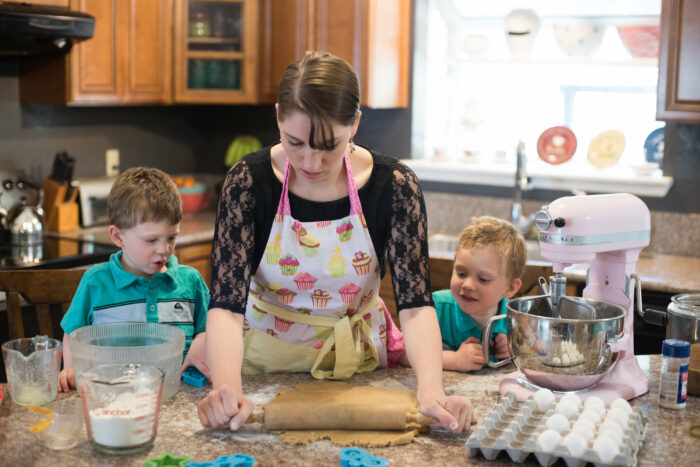
I love being in the kitchen experimenting, baking, and creating. So what do you do when you’ve got a 1-year-old, a 3-year-old, and a 5-year-old who just want to be wherever you are?
You hand them a spatula, a spoon, a few chocolate chips and let them “cook” right alongside you.
You invite them into the good work set before you.
Whenever I post about cooking with my kids or them learning new kitchen skills, I get asked, without fail, “How do you actually do this?”
What’s age-appropriate?
How do you manage the mess?
Is it safe?
So let me share what this has looked like in our home, age by age.
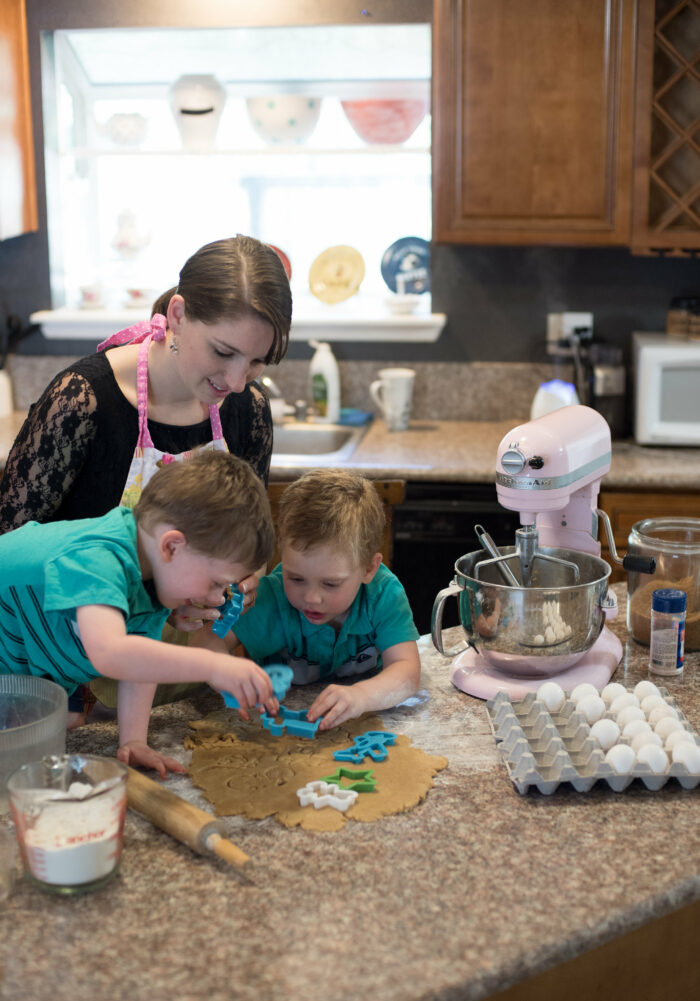
👶 Toddlers (1–3 years old)
At this age, the goal is simple: invite them into the work.
Yes, it’s messier.
Yes, it takes longer.
No, I don’t say yes every single time.
But whenever possible, I invite them into the kitchen with me.
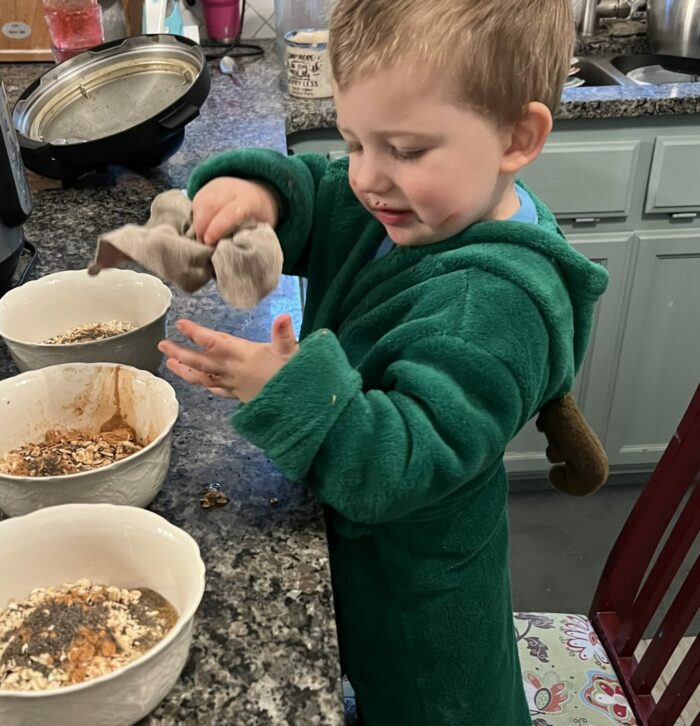
I’ll hand them a measuring cup and gently guide their hands as they dump flour into the bowl. They throw berries into batter. They hold the salt until it’s time to pour. They stir and sample far more than they help. 😉
And here’s my secret trick for the days when you really just need dinner done:
Set them up next to you with their own little station. A small bowl. A spoon. A little flour. A few chocolate chips. Let them mix up their own delightful creation while you get the real cooking done.
Everyone feels included — and you still get dinner on the table.
[caption id="attachment_24076" align="alignnone" width="700"]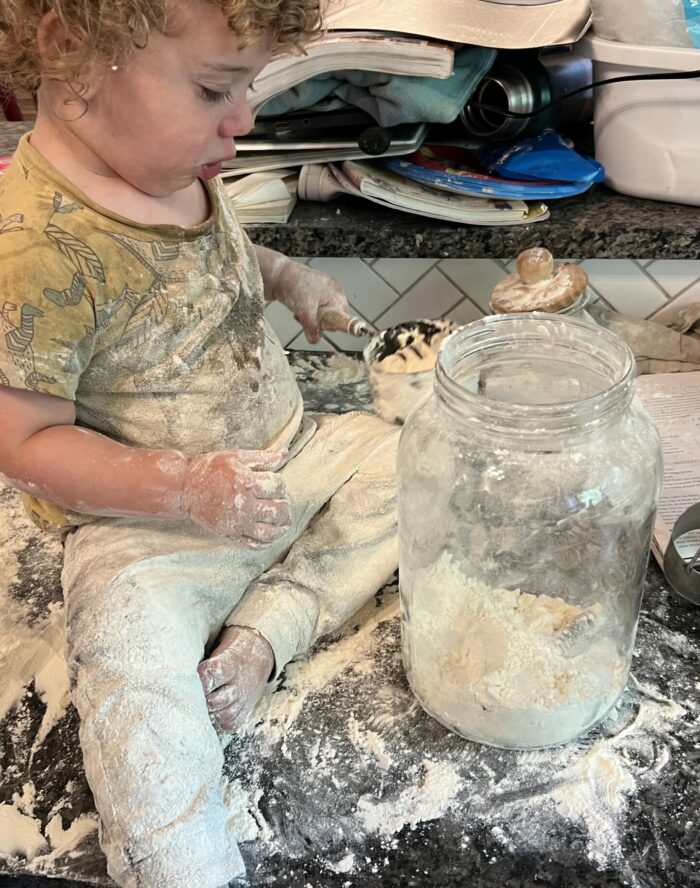 I looked away for a moment too long and this guy poured flour all over himself. Oh well![/caption]
🧒 Preschool / Early Elementary (4–7 years old)
This is where the real fun begins.
When you invite toddlers into the kitchen consistently, they pick up far more than you realize. By ages 4–5, kids are genuinely capable helpers.
They can:
Run to the fridge to grab eggs
Measure out oil or water
Mix ingredients
Help pour
Roll out dough
They will still make messes, probably a lot of them, but little by little the spills decrease and their confidence grows.
My son Maverick (age 5) has been helping me in the kitchen since he was about one. Just this past week, I started teaching him how to make his own eggs on the stove. He did about 95% of it himself while I instructed. The second time, I stayed nearby while he led the steps. In another week or so, he’ll likely be able to make his own eggs start to finish.
This age is perfect for learning how to crack eggs, measure, pour, stir, and roll out dough. They won’t be making full meals on their own yet — but you are laying the groundwork for lifelong skills.
And as a homeschool mom, I’ll just say this: one of the best ways to learn fractions is by measuring ingredients.
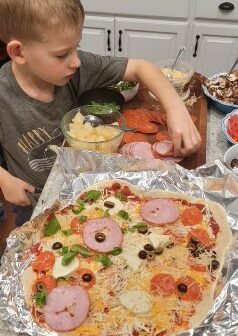
👦 Older Elementary (8–11 years old)
This is when kids can start taking ownership of full recipes.
My daughter (almost 9) makes a recipe completely on her own at least 3–4 times a week. Yesterday she made snickerdoodles. Today she made brownies.
When she was 6–7, she cooked alongside me. I explained why we did certain steps. Slowly, I let her start reading recipes, gathering ingredients, and thinking through the process. Over time, she needed less and less help.
Now she mostly comes to me only if she has questions or needs clarification, but she’s capable of making a lot on her own.
Her older brothers (10–13) can also make quite a bit independently. Their training now focuses on more advanced skills like cheesecake, apple pie, soup stock, and all the bread.
This isn’t formal “lessons.” It’s simply teaching as we cook together.
If you have kids over 8–9 years old — start teaching them full recipes. They truly can do it.
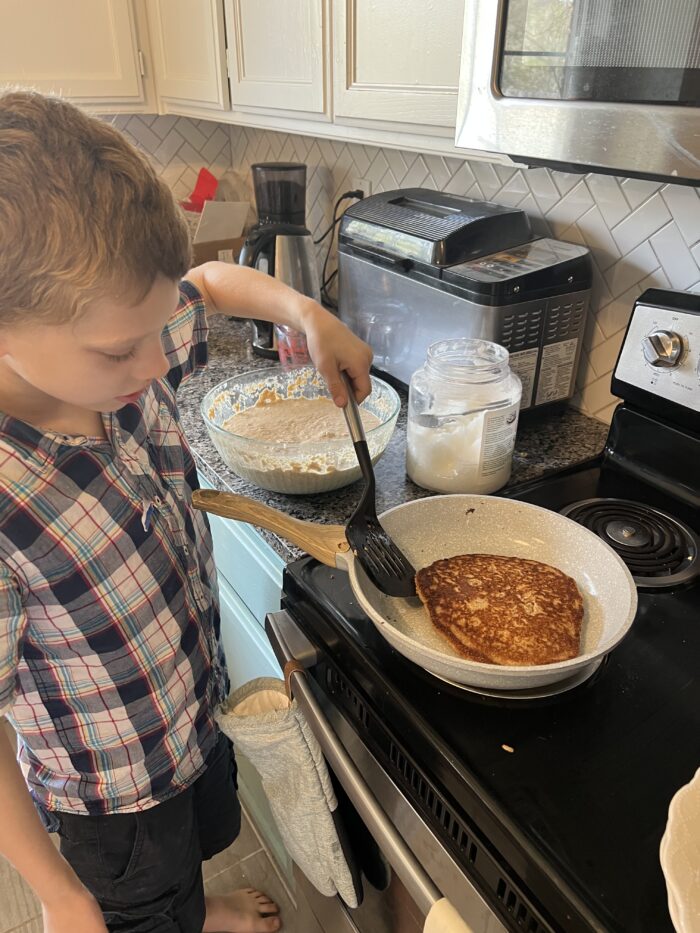
🧑🍳 Teens
My next step with our older boys will be teaching them how to:
Plan full menus
Build grocery lists
Manage multiple dishes at once
Think through timing and budgeting
They’ll take the foundation they’ve built and begin managing the full process of feeding a household. This is real life preparation.
🔥 Safety (Because Everyone Asks)
Kids absolutely need to learn how to handle real kitchen tools, appropriately and gradually.
My toddlers are watched constantly and never near knives or hot stoves.
But my 5-year-old is learning basic knife skills and how to cook eggs on a skillet with supervision.
Could he nick a finger or get a small burn? Possibly. We minimize risk as much as we reasonably can — but learning always involves some risk, just like riding bikes or rollerblading.
A small mistake often teaches caution faster than a lecture ever could.
Use wisdom.
Supervise closely.
Build skills slowly.
Trust your instincts.
Why This Matters So Much to Me
I didn’t grow up learning these skills. I had to learn them as an adult, the hard way.
I want my kids to step into adulthood confident, capable, and joyful in the kitchen. I want them to bless their future families and communities through hospitality and practical skill.
And honestly? I just love watching their confidence grow.
Mess fades.
Skills remain.
Memories multiply.
If You’re Nervous to Start
Start small.
Let them stir.
Let them pour.
Let them crack eggs.
Let them “cook” beside you.
It will be slower at first.
It will be messier at first.
It will be imperfect at first.
But it will be worth it.
You’re not just making food — you’re forming capable humans.