

Show 1454: Stopping Airborne Viruses: Simple Steps to Cleaner Indoor Air
Release Date: 12/06/2025
 Show 1428: The Hidden Power of the Unconscious Brain (Archive)
The People's Pharmacy Podcast
In this episode, a renowned neurosurgeon shares what he has learned in decades of working to restore ailing brains. His new book covers a vast range of neuroscience. Our dilemma was what to pay attention to in all those options. In a sense, that is always the human situation. We are capable of conscious processing of approximately 200 bits per second (bps) of information. Our unconscious brain deals with as much as 11 million bps. At The People’s Pharmacy, we strive to bring you up to date, rigorously researched insights and conversations about health, medicine, wellness and...
info_outline Show 1472: Beyond Lyme: Stealth Infections from Flea and Tick Bites
The People's Pharmacy Podcast
Tick season is well underway in many parts of the country. It seems that a mild winter and a warm spring have brought the nymphs out seeking blood. If that blood is yours, you may be exposed to a range of pathogens. What’s more, ticks are not the only creatures ready to bite you. Fleas are an even bigger problem when it comes to transmitting bacteria called Bartonella. That genus is responsible for cat scratch disease and trench fever. When the infection goes chronic, it’s called bartonellosis. What are the dangers of flea and tick bites? At The People’s Pharmacy, we...
info_outline Show 1471: Broken Bills: Why Americans Pay Twice as Much for Less Care
The People's Pharmacy Podcast
Americans often boast of having the best health care in the world. It is certainly the most expensive health care. We pay twice as much as people in many other industrialized nations. Are we getting our money’s worth? Some population statistics, such as life expectancy, suggest we could be doing much better. How can we make sense of the complexity of American health care? At The People’s Pharmacy, we strive to bring you up to date, rigorously researched insights and conversations about health, medicine, wellness and health policies and health systems. While these conversations intend to...
info_outline Show 1470: Why Your Doctor Should Prescribe Exercise to Treat Depression, Cancer & Aging
The People's Pharmacy Podcast
If you had to name one thing that could contribute to better health throughout the lifespan, what would it be? We think exercise, or at least physical activity deserves the top spot. Yet in 2025, fewer than half of adults met the guidelines for aerobic physical activity. And less than one-quarter were doing both aerobic and muscle-strengthening exercises on a regular basis. Perhaps your doctor should prescribe exercise. What could we expect as the benefits? At The People’s Pharmacy, we strive to bring you up to date, rigorously researched insights and conversations about health,...
info_outline Show 1469: Fresh Air & Sunlight: How Some Hospitals Are Rediscovering This Healing Secret
The People's Pharmacy Podcast
Hospitals can be pretty overwhelming. Sometimes you may feel like you need a map to find your way around the maze, not to mention a trusty guide to get you to the department or health professional that could actually help you overcome illness. In addition, being hospitalized often means being deprived of fresh air & sunlight. Could that be a mistake for proper healing? At The People’s Pharmacy, we strive to bring you up to date, rigorously researched insights and conversations about health, medicine, wellness and health policies and health systems. While these conversations...
info_outline Show 1468: Healing Joints and Nerves: The New Science of Regenerative Therapies
The People's Pharmacy Podcast
Millions of Americans are in pain. Arthritic joints make exercise difficult, even though moving is one of the best things we can do for joint pain. Pinched nerves can cause excruciating, long-lasting pain. The usual treatments, such as NSAIDs, may help ease the pain momentarily, but do nothing to help heal the underlying condition. What do you know about the new science of regenerative therapies? At The People’s Pharmacy, we strive to bring you up‑to‑date, rigorously researched insights and conversations about health, medicine, wellness and health policies and health systems....
info_outline Show 1429: How to Love Your Liver and Protect its Superpowers (Archive)
The People's Pharmacy Podcast
This week, Joe and Terry discuss liver health with two specialists. You may not have spent much time thinking about your liver. It is, however, an absolutely essential organ. When the liver is working properly, every part of the body gets the nutrients it needs and no parts are exposed to damaging toxins. These are among its superpowers. Find out why you should love your liver. At The People’s Pharmacy, we strive to bring you up to date, rigorously researched insights and conversations about health, medicine, wellness and health policies and health systems. While these...
info_outline Show 1467: Can You Disagree Without Fighting? Building Bridges, Not Battles!
The People's Pharmacy Podcast
A chance encounter with a stranger on an airplane offers lessons for all of us in how to disagree without fighting. Infectious disease expert Morgan Goheen, MD, was wary when the person in the seat next to hers struck up a conversation with questions about the origins of Lyme disease and the value of being vaccinated against COVID. His views were quite different from hers. Yet they managed, in the course of the flight, to exchange perspectives in a respectful manner. Can we all learn how to do that? At The People’s Pharmacy, we strive to bring you up to date, rigorously...
info_outline Show 1466: Could Hidden Infections Be Driving Chronic Disease?
The People's Pharmacy Podcast
Chronic diseases make up the bulk of the problems that modern health care must address. Each condition seems to have its own drivers–cholesterol for heart disease, airway hyperreactivity for asthma, neurotransmitter imbalance for depression and other psychiatric disorders, a buildup of amyloid beta in the brain for Alzheimer disease. What if all these conditions had similar origins? Today we’ll consider the evidence suggesting that hidden infections may be driving many chronic diseases. At The People’s Pharmacy, we strive to bring you up to date, rigorously researched...
info_outline Show 1465: Food Fight! Should We Flip the Food Pyramid Upside-Down?
The People's Pharmacy Podcast
Every five years, the Departments of Agriculture and of Health and Human Services jointly issue guidelines on what we should eat. The most recent Dietary Guidelines for Americans (2025-2030) have been controversial. [Here is a link: https://www.dietaryguidelines.gov] Among other things, the administration decided to flip the food pyramid upside-down in illustrating its recommendations. Why did that cause such a stir, and what will it mean for you? At The People’s Pharmacy, we strive to bring you up to date, rigorously researched insights and conversations about health, medicine,...
info_outlineDo you worry about things you can’t see, smell or taste? Most of us don’t. Yet particles we can’t detect with our five senses are often present in the air we breathe. They have the power to make us sick. How can we achieve cleaner indoor air so that we have less chance of coming down with a serious infection?
At The People’s Pharmacy, we strive to bring you up‑to‑date, rigorously researched insights and conversations about health, medicine, wellness and health policies and health systems. While these conversations intend to offer insight and perspective, the content is provided solely for informational and educational purposes. Please consult your healthcare provider before making any changes to your medical care or treatment.
The Importance of Cleaner Indoor Air:
When we talk about air pollution, the image that may arise is factories belching dark plumes of smoke. While the particles generated by industrial processes can indeed be dangerous for our health, sometimes the greatest danger is from particles we can’t even see.
The COVID-19 pandemic brought this into sharp focus, as we realized that people who had not yet begun to experience symptoms could be spreading infectious viruses. But the need for cleaner indoor air is not limited to COVID, or even to an epidemic like measles or the flu. Many infections spread primarily on viral particles wafting through the air. We are reminded of this every winter, as cases of influenza start to rise. But respiratory syncytial virus, human metapneumovirus and dozens of rhinoviruses and coronaviruses that cause colds also travel on the air. So do measles viruses.
Our guest, Dr. Linsey Marr, is one of the country’s leading environmental engineers. She got interested in airborne transmission of infection even before SARS-CoV-2 appeared. Then, with COVID, it became clear that the advice to the public about maintaining 6 feet of distance was inadequate to protect people from coming down with the infection. It was developed based on an outdated understanding of how infectious particles travel.
Can You Tell If Indoor Air Is Contaminated?
Given the extremely small size of viral particles, we might have to use our imagination to understand how they could be present. We can’t smell viruses. But if you imagine someone smoking a cigar in the room, you know that the smell will linger for quite a while after the smoker has left. Viral particles can float around like the smell of cigar smoke, which is why they can still be present even after an infected person has left the space.
This viral behavior means that the riskiest places are those where many people congregate, especially during a season when infections are spreading. Think of grocery stores, hospitals, or athletic event venues. Wearing a tightly fitted N95 or KN95 mask could provide some protection (especially if others also wore masks). It is not a magic bullet, though. Japanese people accept mask protocol during flu season, and they have still experienced the spread of influenza. In the US, it is very unlikely that most people will accept wearing masks, even if it could help reduce their risk of infection.
While we can’t measure viral particles in the air without complicated equipment, we can use a simple relatively inexpensive piece of equipment to check the ventilation in a space with multiple people. It is called a carbon dioxide (CO2) monitor. Because people exhale CO2, high levels of this harmless gas indicate lots of people breathing in the space without much ventilation. Fresh outdoor air runs about 400 ppm CO2; once indoor air reaches 1,000 ppm or higher, you may want to take action.
Moving Toward Cleaner Indoor Air:
Ventilation:
Improving ventilation would be very advantageous. Most public places should strive to achieve at least 4 to 6 air exchanges per hour. More sensitive spaces such as health care facilities might benefit from a higher level of ventilation.
Filtration:
The other way to deal with airborne viruses is through filtration. Home air handling systems could be equipped with a high-efficiency particulate arresting (HEPA) filter. This is ideal, but it may not be practical in every space. Ordinary air filters carry a MERV number such as 8, 11 or 13. Higher numbers indicated better filtration capacity. In general, you’d want to use the highest MERV number your HVAC system will tolerate. Too high a number can create too much pressure and cause problems.
What if you don’t have access to the filters for your air? That is the case for many apartment dwellers who have to share their air with everyone else in the building. One affordable option is to build and use a Corsi-Rosenthal box. It can be assembled at home for $50 to $70 and it works quite well to provide cleaner indoor air in the space where it is operating. Dr. Marr describes how to build one. Here is a link to our interview with Dr. Corsi, including instructions on building a Corsi-Rosenthal box.
Elimination:
Another step toward cleaner indoor air might be to utilize ultraviolet (UV) light as a disinfectant. A unit that uses germicidal UV at a wavelength of 250 nanometers needs to be tucked into air ducts. That wavelength can damage eyes and skin. New technology is being developed using a slightly different wavelength of 222 nanometers. While still germicidal, it is supposed to be safe for human eyes.
This Week’s Guest:
Linsey Marr, PhD, is a professor of civil and environmental engineering at Virginia Tech, where she leads the Applied Interdisciplinary Research in Air (AIR2) laboratory. Her research group focuses on the dynamics of biological aerosols like viruses, bacteria, and fungi in indoor and outdoor air. Marr teaches courses in environmental engineering and air quality, including topics in the context of global climate change, as well as health and ecosystem effects. She has been thinking and writing about how to avoid airborne viral transmission since the pandemic began, as in this article published in Environment International (Sep. 2020). Photo by Peter Means, courtesy of Virginia Tech.
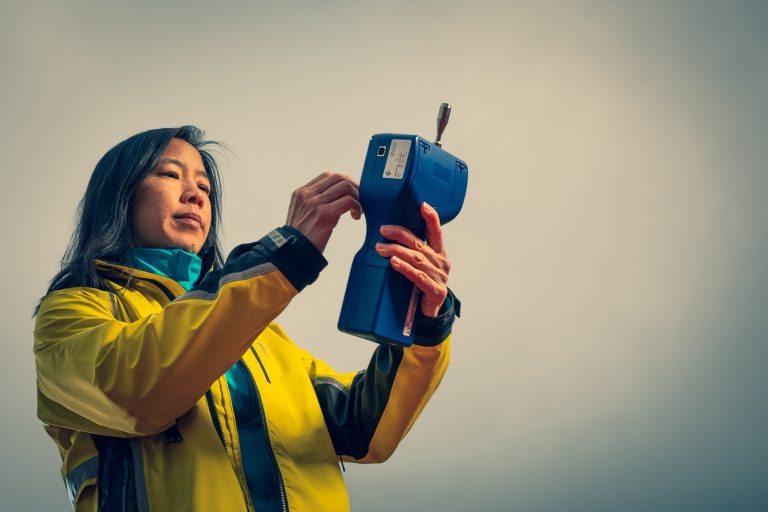
Dr. Linsey Marr of Virginia Tech. Photo by Peter Means, courtesy of Virginia Tech
Dr. Marr mentioned her publication, with many colleagues, advocating for cleaner indoor air in public buildings. Here is a link.
Joe Graedon conducted this interview, as Terry was unavailable.
Listen to the Podcast:
The podcast of this program will be available Monday, Dec. 8, 2025, after broadcast on Dec. 6. You can stream the show from this site and download the podcast for free. This week’s episode contains some additional discussion of outside air, including the dangers of smoke from wildfires, along with particulates from car tires or microplastics.
Citations
- Morawska L et al, "Mandating indoor air quality for public buildings." Science, March 29, 2024. DOI: 10.1126/science.adl0677