468 Born into Water Treatment: Tom Brandvold on AWT’s Origin Story and a Life in the Industry
Release Date: 03/20/2026
 494 Preparing for AWT 2026: Leadership, Change, and CWT Growth with Matt Coffindaffer, Part 2
Scaling UP! H2O
A strong convention outcome starts before the first session and continues long after the exhibit hall closes. Association of Water Technologies Executive Director Matt Coffindaffer explains how deliberate preparation, wider professional relationships, and volunteer service can turn AWT 2026 into practical value for an industrial water treatment career or business. Find the Right Place to Volunteer AWT offers yearlong committee service, shorter task-force assignments, and opportunities across technical research, marketing, membership, regulatory affairs, business resources, young...
info_outline 493 Preparing for AWT 2026: Leadership, Change, and CWT Growth with Matt Coffindaffer, Part 1
Scaling UP! H2O
Strong professional associations do more than provide programs and credentials. They create an environment where members can exchange knowledge, build trusted relationships, and prepare their businesses for what comes next. As the Association of Water Technologies enters a new operational chapter, Executive Director explains how AWT is strengthening that environment without losing the culture that makes it distinctive. From the Arts to Association Leadership Before entering association management, Matt built a career behind the scenes in theater. His...
info_outline 492 AI for Water Treaters: A Thought Partner, Not a Replacement
Scaling UP! H2O
info_outline 491 Environmental Microbiology and Legionella: Managing Building Water Risks with Dr. Rajiv Sahay
Scaling UP! H2O
Reliable Legionella results begin long before a sample reaches the laboratory. of explains how building conditions, field collection practices, and laboratory methods influence the quality—and usefulness—of the data water professionals receive. Building Water Conditions Shape the Risk Modern buildings rely heavily on controlled mechanical systems, yet water can remain an overlooked part of the indoor environment. Stagnation, low flow, dead legs, temperature, pH, disinfectant residuals, corrosion, and accumulated organic material can all influence biofilm development and microbial...
info_outline 490 From Plans to Prevention: Water Management Insights with Dr. Abe Cullom
Scaling UP! H2O
A water management plan protects people only when the facility uses it to guide decisions. Dr. Abe Cullom, Director of Water Safety & Management at Pace Analytical, joins Trace Blackmore, CWT, to examine why Legionella programs break down—and how testing, communication, and consistent implementation can strengthen them. Implementation Is the Bottleneck Five decades after Legionella was identified, researchers understand much more about the organism, its ecology, the conditions that support its growth, and the interventions available to control it. However, Dr....
info_outline 489 Copper-Silver Ionization Technology and Legionella Control with Tory Schira
Scaling UP! H2O
Copper-silver ionization offers building operators a persistent approach to Legionella control—one designed to carry an active disinfectant residual throughout complex plumbing infrastructure. LiquiTech CEO Tory Schira explains how the technology works, what operating data matters, and why successful implementation requires more than installing equipment. How Copper-Silver Ionization Works Copper and silver ions are introduced through a flow chamber containing sacrificial electrodes. A controlled electrical charge releases the positively...
info_outline 488 Managing Legionella with confidence: A Conversation with Patsy Root
Scaling UP! H2O
“Our goal is not zero Legionella pneumophila bacteria. Our goal is zero cases.” – Patsy Root Legionella risk becomes harder to manage when building teams treat every detection as equivalent—or collect samples without first deciding what a positive result will trigger. , Senior Manager of Government Affairs at , explains how a clear water management program can replace uncertainty with defined responsibilities, routine monitoring, and proportionate action. Focus Testing on the Organism of Concern Patsy distinguishes between the broader...
info_outline 487 The 60‑Minute CFO: Tracy Bech on Making Business Finance Less Scary
Scaling UP! H2O
“Our gross profit margin is truly the battle we have to win in order to win all of the downstream wars.” - Tracy Bech Financial statements become useful when leaders can translate the numbers into decisions. , founder and author of , explains how business owners, managers, salespeople, and field professionals can develop financial fluency without becoming accountants. Turn Financial Data into a Meaningful Scorecard Tracy teaches finance through stories and relationships rather than isolated numbers. Revenue alone does not reveal whether a company is...
info_outline 486 Meter Optimization: Air in the water with Anthony Giudice
Scaling UP! H2O
Water meters register the volume passing through them, but what happens when that volume contains both water and entrained air? Anthony Giudice, president of AquaFlow, explains how turbulent flow can influence meter readings and how AquaFlow’s calibrated valve is designed to help meters reflect what he describes as true water consumption. Why Flow Conditions Matter at the Meter Anthony connects entrained air to the pressure required to move municipal water and the turbulence created as water travels through piping, changes...
info_outline 485 Questions from the Nation Around the World with Trace Blackmore, CWT
Scaling UP! H2O
Ten questions from water professionals around the world become a practical decision-making session with Trace Blackmore, CWT. Drawing on earlier Scaling UP! H2O conversations, Trace explains how to evaluate treatment changes, use emerging tools responsibly, begin water reuse projects, strengthen teams, and continue growing professionally. Evaluate the Entire System A proposed treatment change should be evaluated by more than its purchase price. When comparing chlorine dioxide with traditional chlorine, Trace recommends examining biocide consumption, chemical storage,...
info_outline Tom Brandvold, CWT, has lived industrial water treatment from the inside out. In this conversation, he traces that path from sweeping floors and running sample bottles as a kid to leading Premier Water and Energy Technology and serving as a former president of Association of Water Technologies (AWT). The result is not just a career story. It is a useful look at how credibility, collaboration, and standards are built over time in this industry.
How Association of Water Technologies (AWT) was formed
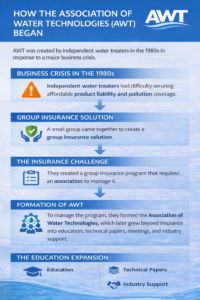
One of the most valuable parts of this discussion is Tom’s explanation of how Association of Water Technologies (AWT) began. The association did not start primarily as a training platform or networking group. It grew out of a business crisis in the 1980s, when independent water treaters were struggling to secure product liability and pollution coverage at prices that would not put them out of business. Tom explains how that pressure led a small group to create an insurance-focused structure that eventually required an association. From there, the collaborative side of AWT expanded into education, technical papers, meetings, and broader support for the independent water treater.
Why Association of Water Technologies (AWT)’s culture feels different
Tom also gives language to something many professionals have experienced but may not have fully defined: AWT members often compete in the same field while still sharing technical knowledge freely. He points to relationships as the reason. Trust, geography, and the practical reality of how accounts are won reduce the sense of technical knowledge as a threat. That helps explain why AWT has become a place where mistakes, lessons learned, and operating insight can be shared in ways that genuinely help other professionals improve.
Why the CWT is changing
A major focus of the episode is the next chapter of the Certified Water Technologist designation. Tom explains that AWT is pursuing ISO-aligned process work and ANSI recognition so the CWT carries stronger independent, third-party credibility. He walks through why that matters, what the CWT commission is doing, how the current process may change, and why he believes ANSI recognition will help the credential gain broader acceptance with customers, spec writers, government authorities, and technical institutions.
What this means for professionals now
This conversation lands on a practical point: the CWT is meant to distinguish serious professionals without making the credential feel inaccessible. Tom is clear that those already preparing should not wait. He also underscores that AWT technical training supports the body of knowledge, but it does not teach to the exam. For leaders, owners, and technical professionals, this episode is a strong reminder that industry standards matter most when they improve confidence, sharpen judgment, and strengthen trust in the field.
Listen to the full conversation above. Explore related episodes below. Stay engaged, keep learning, and continue scaling up your knowledge!
Timestamps
00:46 — Trace explains why AWT matters so much to industrial water treatment professionals.
03:37 — Trace shares the story behind the “magic button” and how it helps people connect at industry events.
07:20 - Upcoming Events for Water Treatment Professionals
11:05 - Words of Water with James McDonald
13:20 - Interview with Tom Brandvold, CWT, President at Premier Water and Energy Technologies and former president of the Association of the Water Technologies
18:18 - Tom explains the origin story of AWT
24:05 - Tom talks about volunteering within AWT over the years
34:14 - The conversation shifts to the CWT designation
37:01 - Tom explains why AWT is pursuing ANSI recognition for the CWT
48:11 - Tom and Trace discuss how ANSI-recognized CWTs could matter in legislation and water safety language
49:00 - Tom talks about the biggest challenge in the accreditation process: ISO 17024 conformance
53:35 - Tom makes an important distinction: AWT training does not teach to the exam
55:03 - Tom explains why professionals should pursue the CWT
Quotes
“The association ah was founded so that those who joined could have access to this captive insurance market where we were self-insuring so that all of us could stay in business.”
"The veil of threat is removed, and you share very freely.”
“We are committed as a trade association to add prominence to the CWT certification.”
"If you want to distinguish yourself from everyone else out there, this is the way to do it.”
"My magic wand would ensure that everybody has safe drinking water”
Connect with Tom Brandvold, CWT
Email: carmac@premierwater.com
Website: CRB Water | Safe, Sustainable & Data-Driven Water Treatment Solutions
LinkedIn: CRB Water: Overview | LinkedIn
Guest Resources Mentioned
ANSI / ANAB Personnel Certification Accreditation
AWT Technical Reference & Training Manual
AWT CWT Exam Candidate Handbook
Kelly: More Than My Share of It All by Clarence L. Johnson
Titanic Thompson: The Man Who Bet on Everything by Kevin Cook
A.J. Foyt - Volume 1: Survivor, Champion, Legend Hardcover by Art Garner
Scaling UP! H2O Resources Mentioned
AWT (Association of Water Technologies)
Scaling UP! H2O Academy video courses
Fearless Pricing by Casey Brown
410 Unleash Your Pricing Power: Casey Brown's 'Fearless Pricing' Revolutionizes Business Value
154 The One With AWT President, Tom Brandvold, CWT
426 Sustaining Success: Tom Hutchison on Leading Through Generational Change
127 The One With Tom Hutchison
Words of Water with James McDonald
Today's definition is a thin barrier that only permits passage of certain particulates or compounds to pass through but inhibits others. It is a semi-permeable skin of which the pass-through is determined by the size or special nature of the particles or compounds. Can you guess the word?
2026 Events for Water Professionals
Check out our Scaling UP! H2O Events Calendar where we’ve listed every event Water Treaters should be aware of by clicking HERE.